




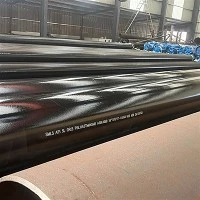
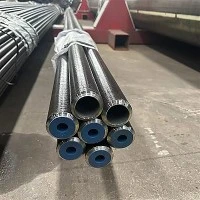


API 5L L555 PSL2 Seamless Steel Pipe
API 5L L555 PSL2 seamless steel pipe is the ISO-named equivalent of API 5L X80 PSL2 seamless pipe - the same line pipe grade with a 555 MPa (80,500 psi) minimum yield, reviewed under PSL2 as a strength window of 555–705 MPa yield and 625–825 MPa tensile. It is a low-carbon microalloyed grade supplied seamless up to NPS 24 (609.6 mm) OD for high-pressure gas and oil transmission. The two numbers that decide your design are the PSL2 strength window and the chemistry ceiling (C ≤ 0.18 % for the quenched-and-tempered route); X80/L555 exists only in PSL2, never in PSL1.
API 5L L555 PSL2 seamless steel pipe carries the X80 identity in the ISO 3183 naming system. The "L555" tag means a 555 MPa specified minimum yield; "X80" is the API imperial tag for the same 80 ksi grade. Both names describe one product, and both are written PSL2. The seamless route delivers a homogeneous wall without a longitudinal weld seam, which matters for girth-weld consistency and for sour-service qualification on critical transmission lines. As an L555 seamless pipe it carries the l555 equivalent grade name alongside X80 on every material certificate. Send your NPS, schedule, quantity and destination for a quote.
Technical Specifications
The api 5l l555 psl2 dimensions covered here run from NPS 1/2 to 24 in seamless form; larger diameters move to the welded route described below. Seamless dimensional tolerances per API 5L / ISO 3183 are OD ±0.75 % (or ±0.75 mm for D ≤ 60.3 mm) and wall −12.5 % of nominal, with straightness ≤ 0.15 % of length. For the l555 psl2 wall thickness tolerance, many mills work to +15 % / −12.5 % of nominal wall while the API 5L body tolerance is −12.5 %.
| Parameter | Capability |
|---|---|
| Standard | API Spec 5L / ISO 3183, PSL2 |
| Grade | L555 / X80 (L555Q/X80Q, L555M/X80M) |
| Outside diameter | 21.3–609.6 mm (NPS 1/2–24) |
| Wall thickness | SCH 10–160; heavy wall to ~25.4 mm on NPS 14–24 |
| Length | SRL, DRL, 6 m / 12 m, fixed lengths |
| Ends | Plain or beveled 30°–35° with 0.8–2.4 mm root face |
| Delivery condition | Quenched and tempered (Q) for seamless; TMCP (M) for welded |
| Certification | EN 10204 3.1 / 3.2 MTC; NACE MR0175 sour service; third-party inspection available |
Chemical Composition
The API 5L L555 chemical composition is controlled to low-carbon microalloy limits. The table shows the API 5L PSL2 specification maximums - not a single mill's heat analysis.
| Element | L555Q / X80Q (seamless + welded) | L555M / X80M (welded TMCP) |
|---|---|---|
| Carbon (C) | 0.18 | 0.12 |
| Silicon (Si) | 0.45 | 0.45 |
| Manganese (Mn) | 1.90 | 1.85 |
| Phosphorus (P) | 0.025 | 0.025 |
| Sulfur (S) | 0.015 | 0.015 |
| Nb + V + Ti | ≤ 0.15 | ≤ 0.15 |
| Cu / Ni / Cr / Mo | each ≤ 0.50 | each ≤ 0.50 |
| Boron (B) | ≤ 0.004 | ≤ 0.001 (residual) |
Note the Mn–C trade-off: for each 0.01 % reduction in C below the maximum, Mn may rise 0.05 %, up to 2.00 % for grades at or above X70. For seamless pipe with wall thickness above 20 mm, carbon-equivalent limits are set by agreement.
Mechanical Properties
The API 5L L555 mechanical properties are defined as a PSL2 strength window, not a single minimum. This is the single most misquoted fact about X80.
| Property | L555 / X80 (PSL2) |
|---|---|
| Yield strength (Rt0.5) | 555–705 MPa (80,500–102,300 psi) |
| Tensile strength (Rm) | 625–825 MPa (90,600–119,700 psi) |
| Yield-to-tensile ratio | ≤ 0.93 (for D > 323.9 mm) |
| Weld seam tensile (welded pipe) | ≥ 625 MPa |
| Elongation | Per API 5L formula Af = 1940·(Axc^0.2 / U^0.9) % |
| CVN impact (PSL2) | 0 °C, transverse avg ≥ 27 J / single ≥ 20 J |
The Number That Decides Your Design
For API 5L X80 PSL2 yield strength, the value 555 MPa is the grade identity - the minimum - but PSL2 acceptance is the whole window: 555–705 MPa yield and 625–825 MPa tensile. Designing only to the 555 MPa floor ignores the over-strength cap that protects ductility and weldability, and it understates what a finished pipe must demonstrate on its MTC.
| Reading | Yield | Tensile | Risk if used alone |
|---|---|---|---|
| Minimum only (wrong for PSL2) | 555 MPa | 625 MPa | Ignores over-strength and consistency control |
| PSL2 strength window (correct) | 555–705 MPa | 625–825 MPa | Full acceptance basis |
Choosing the Delivery Condition (L555Q vs L555M)
The l555 psl2 delivery condition you specify - Q (quenched and tempered) or M (TMCP) - changes the carbon-equivalent basis and the welding procedure, so confirm the suffix with the mill before order entry.
| Route | Process | Typical use for L555 |
|---|---|---|
| L555Q / X80Q | Quenched and tempered | Seamless pipe; heavy-wall and sour-service-qualified routes |
| L555M / X80M | Thermomechanical rolled/formed (TMCP) | Welded pipe from TMCP plate; lowest carbon equivalent |
Seamless L555 PSL2 is most often supplied as X80Q (L555Q). X80M (L555M) is the TMCP route applied to plate-based welded pipe; confirm the exact suffix with the mill, because it changes the carbon-equivalent basis and the welding procedure.
Applications
X80 seamless pipe applications cluster where pressure, wall weight and weld control decide project economics. Five representative cases:
High-pressure long-distance gas transmission
The default use for X80/L555 - trunklines that need maximum pressure capacity without an over-heavy wall.
Large-diameter trunklines
Where pipe weight, girth-weld speed and CVN toughness directly affect field acceptance and total installed cost.
Cold-region and arctic routes
TMCP and QT routes give the low-temperature toughness needed for northern and offshore service when specified with qualified impact temperatures.
Offshore and deepwater lines
Seamless X80 is used where a weld-free homogeneous wall simplifies girth welding and sour-service qualification.
Strategic reserves and high-security distribution
Critical-infrastructure lines designed for a 50-year service life with strict traceability.
Why Source API 5L L555 PSL2 Seamless Pipe from GNEE
As an api 5l l555 psl2 supplier of L555 seamless pipe, we support critical transmission projects with:
Seamless X80/Q (L555Q) and welded X80M supply across the full size window, with EN 10204 3.1/3.2 MTC.
Sour-service (NACE MR0175 / ISO 15156) qualification and third-party inspection (SGS, BV, TÜV) on request.
CVN, DWT, UT/RT and hydrostatic release records tied to heat number for lifetime traceability.
Coating coordination (3LPE, 3LPP, FBE) so NDE and hydrotest precede coating.
Technical quotation with lead time, normally within 24 hours of inquiry.
Quality Control and Testing
The l555 psl2 impact test requirements and the wider PSL2 test set are what separate X80 from commodity pipe:
Chemistry and carbon equivalent - verified against the PSL2 limits and the agreed CE basis.
Tensile and yield - reviewed across the 555–705 / 625–825 MPa window, with Y/T ≤ 0.93 where applicable.
Charpy V-notch - 0 °C transverse, avg ≥ 27 J / single ≥ 20 J; project temperatures added by agreement.
Hydrostatic test - required; NDT cannot substitute.
NDE - mandatory for every pipe; UT or RT per the route and agreement.
Traceability - full heat-number tracking; EN 10204 3.1/3.2 MTC; third-party inspection on request.
Test and inspection


Packaging and shipping


Send your NPS × schedule, grade and PSL level, quantity, coating and destination port - our technical team will confirm the specification and return a quotation with lead time, normally within 24 hours. Contact GNEE today.
FAQ
What is the yield strength of API 5L L555 / X80 PSL2 pipe?
The specified minimum yield strength is 555 MPa (80,500 psi), but PSL2 is reviewed as a strength window of 555–705 MPa (80,500–102,300 psi) yield and 625–825 MPa (90,600–119,700 psi) tensile. Treat 555 MPa as the grade identity, not the only acceptance point.
Is API 5L X80 available in PSL1?
No. X80 (L555) is defined only in PSL2; API 5L PSL1 tops out at X70 / L485. Any "X80 PSL1" offer is outside the API 5L grade system and should be rejected or re-specified as PSL2.
What is the difference between L555 and X80?
None in grade. L555 is the ISO 3183 metric name and X80 is the API imperial name for the same line pipe grade with a 555 MPa minimum yield. Both are written PSL2 (L555Q/X80Q, L555M/X80M).
What is the chemical composition of API 5L L555 PSL2?
For L555Q/X80Q (including seamless): C ≤ 0.18 %, Mn ≤ 1.90 %, P ≤ 0.025 %, S ≤ 0.015 %, Nb+V+Ti ≤ 0.15 %, with Cu, Ni, Cr and Mo each ≤ 0.50 % and B ≤ 0.004 %. The TMCP grade L555M/X80M holds C ≤ 0.12 % and Mn ≤ 1.85 %.
What is the maximum size of seamless L555 pipe?
Seamless L555 / X80 line pipe is commercially available up to NPS 24 (609.6 mm) OD. Larger diameters are produced as LSAW or SSAW from TMCP plate; heavy walls above about 25 mm also favour the welded route.
What carbon equivalent and weldability apply to L555 PSL2?
Carbon equivalent is controlled by agreement: CE_Pcm (C ≤ 0.12 %) or CE_IIW (C > 0.12 %), with the TMCP grade typically held to CE_IIW ≤ 0.43 % and CE_Pcm ≤ 0.25 %. Field girth welding uses low-hydrogen consumables and controlled heat input; preheat follows the WPS.
What impact testing does L555 PSL2 require?
PSL2 mandates Charpy V-notch impact at 0 °C: transverse average ≥ 27 J and single value ≥ 20 J. Drop-weight tear (DWT) may be required by agreement for fracture control. Values such as 190 J at −20 °C are project-upgraded requirements, not the API 5L baseline.
What is the difference between L555Q and L555M?
L555Q (X80Q) is quenched and tempered; L555M (X80M) is thermomechanically rolled or formed (TMCP). Both are PSL2. Seamless L555 is most often supplied as X80Q; X80M is the route used for welded pipe made from TMCP plate.
Hot Tags: API 5L L555 PSL2 Seamless Steel Pipe, China API 5L L555 PSL2 Seamless Steel Pipe manufacturers, suppliers, factory, api 5l line pipe for crude oil transportation, line pipe for oil and gas, api 5l pipe for energy projects, api 5l line pipe for water supply, api 5l pipe for infrastructure projects, api 5l line pipe for harsh environments
You Might Also Like




Send Inquiry