




Welded Steel Pipe
Your Professional Welded Steel Pipe Supplier
Gnee Steel Group is a supply chain-integrated enterprise including steel plate, coil, profile, outdoor landscape design and processing. Products include: API 5L Line Pipe, Seamless Steel Pipe, Welded Steel Pipe, OCTG, Stainless Steel Pipe, Coated Steel Pipe, Galvanized Steel Pipe, Pipe Fittings.
Why Choose Us?
Rich Experience
Gnee Steel Group was founded in 2008, has 18 years of experience in steel manufacturing.
Wide Product Range
The company's main products include: stainless steel pipes, stainless steel plates, stainless steel pipe fittings, duplex stainless steel, nickel-based alloys, etc.
Broad Market
The company's products are exported to more than 160 countries around the world, with a total of more than 800 global cooperative enterprises, including 15 shipbuilding companies, 143 engineering project companies, and 23 boiler machinery manufacturers.
Quality Guaranteed
Gnee has a strict procurement and quality inspection team carefully selects high-quality raw materials; an advanced science and technology team improves production and reduces costs for customers; an excellent design and processing team strives for excellence.


Brief Introduction to Welded Steel Pipe
Welded steel pipe is created using a flat steel plate or steel strip, and its manufacturing process results in a seam on its body. Specifically, when welded steel pipe is manufactured, a steel plate or strip is bent and subsequently welded into either a circular, traditional pipe shape or a square shape.
What are Advantages of Welded Steel Pipe?
High Strength and Durability
Welded pipes are made of high-quality steel materials, which are processed and welded through strict quality control and testing procedures to ensure high strength and durability. This makes them suitable for long-distance transportation and harsh environments.
Corrosion Resistance
Welded pipes are usually made of austenitic stainless steel, which has excellent corrosion resistance properties. This makes them suitable for use in environments where corrosion is a concern, such as oil and gas pipelines.
Easy Installation and Maintenance
Welded pipes are easy to install and maintain due to their standardized design and manufacturing process. They can be easily connected and disconnected using standard fittings and connectors, making them suitable for quick repairs and maintenance.
Long Service Life
Welded pipes are typically made of high-quality steel materials with long service lives, which can reduce maintenance costs and minimize downtime.
Safety and Reliability
Welded pipes are reliable and safe due to their reliable welding technology and quality control measures. This reduces the risk of pipeline failure or leaks, ensuring safe and reliable transportation of oil and gas.
Types of Welded Steel Pipe
High Frequency Welded Steel Pipe
A tubular structure with uniform thickness, internal and external burrs produced by the welding tool, calibrated appropriately online through strict control of non-destructive testing of weld quality. It offers a high degree of automation and low production costs. However, it typically has a relatively thin wall thickness and small diameter, usually not exceeding a wall thickness of 12mm and a diameter of 610mm. This makes it particularly suitable for the production of steel tube truss structures.
LSAW Pipe
This type involves welding under static conditions, resulting in high weld quality with short welds that have a very low probability of defects. By expanding the full-length steel tubular structure, precise sizing is achieved with a wide range of pipe wall thicknesses and diameter ranges. The diameter range extends up to 406-1829mm and the wall thickness range from 6.0-60mm. LSAW pipes offer a high degree of automation and lower production costs compared to seamless steel. They are commonly used for buildings, bridges, dams, offshore platforms, steel bearing columns, large span structures, as well as for meeting wind and seismic requirements for electrical tower mast structures.
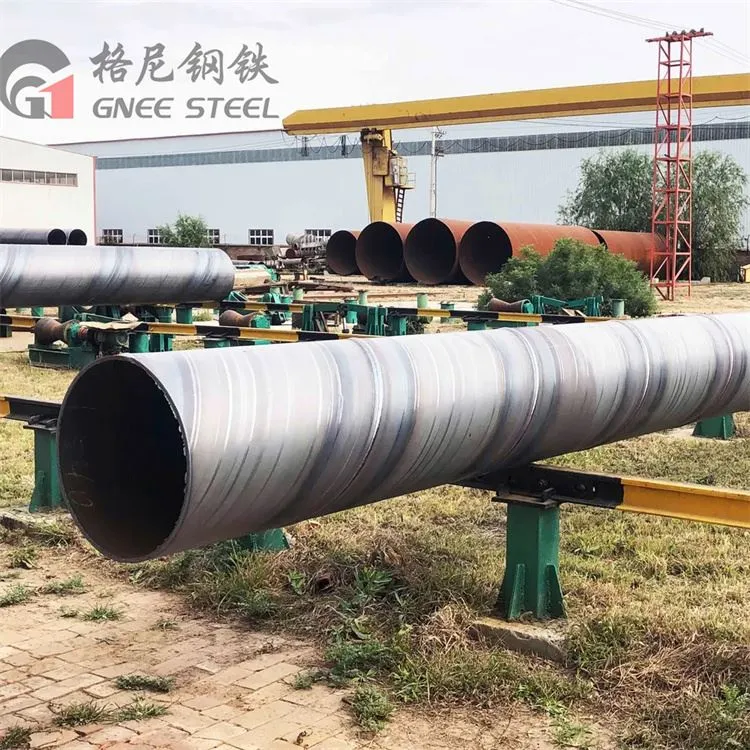
Spiral Submerged Arc Welded Pipe
The spiral weld line distribution in this type of pipe results in long welds which, especially under dynamic welding conditions, allows for the weld to cool and solidify, potentially leading to welding hot cracking. The direction of the weld crack is typically parallel at a certain angle to the axis of the steel pipe, usually between 30-70 degrees. This angle aligns with the shear failure angle, resulting in better bending, tensile, compressive, and torsional performance compared to LSAW pipe welding positions. Spiral submerged arc welded pipes tend to have saddle ridge seams and pronounced fish impacts due to construction process constraints. In addition, at intersecting line pipe welds and fragmented spiral seams of spiral welded parent nodes, there is a significant welding stress which weakens the safety performance of components. Therefore, it is essential to reinforce efforts towards non-destructive testing of spiral welded welds to ensure welding quality, especially on important occasions where steel spiral submerged arc welded pipes are not recommended.
Uses of Welded Steel Pipe
Transmission Pipelines
Welded steel pipes are widely used to transport fluids such as oil, natural gas, coal gas, and water, especially in urban gas and water supply systems.
Structural Pipes
Welded steel pipes are used in building structures, bridges, steel frames, supports and other engineering fields. They have good load-bearing capacity and earthquake resistance.
Machinery Manufacturing
Welded steel pipes can be used to manufacture various mechanical parts such as shafts, brackets, conveyor rollers, etc.
Oil and Gas Drilling
Welded steel pipes can be used to manufacture oil and gas drilling and oil production equipment, such as drill pipes, casing, etc.
Tower Fabrication
Welded steel pipes are used in the fabrication of broadcast and communications towers.
Greenhouse
Welded steel pipes are often used to make greenhouse supports because of their lower cost and better strength.
Bicycle and Motorcycle Manufacturing
Welded steel tubes are used to make bicycle and motorcycle frames.
Furniture Manufacturing
Welded steel pipes can be used to produce various furniture such as bed frames, bookshelves, chairs, etc.
Oil and Gas Industry
In the oil and gas industry, welded pipes are extensively used for transporting crude oil, natural gas, and refined petroleum products. The pipes' ability to withstand high pressures and corrosive substances makes them indispensable for offshore and onshore pipelines.
Construction and Infrastructure Projects
Welded pipes play a critical role in construction and infrastructure projects, where they are used for structural support, underground utility systems, and water supply networks. The pipes' strength and durability ensure the integrity and safety of buildings and infrastructures.
Water Supply and Sewage Systems
Welded pipes are widely employed in water supply and sewage systems due to their corrosion resistance and leak-proof joints. They ensure the efficient flow of water and wastewater, contributing to the overall public health and environmental well-being.
Power Generation Plants
Power generation plants, whether thermal, nuclear, or renewable, often rely on welded pipes for their cooling systems and steam distribution. The pipes' ability to withstand high temperatures and pressures is crucial for the reliable operation of power plants.
Automotive and Transportation Sector
In the automotive and transportation sector, welded pipes find applications in exhaust systems, chassis components, and fuel delivery systems. The pipes' versatility and customizability cater to the diverse needs of this industry.
Process of Welded Steel Pipe
Cutting
A single flat sheet of steel plate is cut on a burning table using plasma or cutting gases. This plate is cut according to the required width and length for each individual can that will form the final product.
Beveling
After the plate is cut, it is transferred to the beveling station where the plate edges are beveled and prepped for welding.
Bending
After beveling, the plate is transferred to the bending rolls.
Welding
The can is then staged for longitudinal welding (Long Seam). During this process, the seam between the two plates is welded on both the inside and outside.
Circumferential Welding
During this last step of the manufacturing process, cans are fit together using the submerged arc weld (SAW) process, according to customer requirements for specific lengths.
Quality Control
Once the welding is complete, the finished pipe is visually inspected by Quality Control (QC) and, if required, Ultrasonic (UT) testing is performed to ensure the weld is defect-free.
Finished Pipe
The finished pipe is then removed and ready for delivery.
Our Factory
GNEE Steel Group is China's professional one-stop supply chain enterprise for steel products.


Our Certificate
Its stainless steel pipe production technology has reached the world's average technical level. It has been recognized by dozens of project companies and has become a star enterprise in Asia.

Contact Us
Frequently Asked Questions
Q: How is Welded Steel Pipe made?
The rectangular sheets are fed through a rolling machine that curls the longer sides up toward one another, forming a cylinder. In the ERW process, high-frequency electrical current is passed between the edges, causing them to melt and fuse together.
An advantage of ERW pipe is that no fusion metals are used and the weld seam cannot be seen or felt. That’s opposed to double submerged arc welding (DSAW), which leaves behind an obvious weld bead that must then be eliminated depending on the application.
Welded pipe manufacturing techniques have improved over the years. Perhaps the most important advancement has been the switch to high-frequency electric currents for welding. Prior to the 1970s, low-frequency current was used. Weld seams produced from low-frequency ERW were more prone to corrosion and seam failure.
Most welded pipe types require heat treatment after manufacture.
Q: What should you pay attention to when installing Welded Steel Pipe?
Check whether the welding materials are qualified and stored in accordance with the regulations. Pay attention to see if there is rust on the surface of the welding material. If the steel pipe has been rusted or mildewed, it will not work.
The cleaning of the welding area should be managed well, and the welding area should be kept clean and dust-free, and there should be no water, oil, rust and other dirt, and external defects of the weld should be prevented.
Select the welding method, try to test the welding first, and then apply the welding principle. In order to avoid welding quality accidents caused by wrong use of welding wire.
Look at the groove size before pre-welding. Pay attention to check whether the gap, blunt edge, etc. meet the process requirements.
Welders should clean the slag first when repairing the welding work to see if the joints are treated. There should be no oil, rust and other dirt on the groove.
Q: What is Welded Steel Pipe?
Q: What are the processes of Welded Steel Pipe?
Utilizing the skin effect of high-frequency current and the proximity effect, the edge of the steel billet strip is rapidly heated to the molten state. The molten metal is then squeezed and pressed by the squeezing roller to achieve welding.
Submerged arc welding:
The welding method involves the coverage of flux. The weld metal pool solidifies into a weld under the protection of the flux coating, with the flux melt layer cooling to form a slag shell over the outer surface of the weld.
Tungsten inert gas welding (TIG):
Tungsten inert gas shielded welding utilizes pure tungsten or activated tungsten (such as thorium tungsten, cerium tungsten, etc.) as the electrode. This method involves using tungsten arc welding electrodes generated between the hot-melt parent metal and filler wire under inert gas protection.
Melting inert gas welding (GMAW):
The process involves the use of welding wire as electrodes for inert gas welding.
CO2 gas shielded welding:
CO2 gas shielded welding uses a protective gas with a purity greater than 99.8% CO2 for arc welding.
Mixed gas welding:
This method involves using two or more gases, in a certain proportion, as a protective gas for gas shielded welding. In TIG welding, argon is commonly utilized as the shielding gas.
Pulse TIG:
Pulse TIG involves maintaining the main arc of the ionization channel using base current and periodically introducing a pulse of high peak current of the same polarity to melt the molten metal and control the transition of argon arc welding.
Plasma arc welding:
Through the restraining action of the water-cooling nozzle on the arc, a plasma arc with higher energy density is used for welding.
Hot brazing:
In this welding process, a metal material with a lower melting point than the base metal is used as a brazing filler metal. The weldment and brazing filler metal are heated to a temperature higher than the melting point of the filler metal and lower than that of the base metal. This allows for wetting of the base metal with the brazing filler metal, gap filling, and mutual diffusion with the parent material, resulting in the brazing connection method. The induction brazing commonly utilizes a composite brazing method.
Q: What types of Welded Steel Pipe can be divided into?
Straight seam welded steel pipe is a steel pipe made by butting the edges of steel plates or coils and then welding them along a straight line. This kind of steel pipe has good strength and low production cost, but its strength is slightly lower than that of spiral welded steel pipes of the same specification.
Spiral welded pipe (SSAW)
Spiral welded pipe is a steel pipe formed by rolling strip steel into a cylinder and welding it in a spiral direction. This kind of steel pipe has higher strength, but the production cost is slightly higher.
Q: What is the difference between Seamless steel pipe and Welded Steel Pipe?
a. Seamless steel pipe: a steel pipe made of a single piece of metal with no seams on the surface.
b. Welded steel pipes: steel strips or steel plates that are bent and deformed into round or square shapes and then welded into steel pipes with seams on the surface.
The Characteristics Are Different
a. Seamless steel pipe: the maximum diameter is 650mm, and the minimum diameter is 0.3mm. According to different uses, there are thick-walled pipes and thin-walled pipes.
b. Welded steel pipes: T-welded steel pipes have strong corrosion resistance in acidic environments when they contain Ni. In environments containing sulfuric acid or hydrochloric acid, the higher the Ni content in the T-welded steel pipes, the stronger the corrosion resistance. Under normal circumstances, only adding Cr to the T-welded steel pipe can prevent corrosion.
The Role Is Different
a. Seamless steel pipes: seamless steel pipes are mainly used as petroleum geological drilling pipes, cracking pipes for petrochemicals, boiler pipes, bearing pipes, and high-precision structural steel pipes for automobiles, tractors, and aviation.
b. Welded steel pipes: electric welded steel pipes are used in oil drilling and machinery manufacturing, etc.; furnace welded pipes can be used as water gas pipes, and large-diameter longitudinally welded pipes are used for high-pressure oil and gas transportation; spiral welded pipes are used for oil and gas transportation, pipe piles, bridge piers, etc.
Q: What are the classification methods of Welded Steel Pipe?
Electric welded steel pipe: used in oil drilling and machinery manufacturing.
Furnace welded pipes: can be used as water gas pipes, etc., large-diameter longitudinally welded pipes are used for high-pressure oil and gas transportation, etc.; spiral welded pipes are used for oil and gas transportation, pipe piles, bridge piers, etc.
According to the weld shape, it can be divided into straight seam welded pipe and spiral welded pipe.
Longitudinal welded pipe: The production process is simple, the production efficiency is high, the cost is low, and the development is fast.
Spiral welded pipe: The strength is generally higher than that of straight seam welded pipes. A narrower blank can be used to produce welded pipes with larger pipe diameters, and a billet with the same width can also be used to produce welded pipes with different pipe diameters. But compared with the straight seam pipe of the same length, the weld length is increased by 30-100%, and the production speed is lower. Therefore, most of the smaller diameter welded pipes adopt straight seam welding, and the large diameter welded pipes mostly adopt spiral welding.
According to the purpose, it is divided into general welded pipe, galvanized welded pipe, oxygen-blowing welded pipe, wire casing, metric welded pipe, roller pipe, deep well pump pipe, automobile pipe, transformer pipe, electric welded thin-walled pipe, electric welded special-shaped pipe, and spiral welded pipe.
According to the shape of the end, it is divided into round welded pipe and special-shaped (square, flat, etc.) welded pipe.
Other Categories
GB/T3091-1993 (Galvanized welded steel pipe for low-pressure fluid transportation). Mainly used to transport water, gas, air, oil, heating hot water or steam, and other generally lower pressure fluids and other purposes. Its representative material is Q235A grade steel.
GB/T3092-1993 (Galvanized welded steel pipe for low-pressure fluid transportation). Mainly used for conveying water, gas, air, oil, heating hot water or steam, and other generally lower pressure fluids and other purposes. Its representative material is Q235A grade steel.
GB/T14291-1992 (Welded steel pipe for mining fluid transportation). Mainly used for straight seam welded steel pipes for mine pressure, drainage, and shaft gas discharge. Its representative material is Q235A, Grade B steel. GB/T14980-1994 (Large diameter electric welded steel pipe for low-pressure fluid transportation). It is mainly used to transport low-pressure fluids such as water, sewage, gas, air, heating steam, and other purposes. Its representative material is Q235A grade steel.
GB/T12770-1991 (stainless steel welded steel pipe for mechanical structure). Mainly used in machinery, automobiles, bicycles, furniture, hotel and restaurant decoration, and other mechanical parts and structural parts. Its representative materials are 0Cr13, 1Cr17, 00Cr19Ni11, 1Cr18Ni9, 0Cr18Ni11Nb, etc.
GB/T12771-1991 (Stainless steel welded steel pipe for fluid transportation). Mainly used to transport low-pressure corrosive media. Representative materials are 0Cr13, 0Cr19Ni9, 00Cr19Ni11, 00Cr17, 0Cr18Ni11Nb, 0017Cr17Ni14Mo2, etc.
Q: What is SAW steel pipe?
Submerged arc weld of high quality, high production efficiency, arc and smoke a few characteristics of submerged arc welded pipe is widely used in pressure vessels,pipe manufacturing, beams, low pressure fluid, steel works.
LSAW steel pipe (Longitudinal submerged arc welded steel pipe)
Longitudinal submerged arc steel pipe is a steel pipe with a weld seam parallel to the longitudinal direction of the steel pipe. It is made of hot-rolled or cold-rolled steel plates or steel strips that are curled and welded. The production process of straight seam welded pipe is simple, the production efficiency is high, the cost is low, and the development is rapid. Straight seam steel pipes are widely used in water supply projects, petrochemical industry, chemical industry, electric power industry, agricultural irrigation, and urban construction.
SSAW steel pipe (Spiral welded steel pipe)
Spiral welded steel pipe is made of strip steel coils as raw materials, rolled into tube blanks at a certain spiral angle, and then welded together. It can use narrow strip steel to produce large diameters. steel pipe. Spiral steel pipes are mainly used in drainage and water supply projects, fluid liquid, and solid transportation pipelines. It is widely used in urban construction and municipal engineering.
The strength of spiral welded pipes is generally higher than that of straight seam welded pipes. Welded pipes with larger diameters can be produced from narrower billets, and welded pipes with different diameters can also be produced from billets of the same width. However, compared with straight seam pipes of the same length, the weld length is increased by 30~100%, and the production speed is lower.
Q: What are the forming methods of welded steel pipes?
Single radius forming method of welded steel pipe
There are three single-radius roll forming methods: circumferential bending forming method, edge bending forming method and center bending forming method. The single-radius forming method is that the pass shape consists of a single radius. The horizontal rollers and vertical rollers of the forming machine are alternately arranged. The strip passes between the horizontal rollers and the vertical rollers, and the flat plate is gradually bent into a round tube.
Welded steel pipe circumferential bending forming method
The strip is bent and deformed simultaneously in the entire width direction, and the bending radius of each frame gradually decreases; the bending forming method starts from the edge of the strip, with the bending radius unchanged, gradually increasing the deformation angle, and reducing the width of the middle part of the strip until the strip is The steel becomes rounded and closed; the center bending forming method starts from the center of the strip and gradually expands to the edges on both sides with a constant bending radius until it becomes round and closed.
Welded steel pipe double radius forming method (comprehensive bending forming method)
Combined deformation uses more than two basic deformation methods, but the edge forming method + circumferential forming method is widely used. The forming method of comprehensive deformation of the edge and circumference of the tube blank uses the hole radius of the extrusion roller or the radius of the finished tube as the edge bending radius to bend the edge of the steel strip to a certain deformation angle, which remains basically unchanged in each subsequent forming stage. , and the bending forming in the middle part of the steel strip is distributed according to the circumferential bending forming method. The forming process of this method is stable, the deformation is uniform, the relative elongation of the edge is small, and the forming quality is good.
Application scope of welded steel pipe:
Welded steel pipe products are widely used in boilers, automobiles, ships and buildings, light structural door and window steel and furniture, various agricultural machinery, scaffolding, wire pipes, high-rise shelves, containers, etc. All can meet customer requirements, and special welded pipes can be processed according to customer requirements.
Q: How to Control Weld Gap of Welded Steel Pipe?
1.The control of welding temperature
The welding temperature is mainly affected by the high-frequency eddy current thermal power. According to the correlation formula, the high-frequency eddy current heat is mainly affected by the current frequency, the eddy current thermal power is proportional to the square of the current excitation frequency, and the excitation frequency is excited by the excitation voltage, Current and capacitance, inductance effects.
The excitation frequency formula is:
F = 1 / [2π (CL) 1/2]
Where the f-excitation frequency (Hz); the capacitance (F) in the C-excitation circuit, the capacitance = the charge / voltage; the inductance, inductance = magnetic flux / current in the L-excitation circuit
In the above equation, the excitation frequency is inversely proportional to the capacitance in the excitation circuit, the square root of the inductance, or is proportional to the square root of the voltage and current. As long as the capacitance, inductance or voltage in the loop is changed, the current can change the magnitude of the excitation frequency Control the purpose of welding temperature. For low carbon steel, welding temperature control at 1250 ~ 1460 ℃, to meet the wall thickness of 3 ~ 5mm penetration requirements. In addition, the welding temperature can also be achieved by adjusting the welding speed.
When the input heat is insufficient, the edge of the heated weld does not reach the welding temperature, the metal structure remains solid, forming unmelted or not penetrated; when the input heat is insufficient, the edge of the heated weld exceeds the welding temperature, Burn or drop, so that the weld to form a melting hole.
2.The control of extrusion pressure
After the two edges of the tube are heated to the welding temperature, the common metal grains penetrate and crystallize under the extrusion of the squeeze roll to form a firm weld. If the extrusion pressure is too small, the number of common crystals is small, the weld metal strength decreases, the force will produce cracking; if the extrusion force is too large, will make the molten state of the metal is squeezed out of the weld, The weld strength, and will produce a lot of internal and external burrs, and even lead to welding joints and other defects.
3.The control of high-frequency induction coil position
The high frequency induction loop should be as close as possible to the squeeze roller position. If the induction circle is far away from the squeeze roller, the effective heating time is longer, the heat affected zone is wider, the weld strength decreases; on the contrary, the edge of the weld is insufficiently heated, and the molding is bad after extrusion.
4. The control of resistance
The resistance is a or a group of pipe dedicated magnetic bar, the cross-sectional area of the resistor should not be less than 70% of the cross-sectional area of the pipe diameter, the role is to make the induction coil, pipe edge and the edge of the magnet to form an electromagnetic induction Loop, resulting in proximity effects, eddy current heat concentrated in the vicinity of the edge of the pipe weld, so that the edge of the tube heated to the welding temperature. The resistor is dragged in a tube with a wire and its center position should be relatively fixed at the center of the squeeze roller. When the boot, due to the rapid movement of the tube, the resistance of the inner wall of the tube by the friction and wear and tear, need to be replaced frequently.
5.Clear the scar
The weld by welding and extrusion will produce scar, need to clear. The cleaning method is to fix the tool in the rack, the rapid movement of the welding pipe, scraping scrap scar. The burrs inside the pipe are generally not cleared.
Q: What are the advantages of Welded Steel Pipe in the oil and gas industry?
Customizable: the length of welded pipe can be customized according to the specific project, and welded pipe can be linked in different ways – spiral, welded, flange, etc., with strong flexibility.
Adaptability: no matter oil, gas, crude oil, etc., welded pipe can be used to transport, and the production speed of welded pipe is relatively fast, for urgent projects, welded pipe is a good choice.