




API 5L X60 Oil And Gas Transmission Pipe
API 5L X60 Oil And Gas Transmission Pipe: Full Specification & Engineering Guide
API 5L X60 is a medium-high strength low-alloy line pipe grade, designated by its specified minimum yield strength (SMYS) of 60,200 psi (415 MPa). Its ISO 3183 equivalent designation is L415. In most international pipeline projects, API 5L X60 and ISO 3183 L415 are considered equivalent when the same Product Specification Level (PSL) and delivery condition are specified.
It is one of the most widely used pipeline steel grades for long-distance hydrocarbon transmission, balancing high strength, excellent weldability, reliable low-temperature toughness and cost efficiency. It is available in both seamless and welded configurations to fit different pressure ratings and pipe diameters.
Primary Applicable Standards
API Spec 5L 47th Edition (2024): Specification for Line Pipe
ISO 3183:2019: Petroleum and natural gas industries - Steel pipe for pipeline transportation systems
NACE MR0175/ISO 15156: Sour service requirements for H2S-containing environments
ASME B31.4 / B31.8: Pipeline transportation system design codes
DNV-ST-F101 Submarine Pipeline Systems: Offshore submarine pipeline standard
Grade Classification & Delivery Conditions
API 5L X60 line pipe is divided into two product specification levels (PSL), with additional delivery condition suffixes for PSL2 grades to match different service environments.
PSL1 (Product Specification Level 1)
PSL1 is the basic standard grade, designated simply as X60 / L415, supplied in as-rolled (R) condition. It meets fundamental mechanical requirements for general onshore transmission pipelines with neutral service media and mild operating conditions.
PSL2 (Product Specification Level 2)
PSL2 imposes stricter controls on chemical purity, mechanical properties and non-destructive testing. It includes three standard delivery conditions, plus dedicated sour service variants:
X60N / L415N: Normalized delivery, improved low-temperature toughness for cold-climate onshore pipelines
X60Q / L415Q: Intended for demanding high-pressure and offshore applications requiring enhanced toughness.
X60M / L415M: Thermomechanically rolled (TMCP) delivery, balanced performance for large-volume onshore trunk lines
X60QS / X60MS: Sour service grades with ultra-low sulfur and phosphorus, certified for H2S/CO2 corrosive environments in compliance with NACE MR0175
Technical Specifications: Chemical and Mechanical properties
Chemical Composition for X60 (Typical Limits)
| Element | PSL1 (Max %) | PSL2 (Max %) |
| Carbon (C) | 0.26 | 0.22 |
| Manganese (Mn) | 1.40 | 1.45 |
| Phosphorus (P) | 0.030 | 0.025 |
| Sulfur (S) | 0.030 | 0.015 |
Mechanical Properties of X60 / L415
Yield Strength (Min): 415 MPa (60,200 psi)
Tensile Strength (Min): 520 MPa (75,400 psi)
Elongation: Dependent on specimen size.
Manufacturing Types & Dimension Range
API 5L X60 oil and gas pipe is produced in four main manufacturing processes, each optimized for specific diameter and pressure ranges.
| Manufacturing Type | Outside Diameter Range | Typical Wall Thickness Schedule | Primary Application Scenario |
|---|---|---|---|
| Seamless (SMLS) | 1/2 in – 40 in (21.3 – 1016 mm) | SCH 10 to SCH 160, XXS | High-pressure small-to-medium diameter gathering lines, wellhead connections |
| ERW (Electric Resistance Welded) | 1/2 in – 20 in (21.3 – 508 mm) | SCH 10 to SCH 80 | Medium-pressure distribution lines, CO2 injection pipelines |
| LSAW (Longitudinal Submerged Arc Welded) | 16 in – 60 in (406 – 1524 mm) | SCH 20 to SCH 120 | Large-diameter high-pressure transmission pipelines |
| SSAW (Spiral Submerged Arc Welded) | 24 in – 100 in (610 – 2540 mm) | SCH 20 to SCH 80 | Large-diameter onshore transmission pipelines, water transmission and selected offshore applications where permitted by project specifications. |
Standard pipe lengths include single random length (SRL), double random length (DRL), fixed length 20 ft (6 m) and 40 ft (12 m).
Anti-Corrosion Coatings & End Finishes
External anti-corrosion coatings are mandatory for buried and submerged pipelines to extend service life. Common industry-standard options include:
FBE (Fusion Bonded Epoxy): Single-layer coating for general onshore buried pipelines, with good adhesion and chemical resistance
3LPE (3-Layer Polyethylene): Three-layer composite coating, the most widely used solution for onshore and shallow-water pipelines with high corrosion protection performance
3LPP (3-Layer Polypropylene): High-temperature resistant coating for deep-water and high-temperature oil transmission lines
Alloy Cladding / Lining: Corrosion-resistant alloy (e.g. Alloy 625) inner lining for severe sour service with high H2S content
Standard Pipe End Finishes
Plain end
Beveled end (standard for field welding, 30°±5° bevel angle)
Threaded end with coupling
Plastic end caps for protection during transportation
Testing & Quality Control
Testing requirements differ significantly between PSL1 and PSL2 levels, which is a core distinction in procurement specifications.
Tests Mandatory for All X60 Pipes
Tensile test (yield strength, tensile strength, elongation)
Hydrostatic pressure test
Flattening test (for welded pipes)
Guided bend test (for welded pipe weld seams)
Dimensional and visual surface inspection
Additional Mandatory Tests for PSL2 Grade
Charpy V-notch impact test at specified low temperature (pipe body, weld seam and heat-affected zone)
Drop Weight Tear Test (DWT) for large-diameter pipes
100% non-destructive testing (UT / AUT + RT) for weld seams
Full material traceability from melt to finished pipe (per API 5L SR 15.2)
Mandatory mill test certificate (MTC) per SR 15.1
HIC and SSCC testing for sour service (QS/MS) grades
Download Mill Test Certificate Sample
Applications in Oil & Gas Industry
API 5L X60 transmission pipe is applied across the full oil and gas value chain, with grade and process matching as follows:
Onshore long-distance trunk pipelines: LSAW / SSAW X60 PSL1 or X60M PSL2, with 3LPE external coating
Offshore subsea pipelines: SSAW / LSAW X60Q PSL2, with 3LPP coating + cathodic protection, compliant with DNV-ST-F101 Submarine Pipeline Systems
Polar and cold-region pipelines: LSAW X60N PSL2, with low-temperature FBE coating, certified for -45°C service
Sour gas and oil fields: Seamless X60QS PSL2, NACE MR0175 compliant, with alloy lining for high H2S conditions
CO2 injection and enhanced oil recovery (EOR): ERW X60 PSL1 with epoxy inner coating
Well gathering systems and refinery plant piping: Seamless X60 PSL1 / PSL2
Test and inspection of API 5L X60 High Yield Line Pipes

Engineered for excellence. Our X60 PSL2 pipes meet strict API standards with mandatory Charpy V-notch testing. 100% UT & Hydro-tested for maximum safety in critical lines.
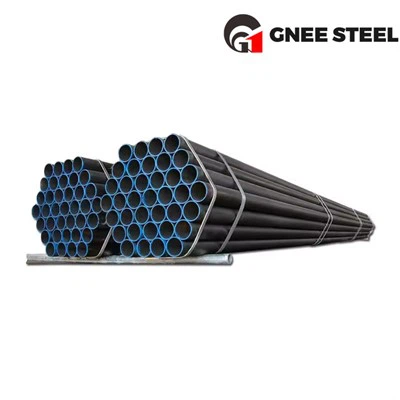
Packaging and shipping of API 5L X60 pipeline for oil and gas

Precision-manufactured LSAW pipes for high-volume gas transmission. Available in large diameters with custom wall thicknesses (Sch 40 to XXS). Get the technical data now.
FAQ
Q1: What is the main difference between API 5L X60 PSL1 and PSL2?
A: PSL2 has stricter limits on carbon, sulfur and phosphorus content, mandatory low-temperature Charpy impact testing, 100% non-destructive weld inspection and full material traceability. PSL1 is a basic grade for general service, while PSL2 is required for high-pressure, low-temperature, offshore or sour service environments.
Q2: Is API 5L X60 pipe suitable for sour service with H2S?
A: Standard X60 PSL1 is not designed for sour service. However, PSL2 sour service grades (X60QS, X60MS) with controlled sulfur content, hardness ≤ 22 HRC and mandatory HIC/SSCC testing fully comply with NACE MR0175/ISO 15156 for H2S-containing oil and gas transmission.
Q3: What is the ISO equivalent grade of API 5L X60?
A: The ISO 3183 equivalent grade of API 5L X60 is L415. The number 415 refers to the same minimum yield strength of 415 MPa (60,200 psi). PSL2 variants correspond to L415N, L415Q and L415M respectively.
Q4: How does X60 compare to X52 for pipeline design?
A: X60 has approximately 15% higher minimum yield strength than X52 (415 MPa vs 360 MPa). For high-pressure trunk pipelines, using X60 allows a ~10% reduction in wall thickness, which reduces steel weight per kilometer and lowers overall project material and transportation costs.
Q5: What is the minimum yield strength of API 5L X60 line pipe?
A: The minimum specified yield strength (Rt0.5) of API 5L X60 line pipe is 60,200 psi, which equals 415 MPa. This value is identical for both PSL1 and PSL2 grades, and for both seamless and welded manufacturing types.
Q6: What wall thickness schedules are available for API 5L X60 pipe?
A: Standard wall thickness schedules include SCH 10, SCH 20, SCH 40 (STD), SCH 60, SCH 80 (XS), SCH 100, SCH 120, SCH 160 and XXS. Custom wall thickness can also be produced according to project design requirements.
Hot Tags: api 5l x60 oil and gas transmission pipe, China api 5l x60 oil and gas transmission pipe manufacturers, suppliers, factory, api 5l grade x52 pipe, api 5l pipe for lubricant transportation, api 5l line pipe for chemical industry, api 5l grade x60 pipe, api 5l pipe for infrastructure projects, api 5l line pipe for refined products transportation
Previous
No InformationYou Might Also Like



Send Inquiry