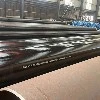
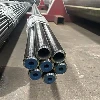
What Makes a Spiral Welded L360 Pipe Different From Other Line Pipe
Spiral welded pipe, designated SAWH in API SPEC 5L and often called helical seam pipe, is formed by feeding a continuous hot rolled coil at an angle to the pipe axis so that the strip wraps into a cylinder and the two edges meet along a helix. The seam is then welded from the inside and the outside by submerged arc welding, usually with two or three wires per side. Because the pipe diameter is set by the relationship between strip width and helix angle rather than by a fixed forming tool, a comparatively narrow coil can produce a very large diameter cylinder, which is why spiral pipe dominates the 500 mm to 3000 mm range for water, slurry and low pressure gas transmission.
The L360 grade adds one specific constraint to that process. Reaching 360 MPa minimum yield in the finished pipe means the coil must arrive with the right thermomechanical history, and the welding thermal cycle must not soften the strip so much that the pipe body tensile test falls below the grade. That interaction between coil metallurgy and welding heat input is the central technical issue in spiral L360 production, and it is the point on which a purchase specification should concentrate.
How the Helical Forming Geometry Works
The geometry is governed by a simple relation: the strip width equals the pipe circumference multiplied by the sine of the forming angle. A 1000 mm wide coil formed at an angle of about 55 degrees produces a pipe of roughly 1220 mm outside diameter; the same coil at a smaller angle produces a smaller diameter, and at a larger angle a larger one. This is the reason spiral mills can change diameter by adjusting the forming angle rather than changing the whole tooling set, and the reason a mill can offer a wide diameter range from a limited coil inventory.
The geometry has a second consequence that matters to a buyer. The length of seam per metre of pipe increases as the forming angle moves away from a right angle, roughly by the ratio of one to the sine of the angle. A typical spiral pipe therefore carries about 25 to 35 percent more weld length per metre than a longitudinal seam pipe of the same diameter and wall. More weld length means more weld metal, more inspection length and more heat input distributed around the circumference, which is the trade off against the lower coil cost that makes spiral pipe economic at large diameter.
A third consequence is that the seam crosses the pipe at an angle, so the seam does not run parallel to the principal hoop stress. This is often presented as a disadvantage, and in a purely hoop stress dominated pipe it is a real consideration; the compensating factor is that a helical seam interrupts any straight path for a longitudinal crack, so a crack that initiates in the pipe body must change direction to propagate along the seam.
Coil Selection for L360 Spiral Pipe
Spiral pipe is made from hot rolled coil in widths from about 1000 mm to 1550 mm, and the coil quality determines the finished pipe more than any downstream operation. For L360 the coil should be supplied to a thermomechanical or normalized rolling schedule with a fine grain practice, a sulphur level consistent with the PSL level ordered, and a coil edge condition free of slivers and laminations, because the strip edges become the weld preparation and any edge defect propagates directly into the seam.
Three coil parameters need to be agreed in writing. The carbon equivalent or Pcm limit, matched to the delivery condition as discussed for the base grade. The coil camber, since a strip that curves in the plane cannot be formed at a constant helix angle and produces diameter variation along the length. And the coil crown and thickness profile, because the wall thickness of the finished pipe at the seam is taken from the strip edge while the body thickness comes from the strip centre, so a heavily crowned coil produces a pipe whose seam region is thinner than its body. A crown limit of 1 percent of strip width is a reasonable contractual figure.
Forming, Welding and the Heat Input Balance
The process sequence is de-coiling, edge milling or planing, pre-bending of the strip edges, helical forming through a three roll set, continuous inside and outside submerged arc welding, cutting to length, then end facing and bevelling. Edge milling is not cosmetic: it removes the work hardened and slightly decarburised coil edge and gives a consistent square face for the weld groove, which is what allows a repeatable penetration on the inside pass.
Heat input is where L360 thermomechanical coil is at risk. A submerged arc weld at 1.5 to 2.5 kJ per millimetre is normal for the wall thickness range of spiral pipe, and that thermal cycle tempers the strip adjacent to the fusion line. In a thermomechanical coil with a lean carbon design, the softened zone can drop below 360 MPa locally. The pipe body tensile specimen is taken away from the weld so the grade test may still pass while the softened band remains in service. Two controls address this: the mill's welding procedure qualification should include transverse weld tensile tests and hardness traverses across the seam, and the finished pipe should be checked for hardness in the softened zone against an agreed cap.
Where the pipe is to be used for sour service or for a low temperature gas line, the seam and heat affected zone Charpy test becomes the governing acceptance item, because the coarse grained region next to the fusion line is where toughness is lowest. Requiring a weld and heat affected zone Charpy set at the same test temperature as the pipe body, with the same acceptance energy, closes the gap that a body only test leaves open.
Dimensional Capability and Tolerances
| Parameter | Typical spiral SAWH capability | Practical buying note |
|---|---|---|
| Outside diameter | About 219 mm to 3000 mm | Below 500 mm longitudinal seam or ERW is normally more economic |
| Wall thickness | About 5 mm to 25 mm | Upper limit set by forming power and weld penetration |
| Length | 6 m to 18 m, 12 m common | Fixed lengths raise cut loss |
| Diameter tolerance | Plus or minus 0.5 to 1 percent of diameter | State the class; ovality matters for lining and for girth welding |
| Wall tolerance | Typically minus 10 percent to plus 10 percent on ordered wall | The minus deviation drives design pressure |
| Straightness | 0.2 percent of length typical | Check after coating, not only at the mill |
Ovality deserves separate attention at large diameter. A 2000 mm pipe with 1 percent diametral deviation is a 20 mm out of round condition, which interferes with girth welding alignment, with internal lining application and with the fit of a concrete weight coating. Spiral pipe is more prone to ovality than longitudinal seam pipe because the forming rolls contact the strip along a helix and the springback is not uniform around the circumference. A specification that states an ovality limit as a percentage of diameter, measured at the pipe ends, gives the fabricator something enforceable.
Comparing Spiral Pipe With the Other Line Pipe Routes
| Attribute | Spiral SAWH | Longitudinal LSAW | ERW / HFW | Seamless |
|---|---|---|---|---|
| Practical diameter range | 219 to 3000 mm | 400 to 1420 mm | 60 to 610 mm | 60 to 660 mm |
| Seam length per metre | Highest, about 25 to 35 percent above LSAW | One longitudinal seam | One longitudinal weld, no filler metal | None |
| Wall thickness uniformity | Good, from coil | Good, from plate | Excellent | Fair, inherent eccentricity |
| Production speed | High for large diameter, slower per metre of weld | Moderate | Highest | Moderate |
| Typical L360 application | Water, slurry, low pressure gas, large diameter mains | High pressure gas and oil transmission | Small and medium diameter liquid lines | High pressure, small diameter, offshore |
| Relative cost at 1200 mm diameter | Lowest | Highest | Not available at that diameter | Not available at that diameter |
The comparison explains the commercial logic rather than prescribing one route. At 1200 mm diameter and 10 mm wall, spiral pipe is normally the cheapest compliant option because the coil is the cheapest input and the forming tooling is not diameter specific. At 1200 mm diameter and 20 mm wall for a high pressure gas line, longitudinal submerged arc pipe from plate is usually specified because the plate can be qualified with a better through thickness toughness and the seam is shorter. The grade is the same; the process decides which risks the buyer is accepting.
What the L360M Suffix Adds
When the grade is written L360M, the M suffix means thermomechanical rolled or thermomechanical formed, and it brings requirements that a plain L360 order does not carry. The steel must be produced by a controlled rolling schedule with a defined finish rolling temperature and cooling practice, the carbon equivalent and Pcm limits apply, and the impact testing is mandatory with a specified test temperature. In practice L360M is the grade written on most modern spiral pipe orders for gas service, because the fine grained microstructure delivers 27 J or better at low temperature without a separate normalising pass that a spiral mill cannot perform on a 12 m finished pipe.
Two consequences follow for the buyer. First, L360M coil cannot be substituted by normalized or as-rolled coil of the same strength, because the toughness and the hardness profile differ. Second, any repair welding on the finished pipe must be qualified against the thermomechanical microstructure, since a repair pass with a high heat input can soften a zone that was already close to the yield limit.
Inspection and Test Requirements for Spiral L360
Spiral pipe inspection has three distinct objects. The seam requires non destructive examination along its full length: normally radiographic or ultrasonic examination of the submerged arc weld for higher PSL levels, and a hydrostatic test of every length at a pressure derived from the hoop stress equation using the specified minimum yield strength and the ordered wall thickness. The pipe body requires tensile and impact testing per lot under PSL2, with the transverse weld tensile and the heat affected zone impact set added where the specification calls for them. The dimensions require measurement of diameter, wall, length, end squareness, bevel angle and weld bead height, with the last of these often overlooked until a coating applicator reports that the three layer polyethylene cannot bridge the bead.
Two supplementary tests appear in demanding spiral pipe orders. The first is a flattening or bend test on a ring cut from the pipe end, which reveals seam ductility and lamination at the weld. The second is a macroscopic examination of the seam cross section to confirm fusion through the wall and to measure the penetration profile; a spiral seam with incomplete fusion on the inside pass will pass a radiographic test in some orientations and fail in service, so the macro check is worth its cost on a first article.
Applications and the Selection Decision
Spiral L360 pipe is used for large diameter water transmission mains, slurry lines in mining, low pressure gas distribution and gathering, outfall and drainage lines, piling casings and structural columns. Its value is highest where diameter is large, pressure is moderate, and the project needs long continuous runs of pipe that can be produced quickly from standard coil. In water service the deciding parameters are the design pressure, the corrosion allowance for the water chemistry, and the internal lining; in slurry service they are the abrasion allowance and the wall thickness required at bends, where the pipe is often upgraded rather than the whole line.
The grade is a poor fit for high pressure gas transmission above about 10 MPa, for low temperature service below minus 20 degrees Celsius without a specifically qualified thermomechanical coil and weld procedure, and for small diameter high pressure work where ERW or seamless pipe dominates on cost and on inspection simplicity. Matching the process to the duty is a more valuable decision than pushing the grade upward: a thicker wall L360 spiral pipe at moderate pressure is usually cheaper and easier to weld than a thinner wall higher grade pipe that needs stricter preheat and a tighter welding procedure.
Transport, Coating and Field Handling
Large diameter spiral pipe is difficult to handle, and the handling damage often exceeds any manufacturing defect in cost. Coating is normally applied after the mill test, with three layer polyethylene to DIN 30670 or fusion bonded epoxy to ISO 21809-2 for buried service, and the coated pipe must be lifted with fabric slings and stored on padded skids with side restraints. The pipe ends should be protected during transport because a damaged bevel means field re-machining. Where the pipe will be concrete weight coated for a submerged crossing, the ovality and the weld bead height at the mill become critical, and the coating yard should approve the pipe before the order is placed rather than after the first delivery.
For long term storage, the internal surface should be cleaned and dried and the ends closed. Spiral pipe made to a thin wall for water service can deform under its own weight in a tall stack, so the stack height should be set by the diameter to wall ratio rather than by available yard space.
FAQ
Q: Why is a spiral pipe cheaper than a longitudinal seam pipe at the same diameter?
Because the raw material is coil rather than plate, and the forming tooling is not diameter specific, so a mill can produce a wide diameter range from a narrow coil. The saving is offset partly by the longer seam, which carries more weld metal and more inspection length per metre of pipe.
Q: Does the helical seam reduce the pressure capacity of L360 spiral pipe?
The seam is not parallel to the hoop stress, so the design calculation must use the joint factor applicable to the seam type and the examination level under the design code. With full radiography and a properly qualified procedure, spiral pipe is accepted for gas transmission in many codes, but the joint factor must be written into the design rather than assumed equal to a longitudinal seam.
Q: What does the M suffix mean in L360M spiral pipe?
It denotes thermomechanical rolling or forming, and it brings mandatory carbon equivalent control, a defined rolling and cooling practice, and mandatory impact testing at a stated temperature. Substituting a normalized or as-rolled coil of the same strength does not satisfy the L360M requirement, because the toughness and the hardness profile come from the thermomechanical microstructure.
Q: What is the maximum wall thickness available in spiral welded L360 pipe?
Around 25 mm is the practical ceiling for most spiral mills, set by forming power and by the ability to achieve full penetration on the inside submerged arc pass. Above that thickness, longitudinal submerged arc pipe from plate is the normal choice.
Q: How is ovality controlled on large diameter spiral pipe?
By a combination of coil camber control, consistent forming roll pressure and a sizing pass at the end of the line. The specification should state an ovality limit as a percentage of diameter measured at the pipe ends, because ovality affects girth weld fit up, internal lining and weight coating.
Q: Which impact test temperature is realistic for L360 spiral pipe?
Zero degrees Celsius with a 27 J average suits moderate climate water and low pressure gas service. For gas service below minus 10 degrees Celsius, or for wall above 20 mm, minus 20 degrees Celsius or lower should be specified, together with weld and heat affected zone Charpy sets at the same temperature, since the coarse grained zone next to the fusion line governs seam toughness.
Q: Can spiral pipe be used for sour service?
Only when the pipe, the seam and the welding procedure are qualified to ISO 15156 / NACE MR0175, which requires a hardness cap across the seam, a low sulphur coil, inclusion shape control and often HIC testing to NACE TM0284. The helical seam is a longitudinal discontinuity path relative to the crack driving force in some geometries, so seam hardness control is more critical than in a longitudinal seam pipe.