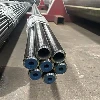
Engineering for Integrity: API 5CT Grade L80-1
In the global oil and gas industry, API 5CT Grade L80-1 is a premier restricted-yield grade designed specifically for service in corrosive environments containing hydrogen sulfide (H2S). Within the American Petroleum Institute's classification, L80-1 is a controlled-hardness material that provides a critical safety barrier in sour service wells. Its mechanical identity is defined by a precise balance of high yield strength and extreme resistance to sulfide stress cracking (SSC).
Mechanical Properties and Hardness Restrictions
The defining differentiator for L80-1 is the mandatory hardness cap. According to API 5CT and NACE MR0175, the maximum allowable hardness for L80-1 is 23 HRC. This restriction ensures that the steel remains sufficiently ductile to resist brittle fracture in the presence of hydrogen atoms, which would otherwise embrittle higher-hardness steels.
| Property | API 5CT L80-1 Requirement |
|---|---|
| Yield strength | 552–655 MPa (80,000–95,000 psi) |
| Tensile strength (min.) | 655 MPa (95,000 psi) |
| Max. hardness | 23 HRC (mandatory) |
| Heat treatment | Quenched and tempered (Q&T) |
Metallurgy and Heat Treatment
L80-1 achieves its mechanical performance through mandatory quenching and tempering (Q&T). This process refines the grain structure into tempered martensite, ensuring a uniform hardness profile from the outside diameter to the inside bore. Unlike N80-1, which can be normalized, the Q&T requirement for L80-1 is absolute, guaranteeing consistent performance in aggressive downhole conditions.
Applications in Sour Gas Wells
L80-1 tubing is the industry standard for production strings in reservoirs where H2S partial pressures exceed safety thresholds for standard carbon steels. It is commonly used with premium connections such as metal-to-metal seals to provide gas-tight integrity. Its predictable yield range allows well designers to perform precise collapse and burst calculations for deep-well completions.
Connection and Makeup Requirements
Because sour service demands leak-free integrity, API-certified high-pressure thread compounds are required to maintain the metal-to-metal seal under high-torque makeup. Thread inspection and proper doping procedures are documented in the running procedures for each well.
Frequently Asked Questions
What is the difference between L80-1 and L80-13Cr?
L80-1 is a carbon steel optimized for H2S (SSC) resistance; L80-13Cr is a martensitic stainless steel designed for CO2 (sweet) corrosion resistance.
Is L80-1 suitable for cryogenic service?
It is rated for reservoir temperatures. For surface equipment in arctic conditions, specialized impact-tested grades such as A333 are required.
Can N80 be used instead of L80-1?
No. While the grades have similar yield strengths, N80 does not carry the 23 HRC hardness restriction and is not considered safe for sour service.
Does L80-1 require special thread lubricants?
Yes, API-certified high-pressure thread compounds are required to maintain the metal-to-metal seal under high-torque makeup.
What is restricted yield?
The gap between minimum and maximum allowable yield strength is narrow, only 15,000 psi for L80-1, ensuring the tubing string behaves predictably under load.
Why is the 23 HRC hardness cap mandatory?
Higher hardness increases susceptibility to hydrogen embrittlement and sulfide stress cracking; the cap keeps the steel ductile in H2S environments.