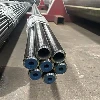
API 5CT J55 Tube Coupling: Role in Casing String Assembly
An API 5CT J55 tube coupling is a standardized tubular connection component in petroleum drilling engineering. Its primary function is to mechanically join adjacent casing sections through internal thread structures, forming a complete casing string assembly. Within the wellbore structure, this component must withstand downhole axial loads and formation pressures while maintaining the overall sealing integrity of the casing string.
Typical Specification
| Parameter | Value |
|---|---|
| Type | Tube coupling |
| Standard | API 5CT |
| Material | J55 |
| Size | DN240 |
| End finish | LTC (long round thread) |
Material Properties of Grade J55
Grade J55 is a carbon steel used widely for shallow to medium-depth casing and tubing. Its specified minimum yield strength is 55,000 psi (379 MPa) with a maximum of 80,000 psi (552 MPa), and a minimum tensile strength of 75,000 psi (517 MPa). The grade offers a good balance of strength, weldability and economy, making it a common choice for non-sour production strings and structural casing.
Design and Sealing Features
The specially designed double-shoulder structure and composite sealing system enhance sealing reliability in high-pressure oil and gas environments. The LTC (long round thread) end provides a longer thread engagement length than STC, improving tensile capacity and making-up performance for deeper strings. Thread compounds approved for API connections are applied during makeup to ensure consistent torque and a leak-tight seal.
Quality Verification
Couplings are verified by dimensional gauging of the threads, hardness testing, magnetic particle inspection for surface defects and pressure testing of assembled joints. Full material traceability to the heat number is maintained through mill test certificates.
Frequently Asked Questions
What does LTC mean?
LTC stands for long round thread, an API 5CT connection with a longer thread engagement than STC, providing higher tensile strength and better make-up characteristics.
What does DN240 indicate?
DN refers to the nominal diameter in millimeters; DN240 corresponds to a nominal outside diameter of about 240 mm (approximately 9-5/8 inch class).
What are the mechanical properties of J55?
Minimum yield strength 55,000 psi (379 MPa), maximum 80,000 psi (552 MPa), and minimum tensile strength 75,000 psi (517 MPa).
Is the coupling the same as the pipe?
No. The coupling is a short, heavier-walled connector threaded on both ends; the pipe is the long tubular body. Both must meet API 5CT material requirements.
Which thread compound should be used?
API-certified high-pressure thread compounds that prevent galling and maintain a gas-tight seal under high torque.
How are couplings inspected before running?
Through thread gauging, surface inspection, hardness checks and, for critical strings, pressure testing of the assembled joint.