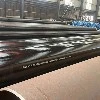
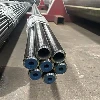
ERW Welded Steel Pipe for Building and Structural Use
Structural steel pipe is used where a round or square hollow section is required to carry load in a building, bridge or foundation. Because a tube carries bending and compression on a closed section, it resists buckling far better than an open section of the same weight, which is why hollow sections are used for columns, trusses, bracing, crane rails and piling. Three standards dominate this market: API 5L for line and structural service, ASTM A500 for cold formed welded structural tubing, and ASTM A252 for steel pipe piles.
The pipes described here are produced by electric resistance welding, in which the strip is formed into a cylinder and the edges are heated and forged together by pressure without filler metal. The result is a pipe with a weld that is metallurgically continuous with the parent metal. For heavy wall construction work, double submerged arc welding and high frequency welding are also used depending on the size and wall thickness.
Standards and Grades
| Standard | Grade | Minimum yield strength | Minimum tensile strength |
|---|---|---|---|
| API 5L PSL1 | Grade B | 245 MPa (35,500 psi) | 415 MPa (60,000 psi) |
| ASTM A500 | Grade A | 230 MPa (33,000 psi) | 310 MPa (45,000 psi) |
| ASTM A500 | Grade B | 290 MPa (42,000 psi) | 400 MPa (58,000 psi) |
| ASTM A500 | Grade C | 317 MPa (46,000 psi) | 427 MPa (62,000 psi) |
| ASTM A252 | Grade 1 | 207 MPa (30,000 psi) | 345 MPa (50,000 psi) |
| ASTM A252 | Grade 2 | 241 MPa (35,000 psi) | 414 MPa (60,000 psi) |
| ASTM A252 | Grade 3 | 310 MPa (45,000 psi) | 455 MPa (66,000 psi) |
European and national equivalents are also produced, including EN 10219 hollow sections in S275 and S355, EN 10217 welded tube, and GB/T 3091 welded steel pipe in grades Q195 to Q345. Grade selection is driven by the design code: a column designed to a structural code takes its allowable stress from the specified minimum yield strength of the grade, while a pile designed to a geotechnical report is usually driven to refusal or to a set criterion and needs a grade that will not crack under the driving energy.
Dimensional Range
| Item | Range |
|---|---|
| Outside diameter | 76 mm to 660 mm |
| Wall thickness | 2.5 mm to 18 mm |
| Length | 5.8 m to 24 m, or cut to order |
| Welding route | Electric resistance welding, high frequency welding and double submerged arc welding |
| Steel grades | API 5L Grade B to X70, ASTM A53 Grade A and B, ASTM A500 Grade A to C, ASTM A252 Grade 1 to 3, EN 10219 S275 and S355, GB/T 3091 Q195 to Q345 |
| Surface finish | Bare, painted, or coated with fusion bonded epoxy, coal tar epoxy or another system to the project specification |
| End preparation | Plain end, beveled end, threaded and coupled, or fitted with end caps for export |
| Certification | Mill test certificate to EN 10204 type 3.1, with third party inspection on request |
Applications
Steel frames, columns, roof trusses and bracing in industrial buildings
Bridge supports, gantry structures and sign gantries
Steel pipe piles and foundation tubes for buildings, jetties and transmission towers
Conveyor galleries, crane rails and mechanical handling frames
Highway guard rail posts and barrier structures
Ordering, Testing and Delivery Points
State the standard, grade, outside diameter, wall thickness and length tolerance together, because a change in wall class can move the grade requirement.
For piling, confirm whether the pile will be driven with an internal mandrel, which limits the wall thickness that can be used without distortion.
For exposed building work, agree the finish up front, since beveling, blasting and painting are normally carried out in the mill rather than on site.
Request the mill certificate, and where the project calls for it, arrange third party witnessing of the tensile, flattening and weld tests.
Load pipes with wooden dunnage between layers and secure them so that the ends are not damaged in transit; beveled ends are protected with caps.
FAQ
Q: What is the difference between ERW and seamless pipe?
ERW pipe is made from strip that is formed and welded along one longitudinal seam. Seamless pipe is pierced from a solid billet and has no weld. ERW is the economical choice for structural and low to medium pressure duty.
Q: Which ASTM A500 grade is used for building columns?
Grade B and Grade C are the common choices, since their higher yield strength allows a lighter section for the same design load. Grade A is used for lighter and less highly stressed members.
Q: What is ASTM A252 pipe used for?
ASTM A252 covers welded and seamless steel pipe piles. The grades are selected according to the driving conditions and the structural load the pile must carry after installation.
Q: Can ERW pipe be used for pressure service?
Yes, when it is ordered to a pressure standard such as API 5L or EN 10217 and the weld is tested as part of the acceptance requirements. Structural grades are ordered for load carrying duty rather than pressure containment.
Q: How is the weld on an ERW pipe tested?
The weld is checked by ultrasonic or electromagnetic methods and by a flattening test, which bends a ring section flat to prove that the weld and the heat affected zone remain sound.
Q: Are beveled ends and painted surfaces available for export orders?
Yes. Pipes are supplied with beveled ends, the agreed coating system, and end caps fitted before loading so that the pipe arrives ready for installation.