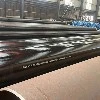
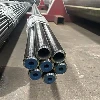
What Is API 5L Grade B Carbon Steel Pipe?
API 5L Grade B is one of the most widely used line pipe grades in the world. It is a carbon steel grade defined by the American Petroleum Institute specification for line pipe, and it sits at the lower end of the strength ladder: above Grade A but below the X42 and higher grades. Grade B is chosen for pipelines, water mains, slurry lines and general fluid transfer where a moderate strength, weldable and economical steel is sufficient.
The grade is supplied at two specification levels. PSL1 covers pipe produced with standard chemistry limits and routine testing, and is the level most often ordered for general service. PSL2 adds tighter chemical limits, a maximum carbon equivalent, tensile testing on the finished pipe and impact toughness testing, so it is selected for pipelines where fracture control matters, such as gas transmission and low temperature service.
PSL1 Grade B Chemistry and Mechanical Properties
| Item | Value, maximum unless stated |
|---|---|
| Carbon | 0.28 % |
| Manganese | 1.20 % |
| Phosphorus | 0.030 % |
| Sulphur | 0.030 % |
| Yield strength, minimum | 245 MPa (35,500 psi) |
| Tensile strength, minimum | 415 MPa (60,000 psi) |
| Tensile strength, maximum | Not specified at PSL1 |
PSL2 Grade B Chemistry and Mechanical Properties
| Item | Value |
|---|---|
| Carbon, maximum | 0.24 % |
| Manganese, maximum | 1.20 % |
| Phosphorus, maximum | 0.025 % |
| Sulphur, maximum | 0.015 % |
| Yield strength | 241 MPa to 448 MPa (35,000 to 65,000 psi) |
| Tensile strength | 414 MPa to 758 MPa (60,000 to 110,000 psi) |
| Impact test | Required at the test temperature agreed for the project |
The PSL2 yield and tensile range, with a stated maximum as well as a minimum, stops the mill from supplying an over-strength pipe that would be hard to weld and less tolerant of strain. The tighter phosphorus and sulphur limits reduce the risk of centreline segregation and improve toughness at low temperature. The equivalent grade designations in other systems are L245 in ISO 3183 and, for structural work, the corresponding grades of ASTM A53 and GB/T 3091.
Manufacturing Routes
Seamless pipe for smaller diameters and higher pressures, produced by piercing and rolling a solid billet.
Electric resistance welded pipe for general service, formed from strip with the edges welded by heat and pressure.
Longitudinally submerged arc welded pipe for larger diameters, with the internal and external weld runs laid by arc welding.
Helically submerged arc welded pipe for large diameter, lower pressure lines and piling.
Whichever route is used, the finished pipe is hydrostatically tested, the weld is examined by non-destructive methods, and the dimensions, straightness and surface condition are checked against the specification. Pipe ordered for welding must also have a carbon equivalent low enough for the intended welding procedure.
Applications
Oil, gas and water transmission and distribution pipelines operating at low to medium pressure
Water supply, irrigation and drainage mains
Slurry and tailings lines in mining and processing plants
Structural and piling duty where a pressure rated pipe is preferred
Pipe work in plants where a weldable carbon steel tubular is required
FAQ
Q: Is Grade B the lowest strength grade in API 5L?
No. Grade A, designated L210, is lower at 210 MPa minimum yield strength. Grade B at 245 MPa sits immediately above it and is the most commonly ordered line pipe grade.
Q: What is the difference between PSL1 and PSL2?
PSL2 applies tighter chemical limits including a maximum carbon, requires tensile testing on the finished pipe, and adds impact toughness testing. PSL1 uses the standard limits without the additional toughness requirement.
Q: Does Grade B contain less than 2 % carbon?
All pipeline steels are low carbon steels, but the specific requirement for Grade B is a maximum of 0.28 % carbon at PSL1 and 0.24 % at PSL2. The low carbon content is what gives the grade its good weldability and formability.
Q: Which pipe sizes are available in Grade B?
The grade is produced as seamless, electric resistance welded, submerged arc welded and helical welded pipe across a wide range of diameters and wall thicknesses, with cut lengths to order.
Q: Can Grade B be used at low temperature?
Low temperature service is normally supplied as PSL2 with impact testing at the design temperature, since the additional toughness requirement controls fracture risk better than PSL1.
Q: How is the pipe tested before delivery?
Hydrostatic testing, weld examination by non-destructive methods, dimensional and visual inspection and, for PSL2, tensile and impact testing are carried out, and the results are recorded on the mill certificate.