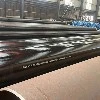
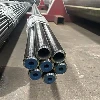
What Is ASTM A53 Grade B Seamless Pipe
ASTM A53 covers black and hot-dip galvanized welded and seamless steel pipe in NPS 1/8 through NPS 26, for mechanical and pressure applications and for ordinary use in steam, water, gas and air lines. Three types are defined: Type F, Type E and Type S, where Type S is the seamless product and is the form normally chosen for thin-wall pipe where a continuous body without a seam is required.
Grade B is the higher of the two standard grades in the specification and the one most widely ordered. Thin-wall A53 pipe is used where a light section is sufficient for the pressure and stiffness of the system, which keeps weight and cost down while still allowing standard butt-weld, threaded or grooved joints.
Chemical Composition and Mechanical Properties
The Grade B limits are shown below. Copper, nickel, chromium and molybdenum are restricted as residual elements, and vanadium is limited as well.
| Element | Requirement, % |
|---|---|
| Carbon | 0.30 max |
| Manganese | 1.20 max |
| Phosphorus | 0.05 max |
| Sulfur | 0.045 max |
| Copper | 0.40 max |
| Nickel | 0.40 max |
| Chromium | 0.40 max |
| Molybdenum | 0.15 max |
| Property | Requirement |
|---|---|
| Yield strength | 240 MPa (35 ksi) minimum |
| Tensile strength | 415 MPa (60 ksi) minimum |
| Elongation | Minimum value measured on a standard round specimen, with a reduced requirement applied to thin-wall subsize specimens |
Thin-Wall Sizes and Tolerances
Seamless A53 pipe is produced in NPS 1/8 through NPS 26 across schedules 10, 20, 30, 40, 60, 80, 100, 120, 140, 160, STD, XS and XXS. Thin-wall orders are usually placed against schedule 10, schedule 20, schedule 40 or STD, with outside diameter fixed by NPS and wall thickness fixed by the schedule. Lengths are supplied as single random at roughly 4 to 7 m, as double random at roughly 11 to 13 m, or cut to the order.
Wall thickness tolerance is a percentage of nominal plus a fixed allowance, and weight per unit length is checked against a calculated weight with a permitted variation. Pipe ends are supplied plain, threaded or bevelled, and threads are cut to the taper pipe thread standard when threaded ends are ordered.
Testing, Marking and Delivery Condition
The specification requires tensile, bend and flattening tests, together with either a hydrostatic test or a non-destructive electric test on each length. Product marking records the manufacturer, the specification and grade, the size and the heat number, so that a test report can be traced back to the producing heat.
A53 pipe can be supplied black or hot-dip galvanized, and when galvanized the coating weight is controlled and the threads are re-cut or chased after coating. Where the pipe is intended for a pressure system, the design calculation uses the minimum wall rather than the nominal wall, so the minus wall tolerance and any thread depth have to be accounted for.
Applications and Selection Notes
Typical applications include water and wastewater lines, compressed air and gas distribution, low-pressure steam and condensate piping, heating and cooling circuits, irrigation systems, and ordinary structural work such as columns, bracing, handrails and supports. Thin-wall pipe is common in plumbing, HVAC and light structural frames where a heavy section is not needed.
Selection should start from the service medium and the design pressure: the thinner the wall, the more the pipe depends on proper support spacing and on protection of the outside surface. Galvanizing or an external coating extends life in humid or buried conditions, and cut ends are normally protected before installation.
FAQ
Q: What does Type S mean in ASTM A53?
Type S is the seamless designation, as distinct from Type F and Type E, which are welded products.
Q: What is the minimum yield strength of Grade B?
240 MPa (35 ksi), with a minimum tensile strength of 415 MPa (60 ksi).
Q: How thin can the wall be?
Wall thickness follows the schedule ordered, and the lightest standard schedules are used where the pressure duty allows.
Q: Is A53 pipe suitable for steam?
Yes, it is specified for steam, water, gas and air service within the temperature and pressure limits of the applicable code.
Q: Can the pipe be galvanized?
Hot-dip galvanized pipe is a standard product form of this specification.
Q: Which test is required on each length?
Either a hydrostatic test or a non-destructive electric test is required, in addition to the mechanical tests.