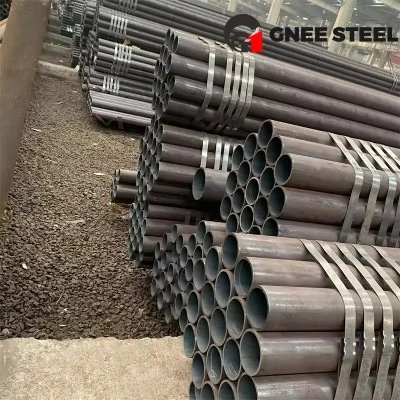
When used as a tensile test, take 1 specimen from each steel pipe and 2 specimens from 2 steel pipes. Each specimen should be prepared into slats or bars by mechanical cutting method, avoiding burning and grinding to process. Each specimen length of about 500mm; as a squash test, to take 1 on each steel pipe, 2 steel pipe a total of 2, each about 40mm long tube ring.
Cold rolled seamless steel pipe production process is generally more complex than hot rolling, the billet should first be three-roll rolling, extrusion should be sizing test, if the surface does not respond to cracks after the round tube should be cut by the cutter, cut into lengths of about one metre of billet.
Then enter the annealing process, annealing to be pickled with acidic liquid, pickling should pay attention to whether there is a large number of blisters on the surface, if there is a large number of blisters produced indicates that the quality of the steel pipe fails to meet the appropriate standards.
Round billet → heating → piercing → three-roll slant rolling, continuous rolling or extrusion → stripping → sizing (or reduction) → cooling → straightening → hydrostatic test (or flaw detection) → marking → warehousing Seamless steel pipe is made from ingot or solid billet by piercing to make a bristle pipe, and then hot rolled, cold rolled, or cold dialed. The specification of seamless steel pipe is expressed in millimetres of outer diameter * wall thickness.
Hot rolled seamless pipe OD is generally greater than 32mm, wall thickness 2.5-200mm, cold rolled seamless steel pipe OD can be up to 6mm, wall thickness can be up to 0.25mm, thin-walled pipe OD can be up to 5mm wall thickness of less than 0.25mm, cold rolled than hot rolled with high dimensional accuracy.
Produced during the production process, such as rolling process parameters are not designed correctly, the mould surface is not smooth, lubrication conditions are not good, hole design and adjustment is unreasonable.
Billet (steel pipe) in the heating and rolling, heat treatment and straightening process, if because of improper control of the heating temperature, deformation is not uniform, heating and cooling rate is unreasonable or straightening deformation is too large and produce excessive residual stress, then it may also lead to seamless steel pipe surface cracks.