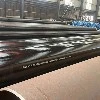
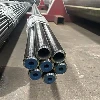
What ASTM A252 Covers
ASTM A252 is the standard specification for welded and seamless steel pipe piles. Pipe piles are tubular steel elements driven into the ground to carry structural loads and to transfer them to deeper, stronger soil or rock, and they are used as the support structure for bridges, highways, wharves, jetties, embankments, retaining walls and other civil engineering works. The specification covers pipes produced by both seamless and welded processes, which means a spirally welded pipe with a helical submerged arc seam is fully acceptable provided it meets the dimensional and mechanical requirements of the standard.
A252 is a mechanical property specification. It fixes minimum yield strength and minimum tensile strength for each grade, and grade selection is made on the strength needed by the foundation design rather than on a chemical composition table.
Grade 1, Grade 2 and Grade 3 Requirements
| Grade | Minimum yield strength | Minimum tensile strength |
|---|---|---|
| Grade 1 | 205 MPa (30 000 psi) | 345 MPa (50 000 psi) |
| Grade 2 | 240 MPa (35 000 psi) | 415 MPa (60 000 psi) |
| Grade 3 | 310 MPa (45 000 psi) | 455 MPa (66 000 psi) |
Grade 1 is the lowest strength grade and is used where the pile carries moderate axial load and where driving stresses are limited, for example in light retaining structures, temporary works and short piles in competent ground. Grade 2 offers higher strength and toughness and suits heavier structures, longer piles and sites where driving stresses are significant. Grade 3 has the highest strength level of the three and is chosen for heavily loaded foundations, deep piles and structures in regions with high seismic demand, where the pile must combine strength with the ductility needed to absorb cyclic loading.
Manufacturing Route for Spirally Welded Pipe Piles
Spirally welded pipe piles are made from steel strip or plate, formed into a helix on a spiral forming machine with the strip edges aligned, and welded along the seam by automatic submerged arc welding, usually with one pass inside and one pass outside. The seam is inspected over its full length by ultrasonic testing, the pipe is cut and end faced to the ordered length and bevel, and each pipe is dimensionally checked for outside diameter, wall thickness, roundness, straightness and length. Where a project specification calls for it, the pipe can also be supplied with a hydrostatic test, a full-body ultrasonic examination or a supplementary toughness test agreed between purchaser and manufacturer.
Heat treatment and impact toughness are not mandatory requirements of A252 itself; they become applicable only when the purchase order adds them. Specification of a driving shoe, a splice detail or a coating system is likewise a project decision and should be stated clearly in the enquiry so that the pipe is produced with the right end preparation and surface protection.
Selection and Application Guidance
When selecting a grade, the designer compares the required pile capacity with the allowable stress allowed by the foundation code, then checks that the wall thickness is sufficient to resist driving stresses without local buckling and that the diameter to thickness ratio remains within the limits used in the design. Corrosion allowance matters as much as strength in aggressive ground or marine conditions: piles in seawater or in contaminated soil are usually specified with an additional wall thickness or with a protective coating, and the exposed zone at the mud line deserves particular attention. For very long piles, splicing by butt welding in the field must follow a qualified welding procedure, and the bevel geometry and alignment of the pipe ends directly affect the quality of that joint.
FAQ
Q: What is ASTM A252 used for?
It is the standard specification for welded and seamless steel pipe piles used as foundation and support structures in civil engineering works such as bridges, wharves and embankments.
Q: How many grades does ASTM A252 define?
Three grades, Grade 1, Grade 2 and Grade 3, distinguished by their minimum yield strength and minimum tensile strength values.
Q: What are the minimum yield strengths of the three grades?
Grade 1 requires 205 MPa (30 000 psi), Grade 2 requires 240 MPa (35 000 psi) and Grade 3 requires 310 MPa (45 000 psi).
Q: Can a spirally welded pipe be supplied to ASTM A252?
Yes. A252 accepts welded pipe, so a helical seam pipe made by automatic submerged arc welding is acceptable when it meets the standard's dimensional and mechanical requirements.
Q: Does ASTM A252 require heat treatment or impact testing?
No. These are not mandatory requirements of the specification; they apply only when they are added by the purchase order or the project specification.
Q: How is the pipe pile protected against corrosion?
By specifying an additional wall thickness as a corrosion allowance, by applying a coating system suited to the ground or marine environment, or by a combination of both.