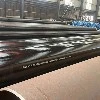
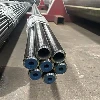
What L360 Steel Pipe Actually Is
L360 is a line pipe grade defined by API 5L and by the equivalent GB/T 9711 series, in which the number denotes the specified minimum yield strength in megapascals. A minimum yield strength of 360 MPa corresponds to the traditional X52 designation. The steel is a carbon-manganese grade rather than an alloy or stainless steel: it contains controlled amounts of carbon, manganese, silicon and residual elements, with micro-alloying additions of niobium, vanadium or titanium when the pipe is supplied to the PSL2 route. Understanding this is important, because L360 is not a corrosion-resistant material by itself. Corrosion protection comes from coatings, cathodic protection or the selection of a genuinely corrosion-resistant alloy, not from the L360 designation.
Strength Series Comparison
| Grade | Minimum yield strength | Minimum tensile strength | Typical position |
|---|---|---|---|
| L245 (Grade B) | 245 MPa | 415 MPa | Low-pressure gathering and utility lines |
| L290 (X42) | 290 MPa | 415 MPa | Medium-pressure distribution and water lines |
| L360 (X52) | 360 MPa | 460 MPa | Transmission lines, general high-pressure duty |
| L415 (X60) | 415 MPa | 520 MPa | High-pressure long-distance transmission |
| L450 (X65) | 450 MPa | 535 MPa | High-strength, large-diameter transmission |
Tensile strength values above are the minimum figures for the PSL2 route; PSL1 specifies minimum tensile strength without the upper limits and yield-to-tensile ratio control that PSL2 imposes. Because the numbers are lower than those of L415 and L450, L360 has two practical advantages: it is easier to weld with conventional procedures, and it is more readily available in small quantities and in seamless form across the full size range.
How L360 Differs from Other Pipe Categories
Against ASTM A106 and API 5L Grade B: L360 offers roughly 50 % more yield strength, so a thinner wall can carry the same design pressure, but it requires qualified welding procedures and tighter heat input control.
Against higher line pipe grades such as L415 and L450: L360 tolerates a wider range of welding conditions, shows better toughness in the heat-affected zone at moderate wall thickness, and is usually the more economical option when the pressure calculation does not demand a higher grade.
Against alloy and stainless pipe: L360 has no meaningful resistance to aggressive chemical attack, and it is not intended for creep service at high temperature, so it should not be substituted for chrome-molybdenum or austenitic grades in those duties.
Applications and Selection Guidance
L360 pipe is used for oil and gas transmission and gathering lines, produced-water and injection lines, slurry and water conveyance, and structural or piling work in construction and machinery. In pipeline design the wall thickness is calculated from the specified minimum yield strength using the formulas of ASME B31.4 or ASME B31.8, and the resulting value is rounded up to the nearest available wall thickness and checked against the mill tolerance.
Confirm the product specification level: PSL2 adds mandatory non-destructive testing, a maximum yield-to-tensile ratio of 0.93 and Charpy impact testing.
Check the design temperature, because allowable stress is reduced above 121 degrees Celsius according to the temperature derating factors of the pipeline code.
Specify the delivery condition, such as as-rolled, normalised or thermo-mechanically rolled, since it affects toughness and field weldability.
Order the coating system with the pipe where possible: three-layer polyethylene or fusion-bonded epoxy are common for buried transmission lines.
FAQ
Q: Is L360 the same as X52 pipe?
Yes. L360 and X52 describe the same strength level; the L designation with a yield figure in megapascals comes from API 5L and GB/T 9711, while X52 is the traditional designation expressed in thousands of pounds per square inch.
Q: Is L360 steel pipe corrosion resistant?
It is a carbon-manganese steel and has no inherent resistance to aggressive media. External protection relies on coating and cathodic protection, and internal protection on inhibitors, linings or a change to a corrosion-resistant alloy.
Q: Which is stronger, L360 or L415?
L415 is stronger, with a minimum yield strength of 415 MPa against 360 MPa for L360, but it also needs more carefully controlled welding and generally costs more.
Q: Can L360 pipe be used at high temperature?
Only within the limits of the governing pipeline code. Above 121 degrees Celsius the allowable stress is derated, and carbon steel line pipe is not a creep-resisting material for sustained high-temperature service.
Q: What documents should accompany an L360 pipe order?
An EN 10204 3.1 mill test certificate showing heat analysis, tensile and yield results, a hydrostatic test record, and for PSL2 pipe the impact test and non-destructive examination results.