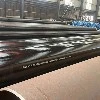
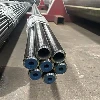
Why L360 Occupies the Middle of the Range
L360 is defined by API 5L and by the equivalent GB/T 9711 series with a specified minimum yield strength of 360 MPa, which corresponds to the traditional X52 designation. The grade is a carbon-manganese steel with controlled micro-alloying, and it is delivered in both seamless and welded form. Its position between the lower grades such as L245 and L290 and the higher grades such as L415 and L450 gives it a wide application window: it carries substantially more pressure than the lower grades for the same wall thickness, yet it is still easy to weld with standard procedures and is available in the full range of sizes and wall thicknesses.
Main Applications
Oil and gas transmission and gathering lines: L360 is used for onshore trunk and branch lines, well-site gathering systems and associated station piping designed to ASME B31.4 or ASME B31.8.
Water and slurry conveyance: raw water, cooling water and tailings lines use L360 pipe because the grade tolerates moderate pressure and is cost-effective in long runs.
Injection and utility piping: produced-water injection lines, gas gathering and plant utility piping where a defined yield strength is needed for the pressure calculation.
Structural and mechanical work: piling, bracing, support structures and general engineering fabrication, where the pipe is used for its stiffness and load capacity rather than for internal pressure.
Coated pipe for buried service: L360 pipe is frequently supplied with three-layer polyethylene or fusion-bonded epoxy coating and internal lining for corrosive media.
Why the Grade Suits These Duties
| Requirement | How L360 meets it |
|---|---|
| Pressure containment | 360 MPa specified minimum yield strength gives a higher allowable stress than L245 or L290, so a thinner wall can be used |
| Field weldability | Carbon and manganese levels within the normal range, with only limited micro-alloying, allow conventional welding procedures |
| Toughness | PSL2 supply provides controlled chemistry, a yield-to-tensile ratio limit and Charpy impact testing |
| Availability | Produced in both seamless and welded form over a wide size and wall thickness range |
| Economy | Lower alloy content than the higher grades, so the cost per tonne is moderate |
Selection and Specification Notes
Define the product specification level. PSL2 is usual for transmission lines because it adds mandatory non-destructive testing, impact testing and chemistry control.
State the design code, since ASME B31.4, B31.8 and other pressure piping codes give different wall thickness formulas and different weld joint factors.
Confirm the design temperature, because allowable stress is derated above 121 degrees Celsius according to the pipeline code.
Choose the coating and lining system at the same time as the pipe, since the delivery condition and surface preparation affect adhesion and field joint quality.
For sour service, verify that the order includes the hardness and chemistry restrictions of NACE MR0175 / ISO 15156.
Some published descriptions of L360 pipe list applications for which the grade is not normally selected, including pressure equipment in nuclear installations or ship structures governed by classification society rules. Those duties call for their own material specifications and qualification systems. L360 should be described accurately as a line pipe and general structural grade for the duties listed above.
FAQ
Q: What is the main use of L360 steel pipe?
Its main use is oil and gas transmission and gathering pipelines, followed by water and slurry conveyance, injection lines and general structural work.
Q: Is L360 pipe the same as X52 pipe?
Yes, they describe the same strength level; L360 states the minimum yield strength in megapascals and X52 states it in thousands of pounds per square inch.
Q: Can L360 pipe be used for drinking water lines?
It can be used for water conveyance subject to the applicable pipeline and water quality requirements; a suitable internal lining or coating is normally specified for potable water service.
Q: Which wall thickness is available?
Wall thicknesses follow the API 5L or GB/T 9711 dimensional tables and the manufacturing route, so availability should be checked against the required outside diameter and wall combination for seamless or welded pipe.
Q: Does L360 pipe need impact testing?
PSL2 supply includes impact testing requirements, and in PSL1 impact testing is ordered as a supplementary requirement, which is common for cold-climate or critical service.