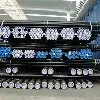
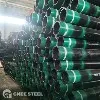
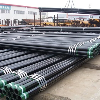
API 5L GRB steel pipes conform to the 5L standard set by the American Petroleum Institute (API), where "GRB" represents Grade B, belonging to medium-strength pipeline steel. Compared with ordinary welded pipes, its core technical indicators are reflected in three aspects:
1. Materials Science: Carbon content is controlled below 0.22%, manganese content is 1.2%-1.5%, and elements such as niobium and vanadium are added through micro-alloying to improve strength while ensuring weldability. Sulfur and phosphorus impurity content must be below 0.025% to ensure low-temperature toughness.
2. Manufacturing Process Requirements: High-frequency resistance welding (ERW) or submerged arc welding (SAW) processes are adopted, and the weld seam must undergo 100% ultrasonic flaw detection and X-ray inspection. Taking leading enterprises such as Baosteel and Tianjin Pipe as examples, their production lines are equipped with online heat treatment equipment to eliminate residual welding stress.
3. Mechanical Performance Standards: Yield strength ≥245MPa, tensile strength 415-655MPa, elongation not less than 23%. According to Sohu Finance, the actual performance of products from leading domestic companies generally exceeds the standards by 15%-20%.

Application scenarios include:
1. Long-distance trunk pipelines: Diameters are typically between 219-610mm, with wall thicknesses of 6-40mm. For example, this specification of steel pipe is used in some sections of the West-East Gas Pipeline III. Its pressure-bearing capacity can meet the pressure requirements of a 2500km-long pipeline.
2. Gathering and transmission branch systems: In oilfield internal gathering and transmission networks, smaller diameter (89-168mm) GrB pipes are commonly used. An example is the application in the Karamay Oilfield, with an operating temperature range of -20℃ to 120℃.
3. City gas gate stations: As a transition section between high-pressure and medium-pressure urban pipeline networks, these stations need to withstand pressure regulation impacts. Products with an impact energy ≥27J (-30℃) provided by the supplier are particularly suitable for this type of operation.
Special modified products can also adapt to polar environments. By adding trace amounts of Ni, Cr, and other elements, the low-temperature impact toughness can be improved by more than 30%.