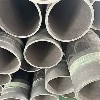
What the X52 Designation Actually Specifies
API 5L X52 is a line pipe grade whose specified minimum yield strength (SMYS) is 52,000 psi, written as 52 ksi and equal to 360 MPa. In the dual metric/imperial designation used by API Spec 5L and ISO 3183 the same grade is called L360, where the number is the minimum yield strength in megapascals. The minimum tensile strength is 460 MPa (66,700 psi). Both figures are specification floors for the pipe body, not a description of what a mill actually produces; a heat that tests at 400 MPa yield is fully compliant with PSL2 as long as it stays under the 530 MPa ceiling.
Three points are worth fixing before reading any further. First, SMYS is a design value that enters hoop stress calculations, while the tensile test result on the mill certificate is evidence that the pipe met the design value. Second, X52 is offered at two product specification levels, PSL1 and PSL2, and the two are not interchangeable in a pressure design or in a sour service review. Third, X52 pipe is ordered by outside diameter, wall thickness, product form (seamless, ERW, LSAW, SSAW), length, coating and supplementary requirements; the grade alone does not define the deliverable.
Chemical Composition Limits for X52
X52 is a low carbon, micro-alloyed steel. Strength comes from manganese in solid solution plus grain refinement by niobium, vanadium and titanium, which is why the grade can reach 360 MPa yield with carbon in the 0.08 to 0.16 percent range and still be welded in the field without preheat in most climates. PSL2 tightens both residuals and the alloying limits that control toughness.
| Element (max, %) | PSL1 seamless X52 | PSL2 seamless X52 | PSL2 welded X52 |
|---|---|---|---|
| Carbon | 0.28 | 0.24 | 0.22 |
| Manganese | 1.40 | 1.40 | 1.40 |
| Silicon | not specified | 0.45 | 0.45 |
| Phosphorus | 0.030 | 0.025 | 0.025 |
| Sulphur | 0.030 | 0.015 | 0.015 |
| Vanadium | 0.10 | 0.10 | 0.10 |
| Niobium | 0.05 | 0.05 | 0.05 |
| Titanium | 0.04 | 0.04 | 0.04 |
In PSL1 the sum of vanadium, niobium and titanium is restricted to 0.15 percent, which prevents the mill from stacking all three grain refiners at their individual limits. Manganese may be raised above 1.40 percent by agreement where the carbon equivalent is adjusted accordingly, a route used for heavy wall LSAW pipe where extra hardenability is needed to keep the seam and heat affected zone properties uniform.
PSL2 also caps carbon equivalent. Where carbon exceeds 0.12 percent the maximum is 0.43 by the IIW formula (CE = C + Mn/6 + (Cr + Mo + V)/5 + (Ni + Cu)/15). Where carbon is 0.12 percent or below the maximum is 0.25 by the Pcm formula, which is the route most modern X52 is designed to. The practical consequence for a purchaser is that a PSL2 X52 heat with 0.07 percent carbon and 1.55 percent manganese can still pass on Pcm while being harder to weld than a 0.14 percent carbon heat with 1.10 percent manganese at the same CE value, so the welding procedure should be qualified on the actual chemistry range the mill will supply.
Mechanical Properties: PSL1 Versus PSL2
PSL1 fixes only a lower bound. Once the pipe reaches 360 MPa yield and 460 MPa tensile it is acceptable, and there is no upper strength limit, no mandatory impact test and no yield-to-tensile ratio requirement. PSL2 adds a window: strength may not be too low or too high, the yield-to-tensile ratio is capped, and Charpy testing of the pipe body becomes mandatory.
| Property | X52 PSL1 | X52 PSL2 |
|---|---|---|
| Yield strength, min | 360 MPa (52,200 psi) | 360 MPa (52,200 psi) |
| Yield strength, max | not limited | 530 MPa (76,900 psi) |
| Tensile strength, min | 460 MPa (66,700 psi) | 460 MPa (66,700 psi) |
| Tensile strength, max | not limited | 760 MPa (110,200 psi) |
| Yield-to-tensile ratio, max | not specified | 0.93 |
| Elongation in 50 mm, min | calculated, see below | calculated, see below |
| Charpy pipe body | only if ordered | mandatory, 27 J average and 20 J single minimum on full size transverse specimens |
The minimum elongation is not a fixed number. API 5L uses a formula in which the required elongation in 50 mm equals 1940 times the applicable cross-sectional area raised to the power 0.2, divided by the specified minimum tensile strength raised to the power 0.9, with the area and strength expressed in square millimetres and megapascals. For a full section strip specimen of a 323.9 mm by 12.7 mm pipe the applied minimum works out in the low twenties of percent, and for a small round specimen it is higher because the formula compensates for the reduced gauge length. Quoting a single elongation figure such as 21 percent in a purchase order therefore conflicts with the standard, and the mill will apply the formula.
The upper limits in PSL2 exist for a reason that matters to a pipeline engineer. Excess yield strength in a 360 MPa grade usually means either a leaner chemistry with more pearlite or heavier cold sizing, both of which raise the yield-to-tensile ratio and reduce the strain capacity the pipe can offer before necking. A pipe at 520 MPa yield and 550 MPa tensile is compliant on both limits but has almost no plastic reserve, and a capped ratio of 0.93 keeps at least some margin for bending during installation and for ground movement in service.
Putting the 360 MPa Figure into a Pressure Calculation
The hoop stress equation used for line pipe is P = 2 S t F / D, where S is the specified minimum yield strength, t the nominal wall thickness, D the outside diameter and F the design factor chosen by the applicable pipeline code. Taking a 610 mm outside diameter pipe with 9.5 mm wall in X52 at a design factor of 0.72 gives a design pressure of 2 x 360 x 9.5 x 0.72 / 610, which equals about 8.1 MPa. Holding the pressure at 10 MPa at the same design factor requires a wall of 10 x 610 / (2 x 360 x 0.72), or about 11.8 mm, so 12.7 mm would be ordered.
The comparison with the next lower grades shows where the money is. The same 10 MPa duty in X42 at 290 MPa minimum yield needs 14.6 mm, rounding to 15.9 mm. Mass per metre is calculated as 0.02466 x t x (D - t) in kilograms per metre, which gives about 187 kg/m for the 12.7 mm X52 wall and about 233 kg/m for the 15.9 mm X42 wall. A 20 percent reduction in steel weight per metre, plus a proportional saving in welding, coating and handling, is the reason X52 replaced Grade B and X42 as the default for medium pressure transmission lines. The saving has a limit: going up to X60 at 414 MPa or X70 at 483 MPa buys another 1.8 mm and 0.7 mm of wall relief on this duty, but the extra cost of tighter chemistry, tougher qualification and lower toughness tolerance is rarely recovered below about 10 MPa design pressure.
What Determines the Yield Strength the Mill Actually Achieves
Reaching 360 MPa is easy; reaching it while keeping 27 J Charpy energy, a carbon equivalent under 0.43 and a yield-to-tensile ratio under 0.93 is the real constraint. Five production variables move the result.
Grain refinement. Niobium in the 0.02 to 0.05 percent range retards recrystallisation during hot rolling, so the final ferrite grain size can be held near ASTM grain size 9 to 11 in thermomechanically rolled strip and plate. Each step of grain refinement raises yield and lowers the ductile-to-brittle transition temperature at the same time, which is why micro-alloying rather than carbon is the preferred strengthening route.
Rolling and cooling practice. Thermomechanically controlled processing with accelerated cooling gives higher yield from the same chemistry than normalised rolling. X52 from a TMCP route can sit comfortably in the 400 to 480 MPa band on the parent coil while remaining inside the PSL2 ceiling; a normalised route tends to sit lower and with a wider scatter.
Cold sizing and expansion. Pipe is expanded or sized after welding to control ovality and diameter. Cold expansion by around 0.4 to 1.0 percent raises the yield strength measured in the transverse direction and lowers the compressive yield, an effect that must be removed before a pipe is qualified for strain based design. Purchasers who specify yield in the as-supplied condition are measuring a property that includes this work hardening.
Test direction and specimen type. Transverse specimens read lower than longitudinal ones on welded pipe because the weld and the forming direction do not align with the loading axis. Full section strip specimens read differently from round bar specimens because the strip includes the pipe surface, where residual stress and decarburisation sit. Both PSL1 and PSL2 allow the mill to use the specimen type the standard assigns to that diameter and product form, and a certificate that does not state direction and specimen type is incomplete evidence.
Strain ageing and temperature. Yield strength rises measurably after a few percent of cold strain plus ageing at 150 to 250 degrees Celsius, which is exactly what happens to pipe that is cold field bent and then coated at elevated temperature. Yield also falls with test temperature, so a pipe qualified at 20 degrees Celsius gives up roughly 5 to 10 percent of its yield strength at 100 degrees Celsius, a point to check whenever the design temperature exceeds ambient.
Verification at the Mill and What the Certificate Must Show
Tensile testing is performed once per test unit, which for PSL2 pipe is a defined number of lengths of the same grade, size and wall from the same heat and the same forming and heat treatment route, and additional tests are required when the heat treatment changes or the lot is long. If a tensile test fails, the standard allows a retest on two further specimens from the same lot, both of which must pass; if either fails, the lot may be individually tested and accepted length by length. Knowing this matters because a certificate showing a single result for a 900 tonne order tells you the test unit rule was applied, not that every length was tested.
For PSL2 welded pipe, non-destructive inspection of the weld seam is required to the methods and acceptance levels of API 5L Annex E, and the welded joint factor that enters a design calculation is only 1.00 where that inspection has been performed as specified. Hydrostatic testing to the pressure derived from the hoop stress table is required for PSL2 pipe, with the holding time defined by diameter, and the mill has the option of a non-destructive substitute only where the standard permits it and the purchaser accepts. Dimensional inspection covers outside diameter, wall thickness, out-of-roundness, straightness, length and square cut ends, with the tolerances tabulated by diameter and product form rather than being a single percentage.
The document package that supports the grade claim should include the mill test certificate with heat number, pipe or lot number, ladle and product analysis, tensile results with specimen orientation, Charpy results with test temperature and specimen size, hydrostatic test pressure and duration, NDT method and acceptance standard, and the marking record. Where a purchaser needs third party confidence, the useful controls are a witnessed heat analysis, a pre-shipment dimensional audit on a defined sample and a review of the toughness data as a distribution rather than a single value, since Charpy scatter of 20 J between lengths of the same heat is normal.
Choosing Product Form and Wall for X52 Service
Seamless pipe covers the small and medium diameter range economically and is the default for wellsite gathering, flowlines and high pressure laterals where the wall exceeds what a coil can carry. ERW pipe with an electric resistance or high frequency welded seam covers the mass market for diameters up to about 610 mm and walls up to around 16 mm, and its seam is subjected to a full body normalising or tempering pass in most modern mills to remove the as-welded hardness spike. LSAW pipe with one or two longitudinal seams is the standard choice from about 508 mm to 1420 mm for transmission mains, because plate allows heavier walls and better toughness control than coil at that size. SSAW spiral pipe is used for large diameters where the pressure duty is moderate and the economics favour a narrow coil input.
Whichever form is ordered, the grade is only held if the pipe body, the weld and the heat affected zone all satisfy the required properties. For X52 in ERW the usual failure mode is a soft or over-hardened seam; for LSAW it is a coarse grain region in the seam heat affected zone; for seamless it is scatter from the piercing and rolling temperature. A purchase specification that names X52 PSL2 with Annex E inspection, 27 J at the required temperature, a maximum yield-to-tensile ratio of 0.93 and a hardness survey across the seam addresses all three.
Where X52 Is the Right Answer and Where It Is Not
X52 is the mainstream grade for onshore oil and gas transmission up to roughly 10 MPa design pressure, for produced water and slurry lines where abrasion rather than pressure governs the wall, for station piping and manifolds, and for casing and structural piling where a 360 MPa yield tube is specified for its weldability. It is a poor choice where the design pressure forces a wall above about 25 mm, because toughness and through thickness properties become difficult and higher grades are more economical, and it is the wrong choice for sour service unless the pipe is ordered as PSL2 with the chemistry and hardness controls for H2S service under API 5L Annex H and evaluated to ISO 15156 / NACE MR0175. In sour service the hardness ceiling, not the yield strength, decides the grade, and a 360 MPa grade with a hard seam can fail the review that a softer Grade B would pass.
FAQ
Q: What is the yield strength of API 5L X52?
The specified minimum yield strength is 360 MPa, which is 52,200 psi or 52 ksi, and it is the origin of both the X52 and the L360 designations. For PSL2 pipe the yield strength must also not exceed 530 MPa.
Q: What is the difference between X52 PSL1 and X52 PSL2?
PSL1 sets only minimum values for yield and tensile strength and does not require impact testing. PSL2 adds a maximum yield of 530 MPa, a maximum tensile of 760 MPa, a yield-to-tensile ratio cap of 0.93, tighter phosphorus and sulphur limits, a carbon equivalent limit and mandatory Charpy testing of the pipe body.
Q: How is the minimum elongation of X52 pipe determined?
It is calculated from the formula 1940 x A^0.2 / U^0.9, where A is the applicable cross-sectional area of the tensile specimen in square millimetres and U is the specified minimum tensile strength in megapascals, giving a required elongation in 50 mm that depends on specimen size rather than being a single percentage.
Q: Is X52 stronger than X42 and X46?
Yes. Grade B is specified at 241 MPa minimum yield, X42 at 290 MPa, X46 at 317 MPa and X52 at 360 MPa, so X52 allows a thinner wall for the same design pressure or a higher pressure for the same wall.
Q: Can X52 pipe be used for sour service?
Only when it is ordered as PSL2 with the specific chemistry, hardness and testing requirements for H2S service under API 5L Annex H and qualified to ISO 15156 / NACE MR0175. The governing limit in sour service is usually a maximum hardness of 250 HV10 in the parent metal, weld and heat affected zone, not the yield strength.
Q: Why does the mill certificate sometimes show a yield strength well above 360 MPa?
Because 360 MPa is a minimum. Mills target a comfortable margin above it to survive retests, and cold expansion, accelerated cooling and grain refinement all push the achieved value upward. Anything from 360 MPa up to the 530 MPa PSL2 ceiling is compliant, which is why a purchaser who needs predictable strain capacity should also specify the yield-to-tensile ratio and an upper yield limit.