




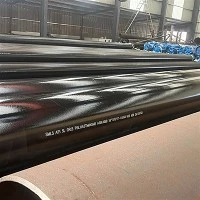
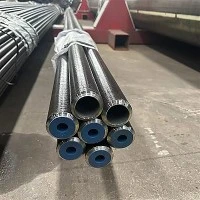


API 5L X52 Steel Line Pipe With Fusion Bond Epoxy And Abrasion Resistant Overcoating Carbon Steel Pipe
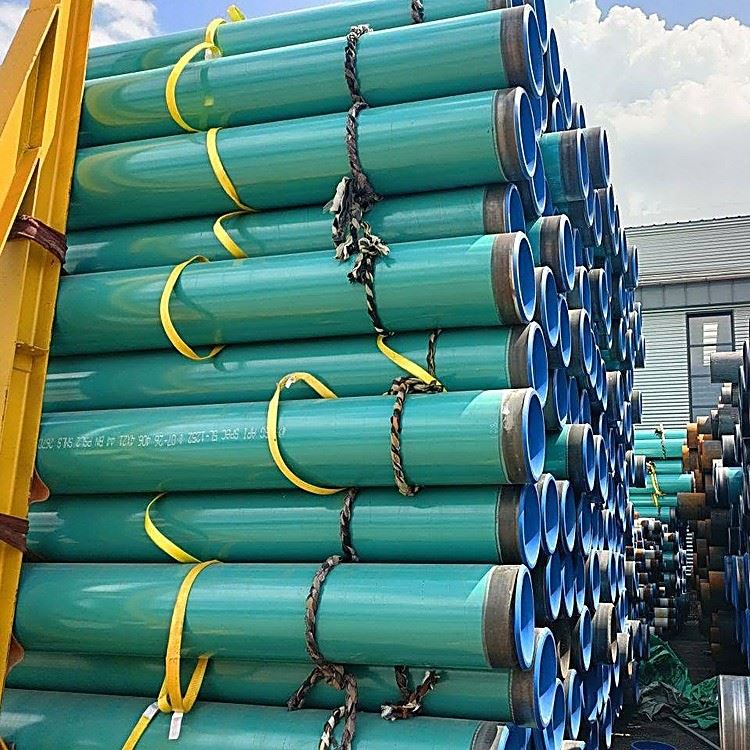
API 5L X52 Steel Line Pipe With Fusion Bond Epoxy And Abrasion Resistant Overcoating Carbon Steel Pipe suppliers

API 5L X52 Steel Line Pipe With Fusion Bond Epoxy And Abrasion Resistant Overcoating Carbon Steel Pipe factory
API 5L X52 Steel Line Pipe With Fusion Bond Epoxy And Abrasion Resistant Overcoating Carbon Steel Pipe
Grade: X52 (L360)
External: FBE + ARO
System: Dual-layer epoxy
Coating std: AWWA C213 / API RP 5L9 / ISO 21809-2
Key use: HDD / trenchless
API 5L X52 steel line pipe with fusion-bonded epoxy (FBE) and an abrasion-resistant overcoat (ARO) pairs a Grade X52 (L360) carbon steel line pipe with a dual-layer FBE + ARO external coating. The FBE primer chemically bonds to the steel and forms the corrosion barrier; the ARO is a harder, modified epoxy laid over it that absorbs the scraping, gouging and impact of installation. This combination is the standard answer for horizontal directional drilling (HDD), microtunnelling, auger boring, pipe jacking and rocky or abrasive backfill, where the pipe is dragged through a borehole under tension and a plain thin coating would be destroyed before it reaches service. This page covers the coating-and-grade product: the FBE + ARO system, the standards that govern it, thickness grading, the temperature envelope, testing, the X52 base pipe and how to order it.
Why FBE + ARO on X52 for trenchless work: X52 (360 MPa minimum yield) is the mid-grade workhorse of transmission and gathering lines - strong enough for the pressure, economical on steel. On a directional-drilled or rocky crossing the dominant risk is not long-term soil corrosion but the mechanical punishment of the pull-through: shear, abrasion, impact and gouge (SAIG). FBE + ARO puts a tough sacrificial shield over a chemically bonded anti-corrosion layer, so the pipe arrives in service condition rather than as a recoat candidate. The coating is also thinner and higher-temperature-rated than 3LPE, which matters for some industrial and hot-gathering lines.
Specification - API 5L X52 base pipe
The base pipe is API 5L / ISO 3183 Grade X52 (ISO 3183 name L360), supplied seamless or welded and to PSL1 or PSL2. PSL2 is normal for high-consequence lines because it adds mandatory impact testing and full-length body volumetric NDE.
Grade X52 chemistry (PSL2, seamless, max unless noted)
| Element | Grade X52 (L360), PSL2 |
|---|---|
| Carbon (C) | 0.24 (seamless route) |
| Manganese (Mn) | 1.40 |
| Phosphorus (P) | 0.025 |
| Sulfur (S) | 0.015 |
| Silicon (Si) | 0.45 |
| Nb + V + Ti (sum) | 0.15 |
| Carbon equivalent (CEIIW) | 0.43 max (tighter for sour service) |
Grade X52 mechanical properties (PSL2)
| Property | Requirement |
|---|---|
| Yield strength | 360 MPa (52 ksi) min, 530 MPa (76.9 ksi) max |
| Tensile strength | 460 MPa (66.7 ksi) min, 760 MPa (110 ksi) max |
| Yield-to-tensile ratio | 0.93 max |
| Charpy V-notch impact | mandatory under PSL2; temperature and energy agreed in the order |
| Body NDE (seamless) | full-length volumetric UT of the pipe body per the specification |
The seamless carbon limit for X52 is 0.24; welded variants (X52M) and sour-service agreements can impose lower carbon and carbon-equivalent limits. Confirm the invoked API 5L / ISO 3183 edition and any project-specific element or CE ceiling.
Dimensions and weight (selected SCH 40 sizes)
| NPS | OD (mm) | Wall (mm) | Mass (kg/m) |
|---|---|---|---|
| NPS 2 | 60.3 | 3.91 | 5.44 |
| NPS 3 | 88.9 | 5.49 | 11.29 |
| NPS 4 | 114.3 | 6.02 | 16.08 |
| NPS 6 | 168.3 | 7.11 | 28.26 |
| NPS 8 | 219.1 | 8.18 | 42.55 |
| NPS 10 | 273.1 | 9.27 | 60.31 |
| NPS 12 | 323.9 | 10.31 | 79.73 |
| NPS 16 | 406.4 | 12.70 | 123.31 |
| NPS 20 | 508.0 | 14.27 | 173.75 |
| NPS 24 | 609.6 | 17.48 | 255.25 |
Theoretical mass uses W = 0.0246615 x (OD - t) x t kg/m and is for the steel only; the FBE + ARO system adds a small, thickness-dependent mass. Other diameters, walls and NPS/schedule equivalents are available; state the required outside diameter and wall or the NPS and schedule on the order.
Two-layer FBE + ARO system
FBE + ARO is a thermoset system: both layers are epoxy powders fused to the steel and to each other, not loose films. The primer does the corrosion work; the overcoat does the mechanical work.
| Layer | Material | Typical total thickness | Function |
|---|---|---|---|
| 1 - Primer | Fusion-bonded epoxy (FBE) powder | ~300 to 600 µm single; ~400 to 600 µm as primer | Chemically bonds to steel; primary corrosion barrier; CP-compatible |
| 2 - Overcoat | Modified abrasion-resistant epoxy (ARO) | ~250 to 400 µm; heavy HDD ≥800 µm total system | Sacrificial mechanical shield against shear, abrasion, impact, gouge |
The total finished system is typically about 350 to 1000 µm. The ARO is the layer that earns its keep during HDD and rocky backfill; a specification that squeezes the overcoat to save cost is trading installation survival for a few micrometres.
Why ARO: trenchless and rocky installation (SAIG)
Pullback is the single most damaging event a pipeline coating sees. The pipe is pulled through a reamed borehole in continuous contact with abrasive cuttings and borehole wall material, under tension and bending, with no inspection during the pull and no easy access for repair afterwards. Four forces act on the coating:
| Force | What causes it | What the ARO does |
|---|---|---|
| Shear | bending through entry/exit curves, pipe curvature in the bore | keeps the bonded system intact under flexure |
| Abrasion | dragging against cuttings-laden drilling fluid and bore wall | sacrificial layer wears instead of the FBE primer |
| Impact | rocks and debris striking the coating | hard topcoat absorbs point loads |
| Gouge | sharp objects cutting into the coating during pullback | shields the corrosion barrier from deep cuts |
Plant-applied FBE + ARO (also described as dual-layer FBE) is the field-proven choice for this service. Field-applied abrasion wraps are used additionally over joints and mainline where the project calls for extra mechanical protection during pullback. For lines where thick polyolefin mechanical protection is also wanted and the temperature envelope allows, 3LPE or 3LPP is the alternative.
Governing standards
The FBE and FBE + ARO system is described by several equivalent specifications; the project states the one it wants. The line pipe is ordered separately to API 5L / ISO 3183.
| Standard | Region / role | Scope |
|---|---|---|
| ISO 21809-2 | International; petroleum & natural gas | FBE coatings, single and dual layer (incl. FBE + ARO) |
| AWWA C213 | International (water) | Fusion-bonded epoxy for steel water pipe and fittings |
| API RP 5L9 | USA; oil & gas line pipe | External FBE coating of line pipe - application & test |
| CSA Z245.20 | Canada | FBE coating for steel pipe |
| SY/T 0315 / GB/T 23257 | China | External FBE / polyolefin coatings for buried steel pipelines |
| AS 3862 | Australia | External FBE coating of steel pipes |
Thickness grading and minimum by duty
Under ISO 21809-2 the FBE duty classes are Class A (normal, roughly 300 to 500 µm) and Class B (enhanced, roughly 450 to 700 µm); FBE + ARO for HDD is usually specified to the enhanced or a project-defined heavy class because the overcoat is what survives the pull-through. The values below are typical references, not a substitute for the invoked edition.
| Configuration | Typical total thickness | Typical use |
|---|---|---|
| Single FBE (Class A) | 300 to 500 µm | general buried service |
| Single FBE (Class B) | 450 to 700 µm | enhanced buried service |
| FBE + ARO (dual layer) | 350 to 1000 µm | HDD, trenchless, rocky backfill |
| Heavy-duty HDD FBE + ARO | ≥800 µm total | long or rocky pullbacks |
Confirm the exact minima against the invoked standard edition and the project's specified duty class; the overcoat thickness is the variable that protects the primer during pull-through.
Temperature envelope and comparison with 3LPE
Standard FBE runs to about 95 to 100°C continuous, and high-temperature FBE variants to about 110°C; this is higher than standard 3LPE (about 80 to 85°C). For lines above about 110°C, 3LPP or high-temperature FBE is used.
| System | Continuous temperature | Outer layer | Primary mechanical role |
|---|---|---|---|
| FBE + ARO | ~95 to 110°C | Abrasion-resistant epoxy | thin-film corrosion + abrasion shield (HDD) |
| 3LPE | about -40 to 85°C | Polyethylene | thick mechanical + moisture barrier |
| 3LPP | up to ~140°C | Polypropylene | high-temperature mechanical barrier |
Performance and test requirements
The system is qualified and production is controlled against the invoked standard. The values below are typical for FBE / FBE + ARO and confirmed by coupon testing.
| Property | Typical requirement | Test basis |
|---|---|---|
| Cathodic disbondment | ≤8 mm radius (65°C / 48 h, or lower temp / longer period) | ISO 21809-2 / API RP 5L9 |
| Adhesion | ≥10 N/cm (pull-off or knife test) | ISO 21809-2 / AWWA C213 |
| Impact resistance | ~3 J/mm at 23°C (hard but brittle; ARO raises field toughness) | ISO 21809-2 |
| Abrasion resistance (ARO) | verified by Taber / falling-sand (ASTM G65) per project | ASTM G65 / project method |
| Continuity (holiday) | no discharges; high-voltage spark test (e.g. ~5 V/µm) | AWWA C213 / ISO 21809-2 |
The cathodic-disbondment and adhesion tests reveal whether the FBE is bonded; the abrasion test reveals whether the ARO will survive the pull. State the test temperature, the acceptance and the ARO abrasion method in the order.
Mill application process
FBE + ARO is applied on a continuous coating line. The sequence is what gives the two layers their bond.
Surface preparation. The pipe is abrasive-blast cleaned to Sa 2½ per ISO 8501-1 with an anchor profile of about Rz 40 to 100 µm; the steel is kept at least about 3°C above the dew point before blasting.
Preheat and FBE primer. The pipe is heated (commonly about 200 to 250°C) and the FBE powder is electrostatically sprayed, where it melts and chemically bonds to the steel.
Abrasion-resistant overcoat. The modified epoxy ARO is applied immediately over the still-warm primer so the two fuse into one system.
Cooling and cutback. The coated pipe is quenched to set the epoxy, then the ends are stripped to a bare cutback for field welding.
Inspection. Holiday detection, thickness measurement and visual check follow before marking and packing.
Inspection, repair and cutback
Production control and field readiness are defined by the coating specification:
100% holiday detection with a high-voltage spark tester on every length.
Thickness readings at multiple positions per pipe, reported against the duty class.
System qualification coupons tested for adhesion and cathodic disbondment; abrasion and impact verified on the system.
Cutback to a bare end for the field girth weld - commonly about 100 to 150 mm per end, set by the project.
Field repair of small defects with a compatible material, within size and frequency limits, with the repair re-tested for continuity.
HDD mechanical protection - additional field-applied abrasion wrap over joints and mainline where specified for the pullback.
Ordering the coating items
A coating purchase order line states the base pipe and the coating scope separately. For the base pipe: API 5L / ISO 3183, Grade X52 (L360), PSL1 or PSL2, seamless or welded, outside diameter and wall or NPS and schedule, length basis, end condition and quantity. For the coating: standard (AWWA C213, API RP 5L9 or ISO 21809-2), single FBE or FBE + ARO, duty class, total and primer/overcoat thickness, colour, cutback length, holiday-test voltage, adhesion and cathodic-disbondment test plan, ARO abrasion method, and whether field-joint and HDD mechanical protection are required. Also state the certificate (EN 10204 3.1; 3.2 with SGS / BV / DNV / TUV or other TPI on request).
test and inspection


Send your requirement as two parts - the base pipe (API 5L / ISO 3183 Grade X52, PSL1 or PSL2, seamless or welded, outside diameter and wall or NPS and schedule, length basis, ends, quantity, EN 10204 3.1 / 3.2) and the coating scope (standard, single FBE or FBE + ARO, duty class, total and primer/overcoat thickness, colour, cutback, holiday voltage, adhesion and cathodic-disbondment test plan, ARO abrasion method, and whether field-joint and HDD mechanical protection are needed). We will return a quote covering steel, coating class and the test file, with lead time against the specific enquiry.
FAQ
What is fusion-bonded epoxy with an abrasion-resistant overcoat (FBE + ARO), and how does the two-layer system protect line pipe?
FBE + ARO is a thin-film, thermoset external coating built from two fused epoxy layers. The first layer is a fusion-bonded epoxy (FBE) primer - epoxy powder electrostatically sprayed onto heated, grit-blasted steel where it melts and chemically bonds, forming the primary corrosion barrier and the cathodic-protection-compatible bond. The second layer is an abrasion-resistant overcoat (ARO): a modified, harder epoxy applied immediately over the still-warm primer so the two fuse into one bonded system. The ARO is the mechanical shield; the FBE underneath stays the chemically bonded anti-corrosion layer. Together they give a tough, thin (typically 350 to 1000 micrometres total) coating that resists both corrosion and the gouging, scraping and impact of installation, which a single FBE layer alone does not.
Why is a single FBE layer usually not enough for HDD, directional drilling or rocky pullback, and what does the ARO add?
During horizontal directional drilling (HDD), microtunnelling, auger boring or pipe jacking the pipe is dragged through a reamed borehole in continuous contact with abrasive cuttings and borehole wall material, sometimes for hundreds or thousands of feet, under tension and bending. The coating sees four forces - shear, abrasion, impact and gouge, often called SAIG - that a standard thin FBE layer is not built to survive. The ARO is the sacrificial mechanical layer that absorbs that wear so the underlying FBE stays intact; if the ARO is stripped during pullback the corrosion coating beneath it is gone and the line enters service with a hidden repair. Plant-applied FBE + ARO (or dual-layer FBE) is the widely used, field-proven answer for trenchless and rocky-backfill service; 3LPE or 3LPP are the alternative where the project also needs thick polyolefin mechanical protection and the temperature envelope allows it.
What standards govern external FBE and FBE + ARO coating on API 5L line pipe?
The external FBE and dual-layer (FBE + ARO) system is governed by several equivalent specifications, and a project simply states the one it wants and the edition. The main ones are ISO 21809-2 (petroleum and natural gas industries - external fusion-bonded epoxy coatings, single and dual layer), AWWA C213 (fusion-bonded epoxy coatings for steel water pipe and fittings, relevant for potable-water lines), API RP 5L9 (external fusion-bonded epoxy coating of line pipe, the API recommended practice for oil and gas transmission), and CSA Z245.20 (Canada). National equivalents include SY/T 0315 and GB/T 23257 in China and AS 3862 in Australia. The coating house applies and tests to the invoked document; the line pipe itself is ordered to API 5L / ISO 3183.
How thick is FBE + ARO coating, and how is thickness graded for HDD versus normal buried service?
Thickness depends on duty. A single FBE layer is typically about 300 to 600 micrometres, while an FBE + ARO (dual-layer) system runs about 350 to 1000 micrometres total - for example a roughly 400 to 600 micrometre primer plus a roughly 250 to 400 micrometre abrasion overcoat, with heavy-duty HDD systems commonly specified at 800 micrometres or more. Under ISO 21809-2 the FBE duty classes are Class A (normal, roughly 300 to 500 micrometres) and Class B (enhanced, roughly 450 to 700 micrometres), and FBE + ARO for HDD is usually specified to the enhanced or project-defined heavy class because the overcoat is what survives the pull-through. The exact minima are set by the invoked standard edition and the project's duty class, not by the grade.
What continuous temperature can FBE + ARO withstand, and how does it compare with 3LPE for hot or high-temperature lines?
Standard FBE is rated for continuous buried service up to about 95 to 100 degC, and high-temperature FBE variants reach about 110 degC continuous; by contrast standard 3LPE is limited to about 80 to 85 degC continuous before the copolymer adhesive softens. That temperature headroom is why FBE-based systems are preferred for hot-crude gathering, geothermal and some industrial lines, and why FBE + ARO is specified where both abrasion resistance and higher temperature are needed. 3LPP (polypropylene) still wins above about 110 degC. The choice is made from the pipe-wall temperature and the soil/backfill chemistry, and stated in the coating specification rather than left to the installer.
How is FBE + ARO tested before shipment - holiday detection, adhesion, cathodic disbondment and abrasion?
Every coated length gets 100 percent holiday (continuity) detection with a high-voltage spark tester so no pinhole passes. Coating thickness is measured at multiple positions per pipe. The system qualification verifies adhesion (pull-off or knife test, commonly 10 N/cm or more), cathodic disbondment (FBE is strong here - commonly 8 mm radius maximum at 65 degC over 48 hours, or lower radii at lower temperature over longer periods, per the invoked standard), impact resistance and bend. Because the ARO exists for abrasion, the abrasion resistance of the topcoat is verified too - by Taber abrasion, falling-sand (ASTM G65) or similar methods according to the project. Results are recorded on the coating inspection certificate, and the acceptance values are those of the invoked standard edition plus any project add-ons.
Can FBE + ARO be repaired after handling damage, and what are the field-joint and cutback requirements?
Yes - small defects found at the holiday test or during handling are field-repairable with a compatible FBE or liquid-epoxy repair material within defined limits (size and frequency caps set by the invoked standard and the project), and the repair is re-tested for holiday continuity. Larger or more frequent damage is re-coated at the plant or cut out. At each girth weld a bare cutback (commonly about 100 to 150 millimetres per end) is left so the field welder joins on clean steel; after welding, the exposed band and the heat-affected coating edge are protected by a field-applied joint coating chosen to be compatible with the mill FBE + ARO. For HDD, additional mechanical protection such as a field-applied abrasion wrap may be specified over the joints and the mainline during pullback.
What base pipe does X52 FBE + ARO line pipe use, and what should the purchase order specify?
The base pipe is API 5L / ISO 3183 Grade X52 (ISO 3183 name L360, 360 MPa minimum yield), supplied by the seamless or welded route and to PSL1 or PSL2 as the project requires; PSL2 is normal for high-consequence lines because it adds mandatory impact testing and full-length body volumetric NDE. A complete order states the base pipe (API 5L / ISO 3183, Grade X52, PSL level, seamless or welded, outside diameter and wall or NPS and schedule, length basis, ends, quantity, EN 10204 3.1 or 3.2) and the coating scope separately (standard - AWWA C213, API RP 5L9 or ISO 21809-2 - single FBE or FBE + ARO, duty class, total and primer/overcoat thickness, colour, cutback length, holiday-test voltage, the adhesion and cathodic-disbondment test plan, and whether field-joint and HDD mechanical protection are required).
Hot Tags: api 5l x52 steel line pipe with fusion bond epoxy and abrasion resistant overcoating carbon steel pipe, China api 5l x52 steel line pipe with fusion bond epoxy and abrasion resistant overcoating carbon steel pipe manufacturers, suppliers, factory, api 5l line pipe for long distance transmission, api 5l line pipe for variable pressure applications, api 5l line pipe for vibration control equipment, api 5l pipe for butt weld pipes, api 5l pipe for energy efficient equipment, api 5l pipe for flange pipes
You Might Also Like


Send Inquiry