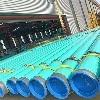
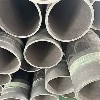
What Is a 3PE Steel Sheathed Insulation Steel Pipe?
A 3PE steel sheathed insulation steel pipe is a prefabricated insulated pipe assembly built from three concentric elements: an inner working steel pipe that carries the medium, a thermal insulation layer around it, and an outer protective steel jacket that has been given a three-layer polyethylene anti-corrosion coating. Because the outer jacket is steel rather than polyethylene, the assembly can carry much higher mechanical loads than a plastic-jacketed insulation pipe and is far more resistant to damage during backfilling and to the load of overlying soil, road traffic or structures.
It is the standard construction for directly buried steam lines and for high-temperature hot water and process lines where strength, watertightness and long service life matter more than the lowest possible material cost.
Structure of the Pipe Assembly
| Element | Material | Function |
|---|---|---|
| Working pipe | Seamless or welded carbon steel pipe, or stainless steel where the medium requires it | Carries the steam, hot water or process medium and resists the internal pressure and temperature |
| Insulation layer | Rigid polyurethane foam for lower temperatures, inorganic insulation for high temperature service | Limits heat loss and keeps the outer jacket surface temperature low |
| Outer jacket | Steel pipe with a three-layer polyethylene external anti-corrosion coating | Mechanical protection, watertight enclosure and corrosion resistance against the soil environment |
| Centring spacers and end seals | Non-metallic spacers and sealed end closures | Keep the working pipe concentric and prevent groundwater ingress at the ends |
Insulation Materials and Temperature Limits
Rigid polyurethane foam is the most widely used insulation material for directly buried pipe because of its low thermal conductivity and good compressive strength. Its practical service range is roughly minus 185 degrees Celsius to 120 degrees Celsius, which covers chilled water, district heating supply and return, and most hot process lines. The foam has limited mechanical strength on its own, so it is confined between the working pipe and the jacket, and a high-density layer is formed at the outer surface to resist groundwater penetration.
Above the polyurethane limit, the insulation has to change. Steel sheathed composite insulated pipe is suitable for transporting steam or other media at temperatures below 350 degrees Celsius, using inorganic insulation such as mineral wool, calcium silicate or aerogel in place of the foam. Confusing the two constructions is a common specification error: polyurethane foam will not survive a 300 degree Celsius steam service, and a foam-filled assembly quoted for such duty should always be questioned.
3PE Corrosion Protection for the Outer Jacket
The outer steel jacket is itself a buried steel structure and must be protected exactly like a pipeline. A three-layer polyethylene coating is applied to its outer surface: fusion-bonded epoxy primer, copolymer adhesive and extruded polyethylene jacket. The jacket is protected at the ends by sealed closures and, where the assembly is welded to the next section, by a field joint coating that restores the anti-corrosion layer over the weld. Because the outer jacket also carries the soil load, the coating class is usually chosen from the reinforced range for sections under roads, railways or deep burial.
Production Process
Shot blasting and rust removal of the working pipe and of the outer jacket pipe
Application of the three-layer polyethylene coating to the outer surface of the jacket pipe
Corona treatment of the inner surface of the jacket and blasting of the working pipe surface to improve foam adhesion
Assembly of the working pipe inside the coated jacket with centring spacers
High-pressure injection and expansion of the polyurethane foam between working pipe and jacket
End sealing to prevent moisture ingress, followed by inspection of coating continuity and insulation dimensions
Installation and Applications
The assemblies are welded end to end in the trench, after which each field joint is insulated and sealed with a poured foam or prefabricated sleeve system and the outer jacket joint is re-coated. The system is used for directly buried district heating and cooling networks, steam and condensate return lines, oil gathering and transportation lines that must be kept above the wax appearance temperature, buried hot water and process pipe in chemical and power plants, and any buried line where heat loss, temperature maintenance or protection from frost is the design driver.
Inspection and Selection Points
Confirm the working pipe specification and grade, the insulation material and its temperature rating against the actual medium temperature, the foam density and compressive strength, the jacket wall thickness and coating thickness, and the sealing arrangement at the ends and at field joints. On the finished assembly check concentricity, the absence of voids or unbonded areas in the foam, coating continuity over the jacket, and the dimensions of the end cut-back that the field joint will use. The relevant references are the prefabricated directly buried insulation pipe standards such as GB/T 29047 and the district heating pipe standards such as EN 253, together with the polyethylene coating standards ISO 21809-1, DIN 30670 and GB/T 23257 for the jacket coating.
FAQ
Q: What is the difference between a steel sheathed and a plastic jacketed insulation pipe?
A steel sheathed pipe uses a coated steel outer jacket and can carry heavy soil, road and structural loads without deforming. A plastic jacketed pipe uses a high-density polyethylene outer casing, which is lighter and cheaper but much more easily damaged and limited in the load it can carry.
Q: What temperature can a polyurethane insulated pipe carry?
Rigid polyurethane foam is used across roughly minus 185 degrees Celsius to 120 degrees Celsius. Above that range the foam degrades, and an inorganic insulation such as mineral wool, calcium silicate or aerogel must be used instead.
Q: Why does the outer jacket need a 3PE coating?
Because the jacket is a buried steel pipe and would otherwise corrode in the soil. The three-layer polyethylene coating gives it the same external corrosion protection as a coated pipeline, and the coating class is usually reinforced where the assembly passes under roads or is deeply buried.
Q: How are the joints between insulated pipe sections sealed?
After the working pipe is welded and tested, the joint is insulated with poured foam or a prefabricated insulation sleeve, and the outer jacket is closed with a welded sleeve that is then coated with a compatible field joint system so the coating is continuous over the whole line.
Q: Is the working pipe always carbon steel?
No. Carbon steel is the usual choice, but the working pipe can also be stainless steel or another alloy where the medium is corrosive, where a clean and non-contaminating bore is required, or where the temperature and pressure duty exceeds what carbon steel would serve reliably.
Q: What causes failure in buried insulated pipe?
The most common cause is water ingress. Groundwater entering through a damaged jacket, an open end or a poorly sealed field joint destroys the insulation value and then corrodes the working pipe from the outside. A watertight jacket, sealed ends and correctly executed field joints are therefore the key durability measures.
Q: Can insulated pipe be installed above ground?
Yes, but the outer jacket coating and the weather exposure have to be considered. Above-ground sections normally require a UV-resistant finish or a protective cladding over the jacket coating, since polyethylene coatings are formulated for burial rather than for long-term direct sunlight.