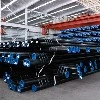
API 5CT Casing and Tubing: An Engineering Overview
API 5CT is the international standard that governs casing, tubing and pup joints for oil and gas wells, covering the full range of steel grades from H40 to Q125. It defines chemical composition, mechanical requirements, manufacturing routes, heat treatment, connections, end finishes and the testing battery that every joint must pass before it is shipped to the wellsite.
Scope of the Standard
The standard covers products in four groups: casing (C), tubing (T), pup joints and accessories such as couplings. Equivalent specifications include ISO 11960 and GB/T 19830, which are technically aligned with API 5CT. Grades are selected according to well depth, pressure, temperature and the corrosivity of produced fluids.
Grade System and Mechanical Requirements
| Grade | Yield Strength Range | Tensile Strength (min) |
|---|---|---|
| H40 | 40 – 80 ksi (276 – 552 MPa) | 60 ksi (414 MPa) |
| J55 / K55 | 55 – 80 ksi (379 – 552 MPa) | 75 ksi (517 MPa) / 95 ksi (655 MPa) |
| N80-1 / N80-Q | 80 – 110 ksi (552 – 758 MPa) | 100 ksi (689 MPa) |
| L80-1 | 80 – 95 ksi (552 – 655 MPa) | 95 ksi (655 MPa) |
| C90 | 90 – 105 ksi (621 – 724 MPa) | 100 ksi (689 MPa) |
| T95 | 95 – 110 ksi (655 – 758 MPa) | 105 ksi (724 MPa) |
| P110 | 110 – 140 ksi (758 – 965 MPa) | 125 ksi (862 MPa) |
| Q125 | 125 – 150 ksi (862 – 1034 MPa) | 135 ksi (931 MPa) |
Manufacturing and Heat Treatment
OCTG products are manufactured by seamless or electric resistance welded (ERW) processes. The required microstructure depends on grade: N80-1 is typically normalized, while N80-Q, L80, C90, T95, P110 and Q125 are quenched and tempered to achieve their higher strength and toughness. Heat treatment is verified by hardness and tensile testing of every heat.
End Finishes and Connections
End conditions are described as P (plain end), N (non-upset), U (external upset) and T&C (threaded and coupled) for tubing, and P, S (short round thread) or L (long round thread) for casing. Threaded connections include STC, LTC and BTC, with premium gas-tight connections available for high-pressure service. Thread protectors safeguard the connections during transport and handling.
Testing and Inspection
Every joint is subject to a comprehensive verification program:
Chemical analysis of each heat
Mechanical testing: tensile, yield strength, elongation and hardness
Technical tests: flattening, flaring, bending and impact tests as applicable
Non-destructive examination: ultrasonic and eddy current inspection of the body and weld zone
Hydrostatic testing of every joint at the specified test pressure
Dimensional inspection of diameter, wall thickness, length and thread geometry
FAQs
What does API 5CT cover?
API 5CT covers casing, tubing, pup joints and accessories for oil and gas wells, from grade H40 to Q125.
What is the difference between casing and tubing?
Casing lines the wellbore and isolates formations; tubing runs inside the casing to carry produced fluids to the surface.
Which grades require quenching and tempering?
Higher strength grades such as N80-Q, L80, C90, T95, P110 and Q125 are quenched and tempered; N80-1 may be normalized.
What connections are used on casing?
Common casing connections are STC (short round), LTC (long round) and BTC (buttress), with premium connections for gas-tight service.
How is OCTG pipe tested?
Testing includes chemical analysis, tensile and hardness testing, flattening and flaring, non-destructive examination, and hydrostatic testing of every joint.
What standards are equivalent to API 5CT?
ISO 11960 and GB/T 19830 are technically equivalent specifications for casing and tubing.