




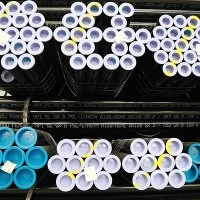
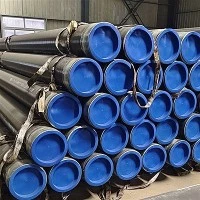


API 5L Steel Pipes For Natural Gas Distribution Work
API 5L steel pipe for natural gas distribution is the carbon-steel line pipe that carries treated gas from the city gate or regulator station to homes, businesses and industry. The duty is different from long-distance transmission: a natural gas distribution pipe works at low to medium pressure, follows a branched network, and is usually a smaller diameter than a trunkline. For this work the dominant choices are API 5L Grade B line pipe and API 5L Gr B seamless pipe for the smaller, higher-integrity sections, with X42 where the main is larger or sees higher medium pressure. Because most of the network is buried, the pipe is paired with an external coating (commonly a 3LPE coated steel pipe system or single-layer FBE) and a cathodic-protection system. This page is written for pipeline engineers, EPC contractors, utility buyers and distributors who need the grade data, the coating logic and the sizing rules in one place.
API 5L gas pipe specifications - at a glance
The table below is the quick reference a buyer or estimator needs when scoping API 5L gas pipe specifications for a distribution project. Always confirm the exact limits against the latest edition of API 5L / ISO 3183 and the project specification.
| Parameter | Typical value for distribution pipe |
|---|---|
| Standard | API Spec 5L / ISO 3183 (China: GB/T 9711) |
| Common grades | Grade B (L245); X42 (L290) for larger mains |
| Product level | PSL1 normal; PSL2 for crossings / stations |
| Pipe types | Seamless (SMLS) and welded (ERW / LSAW / SSAW) |
| Outside diameter | NPS 2 – 12 typical (60 – 323.9 mm OD) |
| Wall thickness | SCH 10 / 20 / 40 / STD / XS, or per design |
| Length | 6 m / 12 m, or SRL / DRL random |
| Ends | Plain, beveled, or threaded & coupled |
| External protection | 3LPE (DIN 30670 / ISO 21809-1) or FBE, plus cathodic protection |
| Service pressure | Low to medium pressure (distribution class) |
| Certificates | EN 10204 3.1 / 3.2 mill test certificate |
Distribution vs transmission: why the grade and size differ
A city gas pipeline is the final, branched stage of the gas system. Understanding how it differs from transmission helps explain why Grade B and modest diameters dominate distribution work.
| Aspect | Distribution pipeline | Transmission pipeline |
|---|---|---|
| Role | Delivers gas to end users from the city gate / regulator | Moves gas between regions and cities |
| Network shape | Branched (dendritic) | Linear, long-haul |
| Typical pressure | Low to medium (roughly up to 0.4 MPa for steel mains) | High (commonly 2.7–9.9 MPa) |
| Typical diameter | NPS 2–12 for steel; smaller for services | NPS 12–42 and above |
| Typical API 5L grade | Grade B (L245), X42 (L290) | X52–X80 |
| Common corrosion system | 3LPE / FBE + cathodic protection | 3LPE / 3LPP + cathodic protection |
The pressure and diameter figures are typical industry ranges used to describe the two pipeline classes; the actual limits for a project are set by the local gas code and the design basis, not by API 5L alone.
API 5L grades used for gas distribution
For distribution the grade is chosen for weldability and economy at low-to-medium pressure, not for maximum strength. API 5L Grade B line pipe (L245) is the baseline; API 5L Gr B seamless pipe is specified where the section must be free of a longitudinal weld (crossings, regulator stations, service tees). X42 (L290) is the step up for larger or higher-pressure mains.
| Grade | Yield min (MPa) | Tensile (MPa) | Typical distribution use |
|---|---|---|---|
| Grade B / L245 (PSL1) | 245 | 415 | Default for low/medium-pressure mains and services |
| Grade B / L245 (PSL2) | 245 – 450 | 415 – 760 | Where impact testing / traceability is required |
| X42 / L290 (PSL2) | 290 – 440 | 415 – 655 | Larger or higher medium-pressure mains |
Grade B keeps a low carbon-equivalent ceiling and is readily welded with conventional SMAW / GMAW procedures, which is why utilities and distributors stock it for steel pipe for gas distribution network work. The yield-to-tensile ratio and impact requirements become mandatory only at PSL2.
PSL1 vs PSL2 for distribution pipe
Whether to order API 5L PSL1 pipe or PSL2 is a recurring distribution question. PSL1 is the economical baseline; PSL2 adds the verification that critical or regulated sections often demand.
| Feature | PSL1 | PSL2 |
|---|---|---|
| Chemistry control | Standard ranges | Tighter P/S limits (P ≤ 0.025 %, S ≤ 0.015 %), CE controlled |
| Charpy impact test | Not required | Mandatory at agreed temperature |
| Maximum yield | Not capped | Capped (e.g. 450 MPa for Grade B) |
| Non-destructive exam | Standard mill test | 100% body UT and full traceability |
| Typical distribution use | General low-risk mains and services | Crossings, stations, stricter utility specs |
Confirm PSL1 or PSL2 on the purchase order. If the enquiry is silent, the supplier will normally quote PSL1, which may not satisfy a utility specification that requires PSL2 verification.
Natural gas pipe size chart - distribution sizes and walls
This natural gas pipe size chart lists the outside diameters and common SCH 40 / SCH 80 walls for the NPS sizes most used in distribution mains. The values follow ASME B36.10M; for a real main the wall is selected from the MAOP, location class and code, then checked against the local minimum-wall rule.
| NPS | OD (mm) | SCH 40 wall (mm) | SCH 80 wall (mm) |
|---|---|---|---|
| 2 | 60.3 | 3.91 | 5.16 |
| 3 | 88.9 | 5.49 | 7.11 |
| 4 | 114.3 | 6.02 | 8.56 |
| 6 | 168.3 | 7.11 | 10.97 |
| 8 | 219.1 | 8.18 | 12.70 |
| 10 | 273.0 | 9.27 | 12.70 |
| 12 | 323.9 | 10.31 | 14.27 |
Service lines to buildings are often NPS 1/2–2, and larger distribution trunks may reach NPS 16–24. Walls below SCH 40 (SCH 10 / 20) are used where the pressure is low and the wall is set by handling rather than hoop stress.
External corrosion protection for buried distribution steel pipe
A buried PE coated steel pipe for gas application is protected by two lines of defence. First, a factory-applied external coating isolates the steel from soil; second, a cathodic-protection system guards any coating defect.
| Protection layer | Option | Standard / note |
|---|---|---|
| Three-layer polyethylen | 3LPE coated steel pipe | ISO 21809-1 / DIN 30670; FBE primer + adhesive + PE; ~1.8–3.7 mm |
| Single-layer epoxy | FBE coating | AWWA C213 / NACE SP0394; 305–1270 µm; easy to inspect |
| Electrochemical | Cathodic protection | Sacrificial anodes (CJJ 95 / GB/T 21447) or impressed current |
| Code basis | External corrosion control | GB/T 21447, CJJ 95 (China); NACE SP0169 generally |
The 3LPE coated steel pipe system is the usual choice for a medium pressure gas pipeline main because its polyethylene jacket resists soil stress and mechanical damage and works from about −40 °C to +80 °C. Where the soil is dry to moderate and the budget is tight, single-layer FBE coating is an alternative. In every case the buried steel is also placed under cathodic protection so that a coating holiday does not become a corrosion site.
Design factor and location class under ASME B31.8
The hoop-stress design of a medium pressure gas pipeline follows ASME B31.8: t = P · D / (2 · F · E · T · S). The design factor F depends on the location class, which reflects how populated the corridor is. Distribution mains run through populated areas, so a more conservative F is common than on a remote transmission line.
| Location class | Description | Design factor F |
|---|---|---|
| Class 1 | Sparsely populated | 0.72 |
| Class 2 | Moderate population | 0.60 |
| Class 3 | Suburban / developed | 0.50 |
| Class 4 | Multistory / high-density | 0.40 |
For a city distribution network the corridor is usually Class 3 or higher, which lowers F and raises the required wall for a given pressure. Always apply the location class from the actual routing and the governing code edition.
Minimum wall thickness reference (municipal codes)
In medium-pressure distribution the wall is often set by external loads (traffic, soil) rather than by internal pressure alone. Chinese municipal practice (GB 50028, Urban Gas Design Code) gives a minimum nominal wall independent of the pressure calculation.
| Steel pipe DN | Minimum nominal wall (mm) |
|---|---|
| DN 80 – 150 | 4.0 |
| DN 200 – 300 | 4.8 |
These are typical minimum-wall values from municipal gas-design practice used to set a floor below the pressure-based wall. The governing local code and project specification control the final value, and larger diameters carry higher minimums.
Steel or PE in a city gas network?
Modern city gas pipeline design often defaults to polyethylene below about DN 300, because PE100 pipe (to GB/T 15558.1) is corrosion-free and joined by fusion. Steel API 5L pipe is still required above that diameter, for road and river crossings, for above-ground or bridge-mounted runs, and for regulator and metering stations. The split follows the local gas-design code, which assigns material by diameter, location and duty. For the steel sections, the corrosion system in Section 6 applies.
Where API 5L distribution pipe is used
Low- and medium pressure gas pipeline mains from the city gate to district regulators.
Steel service laterals and risers where PE is not used or permitted.
Road, railway and river crossings where a welded steel carrier is required.
Regulator stations, metering skids and plant piping needing a uniform, weld-friendly surface.
Above-ground or bridge-mounted gas lines protected by FBE or 3LPE.
Ordering checklist
A complete enquiry for API 5L steel pipe for natural gas distribution should state the items below so the quotation, inspection and mill certificate line up:
Standard and grade - for example API 5L Grade B PSL1 or X42 PSL2.
Quantity (tonnes or metres), NPS / outside diameter, wall or schedule, length basis.
End finish (plain, beveled, or threaded & coupled) and any special preparation.
External protection - 3LPE to ISO 21809-1 / DIN 30670 (normal or reinforced) or FBE, with cutback and field-joint method.
Cathodic-protection accessories (anode type, test points) if required.
Inspection level (third-party SGS / BV, or client inspector) and MTC type (EN 10204 3.1 or 3.2).
Marking, bundling and export documentation.
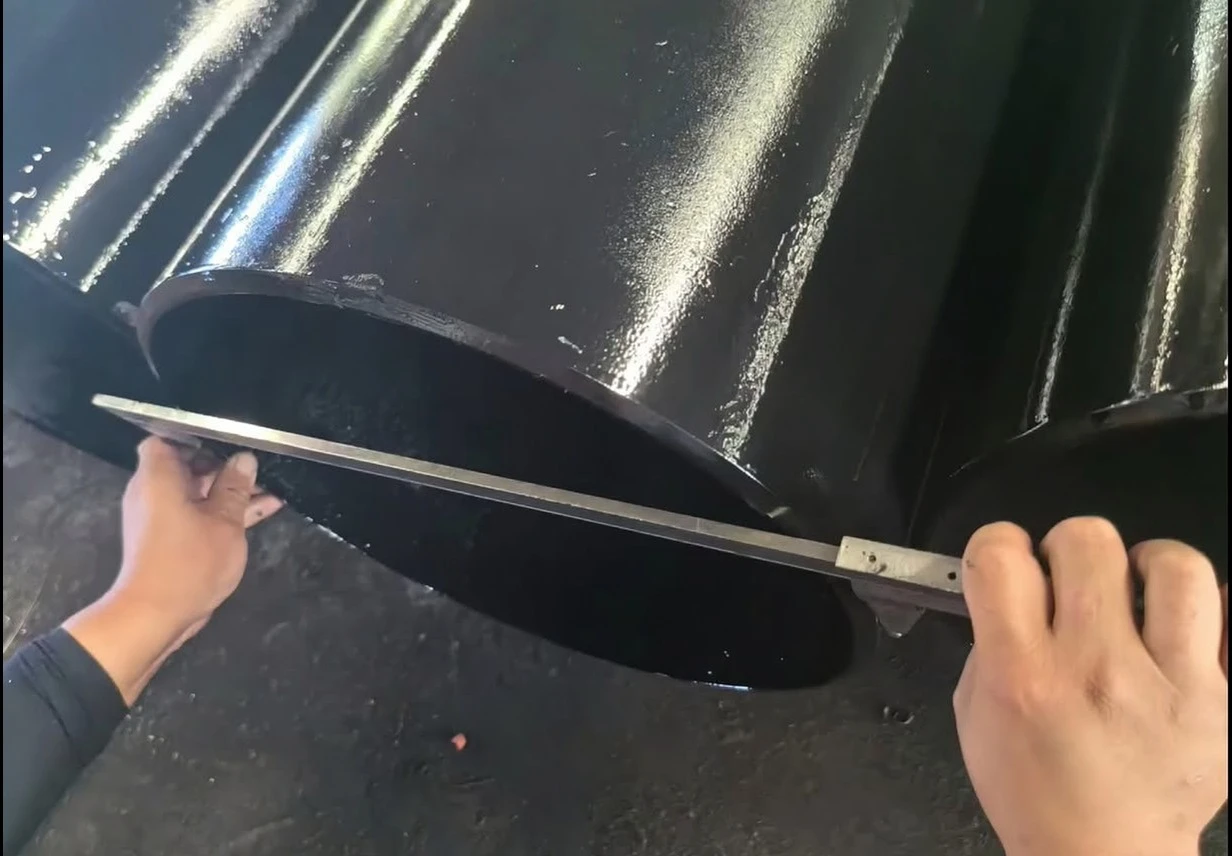
Test and inspection


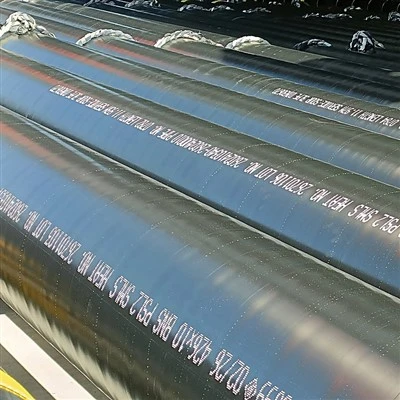
packaging and shipping


Send your enquiry with the key distribution-pipe parameters so we can return a matched quotation: standard and grade (for example API 5L Grade B PSL1 or X42 PSL2), quantity, NPS / outside diameter, wall or schedule, length basis, end finish, the external-protection requirement (3LPE to ISO 21809-1 / DIN 30670 or FBE, with normal / reinforced class and field-joint method), cathodic-protection accessories if any, and the required MTC and inspection level. All chemistry, dimensional and testing limits are confirmed against the latest edition of API 5L / ISO 3183 and the project specification on the formal quotation. As an API 5L gas pipe supplier and exporter, we support bundled, beveled, coated and export-marked delivery.
FAQ
What is the difference between a natural gas distribution pipeline and a transmission pipeline?
A distribution pipeline delivers gas from the city gate or regulator station to residential, commercial and industrial end users. It is a branched, lower-pressure network, often operating from a few tenths of a bar up to about 0.4 MPa (medium pressure) for steel mains, with smaller diameters (frequently NPS 2–12 for steel, smaller for service lines). A transmission pipeline is the long, linear, high-pressure trunkline (commonly 12–42 in OD, up to about 9.9 MPa) that moves gas between regions and cities. API 5L steel pipe is used in both, but distribution work favours lower grades (Grade B / X42), smaller sizes and a robust buried-corrosion system, whereas transmission favours higher grades (X52–X80) and larger diameters.
Which API 5L grade is most commonly used for natural gas distribution pipe?
Grade B (L245) is the most specified API 5L grade for natural gas distribution pipe because it gives the right balance of strength, weldability and cost for low- and medium-pressure city networks, and it is stocked by most distributors. X42 (L290) is added where the main sees higher medium pressure or longer runs, and X52 may be used for the larger-diameter distribution trunk. For distribution the grade is almost always ordered at PSL1, moving to PSL2 only where a project requires mandatory impact testing, tighter chemistry or full heat traceability.
Is PSL1 or PSL2 normally specified for city gas distribution pipe?
For typical low-risk city gas distribution pipe, API 5L PSL1 is the normal specification: it covers the basic chemistry and tensile requirements and is the most economical route for Grade B and X42 mains. PSL2 is selected when the design needs mandatory Charpy impact testing, a capped maximum yield, controlled carbon equivalent, 100% non-destructive examination and per-heat traceability - common for critical crossings, bridge crossings, regulator stations or projects written to a stricter utility specification. State PSL1 or PSL2 explicitly on the enquiry because the default differs between purchasers.
What corrosion-protection system is specified for buried city-gas distribution steel pipe?
A buried steel gas distribution pipe is protected by a factory-applied external coating plus cathodic protection. The coating is typically a three-layer polyethylene (3LPE) system to ISO 21809-1 / DIN 30670, or a single-layer fusion-bonded epoxy (FBE) to AWWA C213 / NACE SP0394 for drier soils. Because the coating alone is never assumed perfect, a cathodic-protection system (usually sacrificial anodes per CJJ 95 / GB/T 21447, or impressed current) is added so any coating holiday stays protected. Chinese municipal practice reinforces this with the external-corrosion-control code GB/T 21447 and CJJ 95.
What minimum wall thickness applies to steel gas distribution pipe under Chinese municipal codes?
Chinese municipal gas-design practice (GB 50028, Urban Gas Design Code) sets a minimum nominal wall thickness for buried steel gas pipe independent of the pressure-only calculation: about 4.0 mm for DN 80–150 and about 4.8 mm for DN 200–300, with larger values for bigger diameters. The actual wall must also satisfy the ASME B31.8 or project hoop-stress design and may be increased for external loads (traffic, soil) that dominate in medium-pressure distribution. Confirm the governing local code and the project specification before fixing the wall.
What NPS sizes and wall schedules are typical for natural gas distribution mains and service lines?
Steel natural gas distribution mains are commonly NPS 2 through NPS 12 (roughly 60–323.9 mm OD), with SCH 10 / 20 / 40 and STD / XS walls, while building service lines are often NPS 1/2–2. Larger distribution trunks may reach NPS 16–24. The published size chart lists representative outside diameters and SCH 40 / SCH 80 walls; for a real main the engineer selects the wall from the MAOP, location class and code, then checks it against the local minimum-wall rule. Always confirm the size and schedule against the latest standard edition and the project specification.
Can polyethylene (PE) pipe replace steel for gas distribution, and where is steel still required?
In many cities polyethylene (PE100, PE pipe to GB/T 15558.1) is the default for buried gas distribution below about DN 300 because it is corrosion-free, leak-tight by fusion jointing and low cost. Steel API 5L pipe (or GB/T 8163) is still required above that diameter, for road or river crossings, for above-ground or bridge-mounted sections, for regulator and metering stations, and where the temperature or mechanical load exceeds the PE envelope. The choice follows the local gas-design code (for example GB 50028 in China), which assigns PE or steel by diameter, location and duty.
What information should a contractor provide when requesting a quotation for API 5L natural gas distribution pipe?
A useful distribution enquiry states: the standard and grade (for example API 5L Grade B PSL1 or X42 PSL2), quantity in tonnes or metres, NPS / outside diameter and wall or schedule, length basis (fixed or random), end finish (plain, beveled or threaded & coupled), the external-protection requirement (3LPE to ISO 21809-1 / DIN 30670, normal or reinforced; or FBE), any cathodic-protection accessories, the inspection level (SGS / BV or client inspector) and the MTC type. Include the service pressure and whether the pipe is buried, crossed or above-ground so the wall and coating are matched to the duty.
Hot Tags: api 5l steel pipes for natural gas distribution work, China api 5l steel pipes for natural gas distribution work manufacturers, suppliers, factory
Previous
No InformationYou Might Also Like


Send Inquiry