





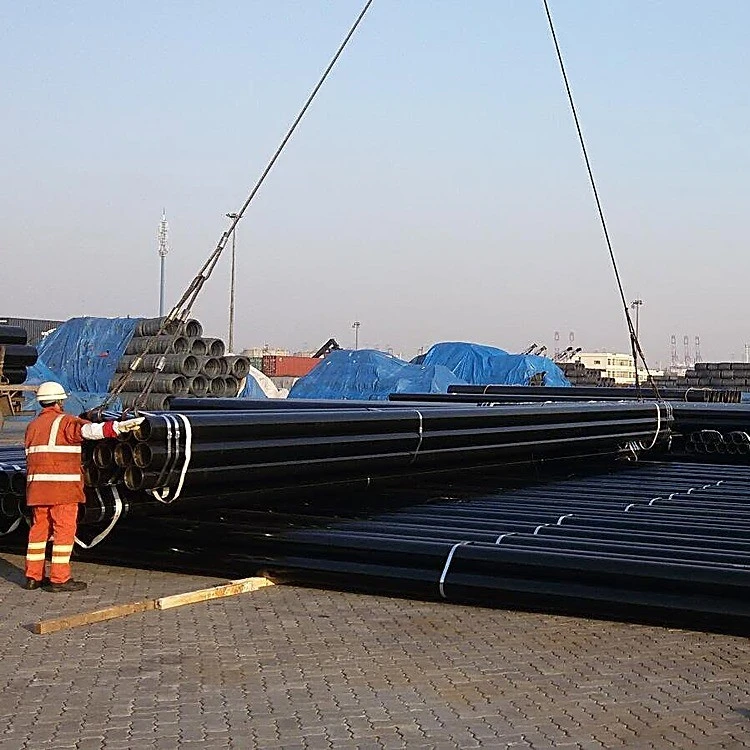
API 5L X65 Seamless Pipes With 3LPE Coating
X65 sits in the upper-middle of the API 5L X-series. Its 450 MPa yield lets a pipeline carry a higher maximum allowable operating pressure (MAOP) at a given wall, or reach the same MAOP with a lighter wall than X42 or X52. The grade is supplied to either PSL1 or PSL2; for transmission service, PSL2 is the normal expectation because it adds mandatory limits on maximum yield, yield-to-tensile ratio, carbon equivalent, Charpy impact testing and 100% non-destructive examination.
PSL2 chemical composition (seamless)
The two PSL2 delivery conditions for X65 differ in their carbon ceiling. X65Q (quenched and tempered) allows up to 0.18% C, while X65M (thermomechanically rolled) is held to 0.12% C for better field weldability. The limits below are product-analysis maxima from API 5L / ISO 3183 Table 5; confirm the exact values on the purchase order and mill certificate.
| Element | X65Q (max %) | X65M (max %) | Note |
|---|---|---|---|
| Carbon (C) | 0.18 | 0.12 | Lower C improves weldability |
| Manganese (Mn) | 1.70 | 1.60 | Strength via C–Mn balance |
| Phosphorus (P) | 0.025 | 0.025 | PSL2 tight limit |
| Sulfur (S) | 0.015 | 0.015 | Lower for HIC resistance |
| Silicon (Si) | 0.45 | 0.45 | Deoxidation |
| Nb + V + Ti (total) | 0.15 | 0.15 | Micro-alloying |
| CEIIW (if C > 0.12%) | 0.43 | 0.43 | Weldability control |
| CEPcm (if C ≤ 0.12%) | 0.25 | 0.25 | Weldability control |
Mechanical properties (PSL2)
PSL2 sets both a minimum and a maximum yield, which prevents over-strength material that could invalidate burst calculations and ductility assumptions in regulated designs. The yield-to-tensile ratio cap of 0.93 applies where the outside diameter exceeds 323.9 mm.
| Property | PSL2 range | Unit |
|---|---|---|
| Yield strength (Rt0.5) | 450 – 600 | MPa |
| Tensile strength (Rm) | 535 – 760 | MPa |
| Yield-to-tensile ratio | ≤ 0.93 | - (D > 323.9 mm) |
| Charpy V-notch | Mandatory at ≤ 0 °C or agreed lower T | per PSL2 |
| Non-destructive examination | 100% UT/RT of body; full heat traceability | per PSL2 |
Equivalent designations commonly accepted for X65/L450: ISO 3183 L450, GB/T 9711 L450, EN 10208-2 L450 (QB/MB) and CSA Z245.1 Grade 448. Confirm the exact grade mapping against the project specification and the latest standard edition.
Delivery condition: X65Q and X65M (no N)
A point that surprises buyers moving up from X52: API 5L PSL2 defines X65 only as X65Q (quenched and tempered) and X65M (thermomechanically rolled). There is no normalized X65N. Seamless X65 is most often supplied in the Q condition, because quench and temper develops the 450 MPa yield uniformly through the wall of a pierced billet. X65M is the usual route for welded pipe made from TMCP plate or coil. Because the suffix changes hardenability and heat-affected-zone behaviour, always write the suffix on the order and check it on the mill certificate.
Why seamless X65 for a 3LPE-coated line
Seamless pipe is produced by hot piercing a solid billet, so it has no longitudinal weld seam. For a corrosion-critical, coated transmission line this matters in three practical ways:
| Aspect | Seamless (SMLS) | Welded (Spiral / LSAW / ERW) |
|---|---|---|
| Longitudinal seam | None | Present; ground flush and re-inspected before coating |
| Coating substrate | Uniform metal surface | Seam toe and HAZ can differ in bond behaviour |
| Body inspection | 100% ultrasonic of the full body | Seam and HAZ NDE in addition to body |
| Typical diameter | NPS 2 – 24 (up to ~610 mm OD) | Larger diameters favour LSAW/SSAW |
For the smaller and mid diameters that dominate station piping, laterals and many gathering lines, seamless X65 gives a clean, uniform surface for the FBE primer of the 3LPE system and removes any seam-related question from the coating qualification.
3LPE as the external corrosion barrier
Over the bare seamless pipe, a three-layer polyethylene system (3LPE) provides the external corrosion protection for buried or immersed onshore service. The system bonds an epoxy primer to the steel, an adhesive copolymer, and a polyethylene outer layer, applied and qualified to ISO 21809-1 / DIN 30670. On a seamless surface the primer wets a single, consistent substrate, which is why the combination is popular for transmission lines. The polyolefin envelope is suited to service up to about 80 °C; where the line sees higher temperatures, a three-layer polypropylene (3LPP) system is the usual alternative. Thickness grading (normal vs reinforced), holiday detection, cutback length at girth welds and field-joint coating are specified on the coating data sheet.
Grade ladder: wall saving at equal MAOP
Because required wall scales inversely with yield strength, stepping up the grade is the standard way to cut steel tonnage, coating area and freight. The table below holds the diameter (NPS 24, 609.6 mm OD) and design pressure (10 MPa) fixed and varies only the grade, using ASME B31.8 with F = 0.72, E = 1.0, T = 1.0.
| Grade | SMYS (MPa) | Calculated tmin (mm) | Wall saved vs X42 |
|---|---|---|---|
| X42 | 290 | 14.60 | 0 % |
| X52 | 360 | 11.76 | 19.4 % |
| X65 | 450 | 9.41 | 35.6 % |
| X70 | 485 | 8.73 | 40.2 % |
These figures are illustrative only. Upgrading X52 → X65 saves about 20% wall at equal pressure; the benefit stops paying off when the thinner wall drops below practical handling, girth-weld control or collapse limits, or when the X70/X80 grade premium outweighs the material saving. Run the trade-off against the actual line profile and code edition.
B31.8 wall design at the 450 MPa SMYS
For a real line, the engineer solves the hoop-stress equation t = P·D / (2·F·E·T·S) with S = 450 MPa for X65. The table shows representative minimum walls for an onshore transmission MAOP of 8.0 MPa, F = 0.72, E = 1.0 (seamless) and T = 1.0.
| Size | OD (mm) | MAOP (MPa) | F · E · T | tmin (mm) |
|---|---|---|---|---|
| NPS 12 | 323.9 | 8.0 | 0.72 | 4.00 |
| NPS 16 | 406.4 | 8.0 | 0.72 | 5.02 |
| NPS 20 | 508.0 | 8.0 | 0.72 | 6.27 |
| NPS 24 | 609.6 | 8.0 | 0.72 | 7.53 |
Illustrative values, not a pipeline design. Use the actual MAOP, location class, temperature derating and the governing code edition. Add allowances for threading, bending, threaded connections or external loads as required by the design.
Typical seamless X65 size range
Seamless X65 is normally available from about NPS 2 up to NPS 24 (roughly 60–610 mm OD). The table lists representative outside diameters and the wall-thickness ranges commonly offered for transmission-grade seamless line pipe.
| NPS | OD (mm) | Typical wall range (mm) |
|---|---|---|
| 2 | 60.3 | 3.9 – 10.0 |
| 4 | 114.3 | 5.0 – 17.1 |
| 6 | 168.3 | 5.5 – 21.9 |
| 8 | 219.1 | 6.0 – 25.0 |
| 12 | 323.9 | 7.0 – 33.3 |
| 16 | 406.4 | 8.0 – 40.5 |
| 20 | 508.0 | 9.5 – 50.0 |
| 24 | 609.6 | 11.0 – 59.5 |
Application
- Onshore high-pressure gas and oil trunklines and laterals where MAOP drives wall economy.
- Station and plant piping, meter runs and tie-ins requiring a uniform, weld-friendly surface.
- Gathering systems in buried or submerged onshore environments protected by the 3LPE barrier.
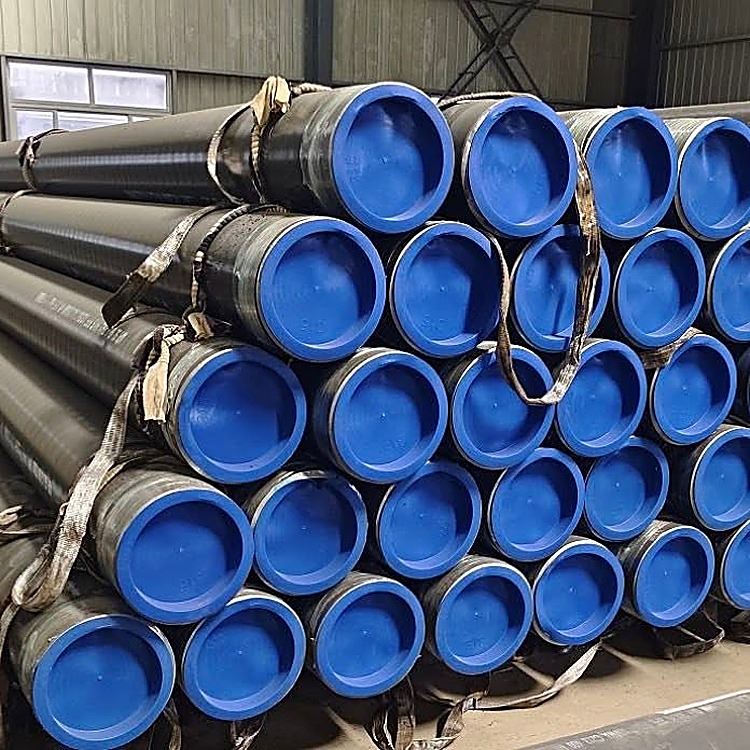
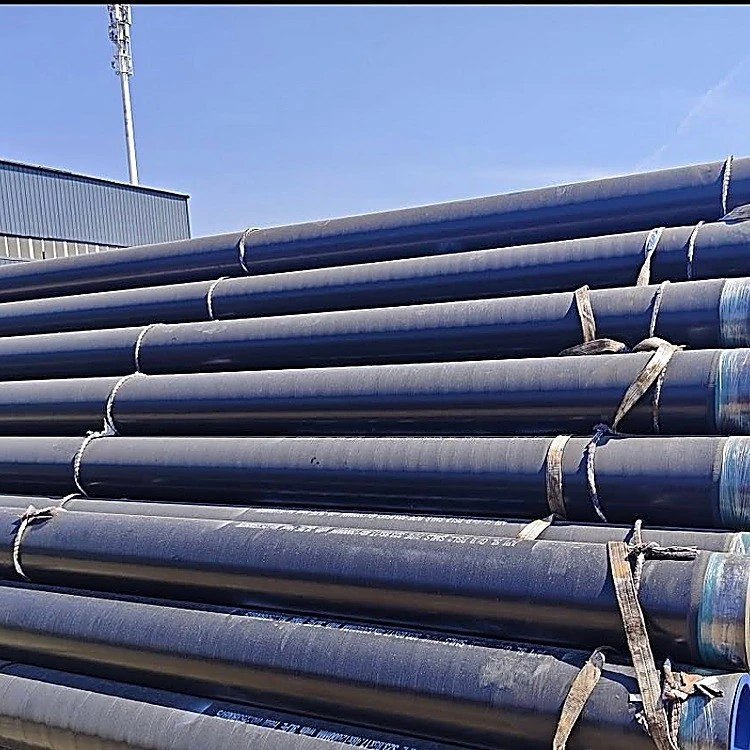
- Export and cross-country lines shipped as coated, beveled, bundled and marked pipe.
X65 PSL2 alone does not qualify pipe for wet H2S (sour) service. Where H2S is present, specify compliance with NACE MR0175 / ISO 15156, including HIC (NACE TM0284) and SSC (NACE TM0177) testing and hardness limits, and state the H2S partial pressure on the enquiry. For low-temperature service, confirm the Charpy test temperature and the coating compatibility with the design temperature.
Ordering checklist
A complete X65 seamless 3LPE enquiry should state the items below so that the mill quotation, the inspection and the mill certificate all line up:
Grade and delivery condition - for example X65Q PSL2 or X65M PSL2.
Quantity, NPS / outside diameter, wall thickness or schedule, and length type (fixed or random).
End finish (beveled or plain) and any special end preparation.
Coating specification - 3LPE to ISO 21809-1 / DIN 30670, normal or reinforced thickness, cutback length, and field-joint method.
Internal lining if required, and any double-blocking or purge provisions.
Inspection level (third-party such as SGS/BV, or client inspector) and MTC type (EN 10204 3.1 or 3.2).
Marking, bundle/packing and export documentation requirements.
Test and inspection


packaging and shipping


Send your enquiry with the key line-pipe and coating parameters so we can return a matched quotation: grade and delivery condition (for example X65Q PSL2 or X65M PSL2), quantity, NPS / outside diameter, wall thickness or schedule, length basis, end finish, the 3LPE coating specification (ISO 21809-1 / DIN 30670, normal or reinforced class, cutback length and field-joint method) and the required MTC and inspection level. All chemistry, dimensional and testing limits are confirmed against the latest edition of API 5L / ISO 3183 and the project specification on the formal quotation.
FAQ
What do the grade names X65 and L450 mean, and why does PSL2 require a delivery-condition suffix such as Q or M?
X65 denotes a specified minimum yield strength of 65,000 psi; L450 is the identical value expressed in metric units (450 MPa). Under API 5L / ISO 3183, PSL2 grades must carry a delivery-condition suffix that states how the pipe was processed: R (as-rolled), N (normalized), Q (quenched and tempered) or M (thermomechanically rolled). The suffix is part of the ordered grade and changes microstructure, toughness and weldability, so it must be written on the purchase order and confirmed on the mill certificate.
Does API 5L X65 PSL2 have a normalized (N) delivery condition, and what delivery condition is typical for seamless X65?
Unlike X52, which is commonly ordered as X52N, API 5L PSL2 defines X65 only as X65Q (quenched and tempered) and X65M (thermomechanically rolled). There is no normalized X65 in the PSL2 grade table. Seamless X65 is most often supplied in the Q condition because quench and temper develops the 450 MPa yield uniformly through the wall of a pierced billet; X65M is the usual choice for welded (TMCP) plate and coil. State the suffix explicitly on the enquiry.
How does seamless X65 interact with 3LPE coating compared with welded X65, and does the longitudinal seam affect coating quality?
A seamless pipe has no longitudinal weld, so its external surface is metallurgically uniform and the 3LPE layers bond to a single, consistent substrate with no seam geometry to disrupt the FBE primer or trap coating at the weld toe. Welded pipe requires the seam to be ground flush and re-inspected before coating, and the heat-affected zone can behave differently under cathodic disbondment testing. For a corrosion-critical transmission line, that uniformity is a practical reason many operators prefer seamless X65 for smaller and mid diameters.
What minimum wall thickness does ASME B31.8 require for an X65 line at a given MAOP using the 450 MPa SMYS?
ASME B31.8 hoop-stress design uses t = P·D / (2·F·E·T·S), where S is the specified minimum yield strength. With X65, S = 450 MPa. For a representative onshore transmission MAOP of 8.0 MPa, design factor F = 0.72, longitudinal joint factor E = 1.0 for seamless, and temperature derating T = 1.0, the calculated minimum walls are about 4.00 mm at NPS 12 (323.9 mm OD), 5.02 mm at NPS 16, 6.27 mm at NPS 20 and 7.53 mm at NPS 24. These are illustrative values only and must be re-run with the actual MAOP, location class and code edition for any real pipeline.
How much wall thickness can X65 save over X52 at the same design pressure, and when does the saving stop paying off?
Because wall thickness scales inversely with yield strength, moving from X52 (360 MPa) to X65 (450 MPa) at the same pressure and diameter cuts the calculated wall by roughly 20 percent, and versus X42 (290 MPa) the saving is about 35 percent. The lighter wall lowers steel tonnage, coating area and freight. The saving stops paying off when the thinner wall falls below the practical minimum for handling, girth-weld control or collapse resistance, or when the project needs X70/X80 and the extra grade premium outweighs the material saving. Run the grade trade-off against the actual line profile.
What mill-certificate (MTC) and traceability data should be required for X65 PSL2 seamless pipe?
Require an EN 10204 3.1 or 3.2 mill certificate per heat and lot showing the actual chemical analysis (including C, Mn, P, S, micro-alloy totals and carbon equivalent), the transverse Charpy V-notch results at the agreed test temperature, the delivered grade with its Q or M suffix, hydrostatic and NDE results, and full heat-number traceability. For sour-service intent, the MTC must reference the HIC/SSC test regime and hardness limits of NACE MR0175 / ISO 15156 rather than only the base PSL2 requirements.
What should a purchase order specify for API 5L X65 PSL2 seamless 3LPE-coated line pipe?
A complete X65 order should state: grade and delivery condition (for example X65Q or X65M PSL2),quantity, NPS and outside diameter, wall thickness or schedule, fixed or random lengths, end finish (beveled or plain), the coating specification (3LPE to ISO 21809-1 / DIN 30670, with normal or reinforced thickness and the required cutback length), internal lining if any, inspection level (e.g. SGS/BV or client inspector), MTC type, and packaging and marking for export. Always confirm chemistry and dimensional limits against the latest edition of API 5L / ISO 3183 on the purchase order.
Hot Tags: api 5l x65 seamless pipes with 3lpe coating, China api 5l x65 seamless pipes with 3lpe coating manufacturers, suppliers, factory
Previous
No InformationYou Might Also Like


Send Inquiry