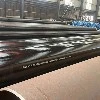
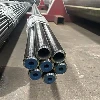
Straight seam submerged arc welded (LSAW) steel pipes are commonly used in various industrial applications, and heat treatment is an important step in their manufacturing process to enhance their mechanical properties and ensure proper performance. The heat treatment process of longitudinal submerged arc welded steel pipes usually includes procedures such as normalizing, stress relief, quenching and tempering. This article provides a general overview of these heat treatment processes.
normalization:
Purpose: To improve the mechanical properties of steel by refining the grain structure.
Process: The steel pipe is heated above its critical transition temperature and then cooled in air. This process helps achieve uniform grain size and improves the overall mechanical properties of the tube.
relieve pressure:
Purpose: Reduce residual stress in steel and improve dimensional stability.
Process: The steel pipe is heated to a temperature below its critical range, maintained at this temperature for a certain period of time, and then cooled slowly. This helps relieve internal stresses created during manufacturing processes such as welding.
Quenching and Tempering:
Purpose: To achieve a balance of hardness and toughness.
process:
Quenching: Heating steel pipe to a critical temperature and then rapidly cooling it, usually by immersion in water, oil, or other quenching medium. This results in a hard and brittle structure.
Tempering: The quenched steel is then reheated to a lower temperature and held for a specific time. This process imparts toughness to the steel by allowing controlled reorganization of the crystal structure.