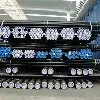
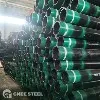
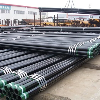
A key inspection method for API 5L X52 steel pipe is appearance quality inspection, which focuses on identifying surface defects and checking dimensional deviations.
Surface flatness:
The surface of API 5L X52 steel pipe should be flat and smooth, without defects such as unevenness, wavy or potholes. If such problems exist, it may affect the strength of the steel pipe and subsequent performance, such as loose connections during installation.
Defects:
Cracks: Check carefully whether there are cracks on the surface of the steel pipe. Cracks are serious quality problems that may cause dangerous situations such as rupture and leakage during use of the steel pipe. Cracks may be longitudinal, transverse or irregular in shape, and even tiny cracks should not be ignored.
Scarring: Scarring is usually caused by impurities, inclusions or other problems in the raw materials during the production process of the steel pipe. Scarring affects the appearance and surface quality of the steel pipe, and may also reduce the strength and corrosion resistance of the steel pipe.
Folding: Folding is a broken line defect on the surface of the steel pipe, which is caused by uneven deformation of the metal material or improper processing during the production process. Folding will reduce the local strength of the steel pipe, easily produce stress concentration at the folding point, and increase the risk of steel pipe rupture.
Bubbles: If there are bubbles on the surface of the steel pipe, it means that there may be problems such as uneven material mixing and gas not being discharged during the production process. Bubbles will reduce the surface quality and corrosion resistance of the steel pipe, and may also affect the strength of the steel pipe.
Cross-sectional shape:
The cross section of the API 5L X52 steel pipe should be a regular circle or other specified shape. If the cross section is elliptical, polygonal or other irregular shapes, it means that there are problems with the production process of the steel pipe, which may affect the installation and use performance of the steel pipe.
Dimensional accuracy:
Check whether the outer diameter, inner diameter and wall thickness of the steel pipe meet the standard requirements. Steel pipes with excessive dimensional deviation may not be properly connected to other pipe fittings or equipment, affecting the quality of the entire project.
Cut quality:
For steel pipes with cuts, check whether the cut is flat and vertical, and whether there are burrs, edge collapse and other phenomena. Uneven cuts may affect the connection and sealing performance of the steel pipe, and burrs and edge collapse may cause personal injury or damage other components during use.