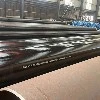
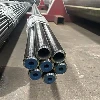
Two standards written for two different duties
API 5L Grade B pipe and No. 20 steel pipe are frequently quoted against the same enquiry because both are low-carbon, weldable, seamless tubes with a minimum yield strength close to 245 MPa. They are not interchangeable, and the difference is not in the strength figure. It lies in what each standard was written to control. API 5L is a line pipe specification: it assumes the tube will carry pressurised hydrocarbon or water over distance, so it controls notch toughness, weld soundness, dimensional consistency along a long joint, and traceability from heat to joint. The 20# grade is a quality carbon structural steel grade defined in the Chinese structural steel system, supplied as tube under GB/T 8163 for liquid service and under other tube standards for boiler, petrochemical and machine-building duty; it controls chemistry and tensile properties, and leaves impact toughness and non-destructive testing to the order.
The practical consequence is that a 20# tube can comply fully with its standard and still be unsuitable for a transmission pipeline, while a Grade B tube can comply fully with API 5L and be a poor choice for a machined mechanical component. The comparison below is written so that a buyer can decide which of the two documents governs the actual duty.
Grade designation equivalence and where it breaks down
Grade B in API 5L corresponds to L245 in the ISO 3183 lineage, and to L245 in GB/T 9711, which adopts the same designation system. In each case the number 245 is the specified minimum yield strength in megapascals, so the label carries real information rather than a traditional grade name. Grade B and L245 are therefore the same requirement expressed in two designation systems, and a certificate written to one may be read against the other.
The 20# designation means something different. It is a carbon content classification in the Chinese structural steel system, nominally about 0.20 percent carbon, and it is a material grade that is then formed into tube under a separate tube standard. There is no numeric yield strength in the name, and the yield strength is supplied by the tube standard rather than by the grade name. The frequently repeated statement that Grade B is "equivalent to 20#" is therefore an approximation based on similar yield strength and similar carbon level; it is not an equivalence of specification, and it should never be used to justify a substitution without the purchaser's written agreement.
- API 5L Grade B and L245: the same requirement, and substitution between them is a documentation exercise.
- 20# tube and API 5L Grade B: different specifications with overlapping properties, and substitution requires a technical review, not a name match.
Chemical composition compared
The chemistry reveals the different design intent. API 5L Grade B permits a higher manganese level, which is what allows a 245 MPa yield to be reached in the as-rolled condition on a hot strip mill without normalising. The 20# grade keeps manganese lower and relies on a tightly controlled carbon range, which suits tube made from a round billet and rolled or drawn to a machined or structural duty.
| Element, percent | API 5L Grade B, PSL1 seamless | API 5L Grade B, PSL2 | 20# tube to GB/T 8163 |
|---|---|---|---|
| Carbon | 0.28 max | lower maximum than PSL1, set by the PSL2 table | 0.07 to 0.24 |
| Silicon | not specified | not specified | 0.17 to 0.37 |
| Manganese | 1.20 max | 1.20 max | 0.35 to 0.65 |
| Phosphorus | 0.030 max | 0.025 max | 0.035 max |
| Sulphur | 0.030 max | 0.015 max | 0.035 max |
| Nickel, copper, chromium | residual, not specified | residual, restricted | 0.25 max each |
Two rows drive most of the downstream difference. The manganese range for 20# is narrow and low, which limits how much strength can be obtained from solid solution strengthening and makes the grade more dependent on the rolling schedule. The sulphur limit separates the PSL2 line pipe from both alternatives: 0.015 percent maximum sulphur is roughly half the 20# and PSL1 allowance, and sulphur is the element that controls the volume fraction and morphology of manganese sulphide inclusions, which in turn govern through-thickness ductility, resistance to lamellar tearing at girth welds, and susceptibility to hydrogen induced cracking in wet sour service. A purchaser who intends to assess a pipe against ISO 15156 for sour service will find a PSL2 Grade B with a calcium-treated, inclusion-controlled steel a far easier starting point than either a PSL1 Grade B or a 20# tube.
Mechanical properties and what the numbers do not tell you
API 5L Grade B requires a minimum yield strength of 245 MPa and a tensile strength between 415 MPa and 760 MPa. The tensile range is deliberately wide because the standard intends to accommodate different manufacturing routes and delivery conditions; the maximum is a ceiling that prevents the mill from supplying steel so strong that it loses deformability. PSL2 adds a maximum yield strength, typically 450 MPa for Grade B, and a maximum yield-to-tensile ratio, which together cap the strength rather than merely floor it.
20# tube under GB/T 8163 requires a minimum yield strength of 245 MPa for wall thicknesses up to 16 mm, falling slightly for thicker walls, with a tensile strength range of 410 MPa to 530 MPa and a minimum elongation of about 20 percent on a longitudinal basis. The narrower tensile band is the significant difference. A 20# tube is expected to land inside a 120 MPa window, whereas a Grade B pipe may legally sit anywhere in a 345 MPa window.
- For a pressure-containing design calculation, the specified minimum yield governs and both materials give the same answer.
- For a forming, bending or swaging operation, the 20# narrow tensile band gives more predictable springback than a Grade B joint that could be at either end of a wide range.
- For a welded connection in a restrained joint, a lower yield-to-tensile ratio is preferable, which generally favours a PSL2 Grade B over an uncontrolled 20# supply.
- For a machined component, the tighter tensile band and the specified silicon range of 20# make machining behaviour more repeatable from heat to heat.
Delivery condition, heat treatment and dimensional practice
API 5L Grade B is characterised by a delivery condition suffix that appears on the certificate: R for as-rolled, N for normalised, Q for quenched and tempered, M for thermomechanically rolled. Grade B is most often supplied as-rolled, which is acceptable for the grade because the chemistry and the rolling schedule together reach the specified strength without a separate heat treatment. Normalising is specified where toughness at low temperature or consistent properties across a heavy wall are required.
20# tube is supplied in the as-rolled, normalised or annealed condition according to the order, and the choice changes the machining behaviour materially. A cold drawn or normalised 20# tube cuts more freely and more predictably than an annealed one, which is one reason the grade is common in machined parts such as sleeves, rings and hydraulic components. For tube made by hot rolling, the finishing temperature and the cooling after rolling determine the ferrite-pearlite morphology and therefore the toughness, and the standard does not fix either, so two mills can supply compliant 20# tube with noticeably different impact behaviour.
Dimensional practice also differs. API 5L is written around long joints for pipelines, with length ranges up to about 12 m, end dimensions for girth welding, and diameter and wall tolerances that are paired with the manufacturing process. 20# tube is commonly ordered to fixed lengths with tighter wall tolerance and with concentricity requirements that suit machining, because the material will be bored, turned or threaded rather than welded end to end in a spread.
Testing and inspection: the largest practical gap
The most useful way to compare the two documents is to list what the buyer must verify. API 5L PSL2 imposes a defined test regime: tensile tests on the pipe body and on the weld, flattening or bend tests on welded pipe, Charpy V-notch impact tests at a specified temperature for the sizes where they are required, hydrostatic testing of every joint unless a non-destructive alternative is agreed, and non-destructive inspection of the weld to a specified acceptance level. PSL1 is lighter but still requires hydrostatic testing and, for welded pipe, weld tensile and ductility checks.
GB/T 8163 establishes chemistry and tensile requirements, requires a hydrostatic test and permits, rather than mandates, non-destructive testing of the tube body. Impact testing is not a routine requirement. In practice this means a 20# tube order is only as good as the additional inspection clauses the buyer writes into it, while an API 5L PSL2 order carries a test package unless the buyer deliberately relaxes it.
- Hydrostatic test: specified by both, but the test pressure, hold time and the acceptance basis should be quoted in the order rather than assumed.
- Non-destructive testing: mandated on the weld for API 5L pipe; optional and separately ordered for 20# tube.
- Impact testing: part of the API 5L PSL2 regime for defined sizes and temperatures; needs a specific clause for 20# tube.
- Certificate content: the API 5L inspection certificate carries grade, product specification level, delivery condition, heat number, test results and the applicable standard edition; a 20# certificate may be a simpler document, so agree the required fields before shipment.
Weldability and behaviour in service
Both materials are weldable with conventional processes and neither requires preheating at normal wall thickness. Carbon equivalent calculated from the composition is the controlling figure: Grade B at the upper end of its carbon and manganese allowance approaches a carbon equivalent of about 0.36, which is still comfortable for cellulosic and low-hydrogen processes, while 20# at 0.20 percent carbon and 0.5 percent manganese gives roughly 0.28. The higher manganese of Grade B gives it more hardenability, so a girth weld in Grade B responds differently to a fast cooling rate than a weld in 20# tube, and the welding procedure qualification is not transferable between them even where the yield strengths match.
In service, the difference shows up in corrosion allowance rather than in strength. Both steels are plain carbon-manganese materials with no deliberate corrosion resistance, and both require coating or cathodic protection in buried service. Grade B line pipe is normally supplied with a specified outside diameter tolerance and surface finish suitable for three-layer polyethylene or fusion bonded epoxy coating, and the coating specification will usually reference the pipe surface condition. A 20# tube repurposed for buried service often fails at the coating stage because the surface condition and the roundness were never specified for it.
Selection guidance and a substitution test
- Choose API 5L Grade B pipe where the tube is part of a pressure pipeline, where girth welding in the field will be followed by hydrostatic testing to a pipeline code, where notch toughness must be demonstrated, or where sour service assessment will be required.
- Choose 20# tube where the part is a machined or threaded component, a structural or mechanical element, a low-pressure fluid line inside a plant, or where a narrow tensile band and predictable machining are worth more than a documented impact test package.
- Where a substitution is proposed to save delivery time, test it on four points: yield strength maximum as well as minimum, sulphur level and inclusion control, impact test temperature and absorbed energy, and the non-destructive inspection level on the body and the weld. A substitution that satisfies only the first point is a strength substitution, not a material substitution.
- Where the application is a boiler or heat exchanger rather than a pipeline or a machine part, neither of these grades is the correct reference; the applicable specification will be a boiler tube standard, and the design temperature will decide the allowable stress rather than the room temperature yield strength.
FAQ
Q: Is API 5L Grade B the same as 20# steel pipe?
No. Grade B corresponds to L245 in the ISO 3183 and GB/T 9711 designation system, and its requirements are set by API 5L. The 20# grade is a carbon content classification in the Chinese structural steel system, and its tube requirements are set by the tube standard used at order, such as GB/T 8163. Their yield strengths are close, but the specifications, test regimes and acceptance criteria are not equivalent.
Q: Can 20# tube be substituted for Grade B in a pipeline?
Only with the purchaser's written agreement and a technical review. The review must compare maximum yield strength, sulphur content and inclusion control, impact test temperature and energy, and the non-destructive inspection level. GB/T 8163 does not mandate body non-destructive testing or routine impact testing, so a compliant 20# tube may carry no evidence for either.
Q: Why does Grade B allow a much wider tensile range than 20#?
Because API 5L is written to accommodate several manufacturing routes and delivery conditions for one grade, so the tensile range must span as-rolled, normalised and thermomechanically rolled product. GB/T 8163 is written around a defined tube-making route and can therefore constrain the range more tightly, which gives more predictable forming behaviour.
Q: Which material is easier to weld?
In carbon equivalent terms 20# is usually lower, roughly 0.28 against up to about 0.36 for Grade B at the upper end of its composition limits. Both weld without preheat at normal wall thickness, but the welding procedure qualification is specific to the material and does not transfer between them even where the specified minimum yield strength is identical.
Q: Does either grade resist corrosion?
Neither has deliberate corrosion resistance. Both are carbon-manganese steels and both need coating, lining or cathodic protection in buried or wet service. For sour service, the deciding factor is sulphur content and inclusion shape control rather than the grade name, which is why a PSL2 Grade B with 0.015 percent maximum sulphur is a better starting point than a PSL1 product.
Q: What should an order state to avoid a substitution?
State the standard and edition, the grade designation, the product specification level, the delivery condition, the outside diameter and specified wall thickness with the tolerance basis, the length band, the hydrostatic test pressure, the non-destructive inspection level, the impact test temperature and energy where applicable, and the required certificate fields. A specification that names only the grade leaves everything that distinguishes the two products to the mill's discretion.