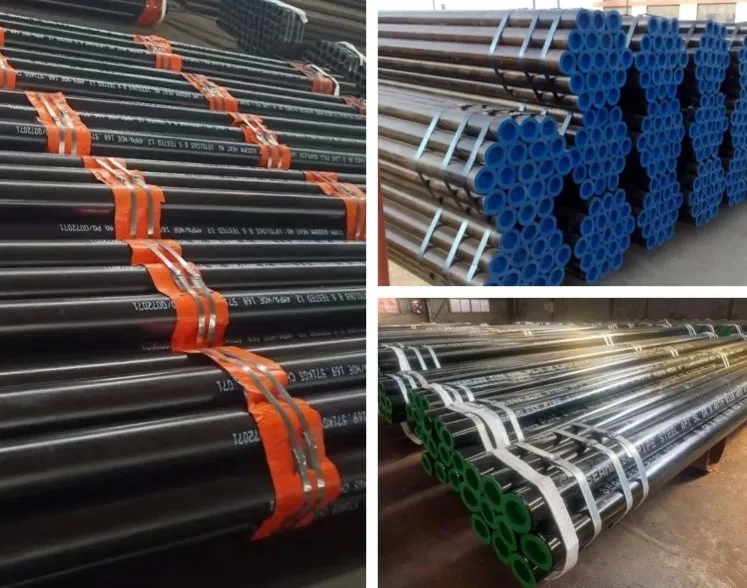
In terms of production technology, seamless steel pipes are formed by hot rolling, perforated by round steel, and sized at high temperature, resulting in inaccurate outer diameter control and large wall thickness deviation; while ERW steel pipes are made of hot-rolled strip coils, and are manufactured by cold bending and welding processes, with precise outer diameter control and good wall thickness uniformity.
In terms of performance characteristics, the outer diameter and wall thickness tolerances are different. The outer diameter of seamless X52 pipes is difficult to control accurately, and the wall thickness deviation is large. Advanced units can only control it within ±5-10% t, while ERW X52 pipes can control the wall thickness tolerance within 0.05mm. In the tensile test, the strength of seamless steel pipes is at the upper limit, and the plasticity is at the lower limit. The strength index of X52 ERW pipes is excellent and the plasticity index exceeds the standard by 33.3%. The raw materials of ERW steel pipes are rolled with high precision of controlled cooling and rolling, uniform performance, and wide and thick continuous casting billets. The surface solidification layer of fine grains is thick, the organization is dense, and the grain size is uniform. The anti-collapse test shows that ERW steel pipes have better anti-collapse performance than seamless steel pipes due to their uniformity of wall thickness and ovality, and their parent material impact toughness is several times that of seamless steel pipes.
In terms of application scenarios, X52 seamless steel pipes are often used in high-pressure pipelines for oil and natural gas due to their high strength and pressure resistance; X52 ERW steel pipes are suitable for buildings, bridges and other structural parts that do not require high strength but require mass production due to their good plasticity and low cost.
API 5L carbon pipe