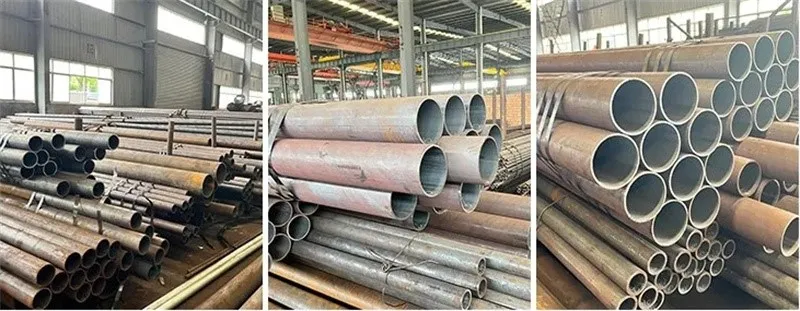
Welded alloy pipe
The production process of hot-rolled seamless steel pipe and its production technology
The production process of hot-rolled seamless steel pipe includes several basic processes such as billet pre-rolling preparation, tube heating, perforation, rolling, fixed diameter reduction and steel pipe cooling, finishing, etc.
There are three general main deformation processes in the production of hot-rolled seamless steel pipes today: perforation, tube rolling and fixed diameter reduction; their respective process purposes and requirements are:
1 Perforation: transform the solid tube into a hollow rough tube; we can understand it as shaping, that is, setting the cross section of the rolled piece into a circular ring; its equipment is called a perforator. The requirements for the perforation process are: first, to ensure that the wall thickness of the rough tube is uniform, the ovality is small, and the geometric size accuracy is high; second, the inner and outer surfaces of the rough tube should be relatively smooth, without defects such as scarring, folding, and cracks; third, there should be a corresponding perforation speed and rolling cycle to adapt to the production rhythm of the entire unit, so that the final rolling temperature of the rough tube can meet the requirements of the tube rolling mill.
2. Pipe rolling: turning thick-walled rough pipe into thin-walled rough pipe (close to the wall thickness of finished product); we can regard it as fixed wall, that is, the wall thickness value of the rough pipe in this process is determined according to the subsequent process reduction and empirical formula; this equipment is called a pipe rolling machine. The requirements for the pipe rolling process are: first, when turning thick-walled rough pipe into thin-walled rough pipe (reducing wall and extending), the rough pipe must first have a high wall thickness uniformity; second, the rough pipe has good internal and external surface quality.
3. Fixed diameter reduction (including stretching): large circle becomes small circle, referred to as sizing; the corresponding equipment is a sizing (reducing) machine, whose main function is to eliminate the different outer diameters of rough pipes (the same pipe or the same batch) caused by the rolling process of the previous process, so as to improve the outer diameter accuracy and roundness of the hot-rolled finished pipe. The requirements for the fixed diameter reduction process are: first, to achieve the sizing purpose under a certain total diameter reduction rate and a smaller single-frame diameter reduction rate; second, to achieve the task of using one specification of pipe blank to produce finished pipes of various specifications; third, to further improve the outer surface quality of the steel pipe.
Seamless Pipe