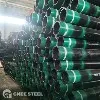
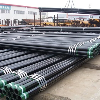
OCTG Connections refer to the specialized joining mechanisms used to screw individual joints of casing and tubing together to form a continuous pipe string. In the oil and gas industry, the connection is the most critical part of the pipe; while the pipe body is rarely where a failure occurs, 90% of wellbore integrity issues happen at the connection.
An OCTG connection must provide two things: Mechanical Strength (to support the weight of miles of pipe) and Sealing Integrity (to prevent oil or gas from leaking into the surrounding environment).
Need a full PDF version of our parameter tables or a safety calculation for a specific well depth? Click to contact GNEE Engineers today.
Two Main Categories of Connections
API Connections (Standard)
These are manufactured according to API Spec 5B standards. They are "open source," meaning a pipe from one manufacturer will always fit a pipe from another, provided the grade and size match.
BTC (Buttress Thread): Trapezoidal threads. Best for heavy casing because they handle high axial tension (pulling force).
LTC/STC (Long/Short Round Thread): 8-round threads per inch. These are easier to screw together and provide good sealing for liquids (oil/water) in shallower wells.
EUE (External Upset End): Used for tubing. The ends of the pipe are thickened (upset) before threading to ensure the joint is stronger than the pipe body.
Premium Connections (Proprietary)
These are "non-API" designs developed by specific companies (like Tenaris, VAM, or specialized domestic mills). They are required for extreme environments where standard API threads might fail.
Metal-to-Metal Seals: Unlike API threads that rely on "thread dope" (grease) to seal, premium connections have a specialized metal surface that creates a gas-tight seal.
High Torque Resistance: Designed for horizontal or directional drilling where the pipe must be rotated forcefully.
Flush Joints: The connection is the same diameter as the pipe, allowing it to fit into very tight boreholes.
API Casing Connection Parameters (BTC/LTC/STC)
Applicable for Outside Diameters (OD) from 4-1/2" to 20".
| Nom. OD (inch) | Wall Thickness (mm) | Steel Grade | Connection Type | Coupling OD (mm) | Coupling Length (mm) | Drift Diameter (mm) | Joint Strength (kN) |
| 4-1/2" | 6.35 | J55 | STC / LTC | 127.00 | 158.75 / 177.80 | 100.53 | 592 / 712 |
| 5-1/2" | 7.72 | K55 | LTC / BTC | 153.67 | 203.20 / 222.25 | 124.36 | 1,020 / 1,210 |
| 7" | 9.19 | N80 / L80 | LTC / BTC | 194.46 | 228.60 / 254.00 | 158.34 | 1,750 / 2,050 |
| 9-5/8" | 10.03 | J55 / K55 | BTC | 269.88 | 269.88 | 220.50 | 2,160 |
| 13-3/8" | 12.19 | J55 | BTC | 365.12 | 269.88 | 315.34 | 3,320 |
API Tubing Connection Parameters (EUE/NUE)
Applicable for Outside Diameters (OD) from 2-3/8" to 4-1/2".
| Nom. OD (inch) | Wall Thickness (mm) | Steel Grade | Connection Type | Upset OD (mm) | Coupling OD (mm) | Burst Pressure (MPa) | Opt. Torque (N.m) |
| 2-3/8" | 4.83 | J55 / N80 | EUE | 65.89 | 77.80 | 53.1 / 77.2 | 1,750 |
| 2-7/8" | 6.45 | J55 / L80 | EUE | 78.59 | 93.17 | 49.8 / 72.4 | 2,300 |
| 3-1/2" | 6.48 | J55 / N80 | EUE | 95.25 | 114.30 | 40.9 / 59.4 | 3,100 |
| 4-1/2" | 6.88 | J55 | EUE | 120.65 | 141.30 | 32.7 | 4,200 |
How to Choose the Right Connection?
Shallow Water/Oil Well: Use STC or LTC (Economical and reliable for liquids).
Deep Vertical Well: Use BTC (High tensile strength to support the heavy string).
High-Pressure Gas Well: Use Premium Connections (Essential for gas-tight integrity).
Horizontal Drilling: Use High-Torque Connections (Prevents unscrewing during rotation).
GNEE API OCTG Connections process line

GNEE API OCTG Connection test equipments

GNEE API OCTG Connection certificate

FAQ
Q: Why is LTC more expensive than STC, and what are the parameter advantages?
A: LTC (Long Round Thread) has a longer Thread Engagement Length than STC. This means under the same load, LTC has higher tensile strength, making it safer for deeper wells where the weight of the string is a major risk.
Q: How does your BTC connection ensure no leaks under high tension?
A: BTC is designed to handle immense pulling force. To ensure a seal, GNEE strictly controls the tolerances for Taper and Thread Profile during machining. We also recommend using high-quality API-standard thread lubricant during installation. For gas wells, we suggest BTC with a Seal Ring or a Premium Connection.
Q: "Galling" is common during installation. How does GNEE prevent this?
A: We control two key parameters: 1. Surface Roughness of the threads; and 2. Mandatory Manganese Phosphating. This treatment creates a layer that holds lubricant and reduces direct metal-to-metal friction, ensuring threads remain intact after multiple make-and-break cycles.
Q: Does "Joint Efficiency" have to be 100%?
A: Not necessarily. API BTC connections often approach 100% efficiency, while STC might only reach 60%–80%. If your well is deep, GNEE engineers will analyze your Tensile Parameters and suggest high-efficiency connections for the top of the string and economical ones for the bottom.