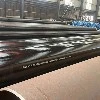
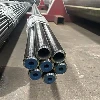
What Pipeline Steel Is, and What It Is Not
Pipeline steel is not a single grade but a family of low-carbon, micro-alloyed steels developed to do one job: carry fluids and gases under pressure through a welded line for decades without brittle failure. The family in API SPEC 5L runs from Grade B through the X-series, where the number after the X is the specified minimum yield strength in thousands of pounds per square inch, so X52 means 52 ksi minimum yield, or 359 MPa, and X70 means 70 ksi, or 483 MPa. ISO 3183 uses the same grades with L designations, so X52 and L360 describe the same strength level.
What separates pipeline steel from ordinary structural steel is not the strength. It is the combination of a low carbon equivalent so the girth weld can be made in the field, a guaranteed notch toughness at a stated temperature, a stress-strain curve with a defined yield plateau and adequate strain hardening, and a dimensional tolerance tight enough for automatic welding and inline inspection tools. A structural plate that happens to reach 450 MPa yield will usually fail the carbon equivalent and toughness requirements of a line pipe specification.
The Distinction Between PSL1 and PSL2
API 5L defines two product specification levels. PSL1 is a chemistry and tensile property specification: the mill certifies composition and tensile results, and that is largely the end of it. PSL2 adds mandatory carbon equivalent limits, mandatory notch toughness testing, tighter chemistry control, and non-destructive examination of the weld seam for welded product. Almost every transmission line designed to a modern code is ordered in PSL2, and in practice the difference in delivered cost is small relative to the difference in assurance.
There is a further layer that buyers often miss: the optional suffixes R, N, Q and M, which fix the delivery condition as as-rolled, normalized, quenched and tempered, or thermo-mechanically rolled. The suffix is not administrative. A thermo-mechanically rolled X70 and a normalized X70 are different products with different toughness behaviour in the heat affected zone, and a welding procedure qualified on one is not automatically valid for the other.
Grade Range and Property Window
Selection starts with the design pressure equation, not with the grade table. The Barlow relationship used in ASME B31.4 and B31.8 expresses design pressure as two times the specified minimum yield strength times the wall thickness, divided by the outside diameter, multiplied by a design factor, a longitudinal joint factor and a temperature derating factor. Higher grade therefore buys either more pressure at the same wall or less wall at the same pressure, and the design factor chooses how much of the yield strength the operator is willing to use.
| Grade | ISO 3183 designation | Yield strength (MPa) | Tensile strength (MPa) | Typical duty |
|---|---|---|---|---|
| Grade B | L245 | 245 to 450 | 415 to 760 | Utility, water, low pressure gas |
| X42 | L290 | 290 to 440 | 415 to 760 | Small diameter distribution and gathering |
| X52 | L360 | 359 to 530 | 455 to 760 | Medium pressure transmission, station piping |
| X60 | L415 | 415 to 565 | 520 to 760 | General transmission mainline |
| X65 | L450 | 448 to 600 | 531 to 758 | High pressure mainline, subsea flowline |
| X70 | L485 | 483 to 621 | 565 to 758 | Large diameter long distance trunkline |
| X80 | L555 | 555 to 705 | 625 to 825 | High strength, high throughput lines |
The window matters commercially. Every grade carries a maximum as well as a minimum yield strength, and a heat that overshoots the maximum is non-conforming. Mills therefore aim for the middle of the window, and a buyer who accepts a certificate showing a yield at the very top of the range should expect reduced strain capacity and a harder heat affected zone at the girth weld.
Chemistry, Micro-Alloying and the Carbon Equivalent Ceiling
Strength in pipeline steel comes mainly from grain refinement and precipitation, not from carbon. Carbon is normally held below about 0.12% in higher grades, manganese provides solid solution strengthening in the region of 1.1% to 1.6%, and niobium, vanadium and titanium are added in small amounts to pin grain boundaries during controlled rolling and to form fine carbonitrides. The result is a steel with high strength, a low ductile-to-brittle transition temperature and a carbon equivalent low enough for cellulosic and low hydrogen girth welding in the field.
Carbon equivalent is the parameter that links metallurgy to constructability. It is calculated from the composition, either as CEIIW or, for higher grades, as Pcm, and API 5L sets a maximum for PSL2 product that tightens as grade and wall thickness increase. A high carbon equivalent raises heat affected zone hardness, which in turn raises the risk of hydrogen cracking when the line is welded in cold or humid conditions, and it is the reason preheat and interpass limits in the welding procedure are tied to the actual heat analysis rather than to the grade alone.
Toughness, Fracture Arrest and Low Temperature Service
Toughness requirements are what allow a transmission line to tolerate a defect without a running fracture. PSL2 product is impact tested at a temperature stated in the purchase order, with acceptance expressed as a minimum average absorbed energy and a minimum single value. For large diameter, high pressure lines the specification usually adds a drop weight tear test to confirm resistance to brittle fracture propagation, and the design may require a specific fracture arrest toughness at the operating temperature.
Three practical rules follow. First, the test temperature must reflect the coldest metal temperature the line will see, including depressurisation scenarios where gas expansion chills the wall. Second, toughness of the weld metal and the heat affected zone has to be demonstrated separately from the pipe body for welded pipe. Third, stored pipe ages: strain ageing after coating and during storage can raise the transition temperature, so specifications for coated line pipe sometimes require impact testing after an ageing treatment.
Corrosion Resistance and the Service Environment
Pipeline steel is a carbon and low-alloy family, so its corrosion resistance comes from coatings, cathodic protection, inhibitors and internal linings rather than from the alloy itself. External protection is normally a three layer polyethylene or fusion bonded epoxy coating to ISO 21809, backed by an impressed current or sacrificial cathodic protection system designed to NACE SP0169 principles. Internal protection may be an epoxy flow coating, a corrosion inhibitor programme, or a corrosion resistant alloy liner where the fluid is aggressive.
Where hydrogen sulphide is present, ISO 15156 / NACE MR0175 governs material selection and caps hardness in the pipe body and weld at about 22 HRC for carbon steels, while restricting chemical composition and the allowable stress. Where the line is intended for hydrogen or hydrogen-blended gas, the design basis moves to ASME B31.12, which addresses hydrogen embrittlement through material limits, hardness control and fatigue assessment rather than through grade alone.
Application Areas in Practice
Oil and gas transmission is the largest application. Gathering lines from wellheads tend to use smaller diameters in X42 to X52, mainline transmission moves to X60 to X70 in diameters from 508 mm to 1219 mm, and high pressure subsea flowlines use X65 in seamless or welded form with tight toughness and dimensional control. The grade and the diameter are chosen together, because wall thickness follows from the pressure equation and the mill capability limits what can be rolled or welded at that wall.
Chemical and petrochemical service uses pipeline steel for utility headers, flare lines, cooling water circuits and low pressure process piping, but the temperature range is narrower and code compliance falls under ASME B31.3 rather than B31.8. Shipbuilding and offshore structures use line pipe for ballast, bilge, fuel oil and fire main systems, where classification society rules add approval and marking requirements on top of the material standard. City gas distribution and long distance water transmission use coated pipe in Grade B to X52, where external corrosion protection and joint coating quality dominate the life cycle cost. Slurry and tailings lines use thicker walls and abrasion resistant linings because the wear mechanism is erosion, not corrosion.
Selection, Acceptance and Storage Discipline
A complete purchase description names the standard, the grade, the product specification level, the delivery condition suffix, the outside diameter and wall thickness with tolerances, the length range, the impact test temperature and energy, the non-destructive examination annex, the pipe end finish, the coating system and the documentation package. Anything left out will be resolved by the mill in its own favour.
On receipt, check the heat number against the certificate, verify the diameter and wall thickness by sampling, confirm the bevel angle and root face, and inspect coating for holidays. Store pipe on timber skids with dunnage at close spacing to prevent ovalisation, keep the ends capped to avoid internal contamination, and stack so that the bottom layer does not carry the weight of the whole pyramid. Pipe that has been stored for a long period should be re-inspected for coating damage and for corrosion at the dunnage contact points before it is welded.
Frequently Misunderstood Points
Higher grade is not automatically better. Above X70 the wall thickness reduction becomes marginal, while welding cost, preheat requirements and inspection burden rise. A thin wall high grade line is also more sensitive to mechanical damage from third party interference, which is a leading cause of transmission line failure. The cheapest compliant answer is usually found by optimising diameter, grade and design factor together, not by maximising grade.
FAQ
Q: What does the number in an X-grade mean?
It is the specified minimum yield strength in thousands of pounds per square inch. X52 equals 52 ksi, or about 359 MPa, which corresponds to L360 in ISO 3183.
Q: Is PSL2 always required for a transmission line?
Modern codes and operator specifications normally require PSL2 because it adds carbon equivalent control, notch toughness testing and non-destructive examination. PSL1 is generally limited to low pressure utility and water duties.
Q: Can X70 be substituted for X65 without requalification?
No. A change of grade changes carbon equivalent, heat affected zone hardness and the qualified welding window, so the welding procedure and often the fracture assessment must be revisited.
Q: Why is drop weight tear testing added to Charpy testing?
Charpy energy measures resistance to initiation; the drop weight tear test measures resistance to propagation of a running fracture, which governs fracture arrest design in large diameter high pressure lines.
Q: What limits pipeline steel in sour service?
ISO 15156 / NACE MR0175 caps hardness at about 22 HRC for carbon steels, restricts chemistry and constrains the combination of stress and environment. A standard grade certificate alone does not demonstrate compliance.
Q: Does a thicker wall always mean a stronger line?
Not in collapse or in fracture terms. Thicker wall raises pressure containment but also raises the toughness and weldability burden, and in external pressure design the fabrication tolerance and ovality reduce the calculated resistance.