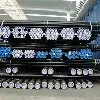
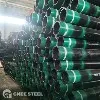
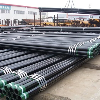
The primary difference between P110 and C110 casing is their suitability for corrosive environments. While both have the same minimum yield strength (110,000 psi), P110 is a general-purpose grade for deep, high-pressure wells, while C110 is a specialized "sour service" grade designed to resist Hydrogen Sulfide ( H2S ).
API 5CT P110 casing is one of the most widely used high-strength steel grades in oil and gas drilling. It belongs to Group 4 under the API 5CT specification and is specifically engineered for deep wells, high-pressure formations, and environments that demand extreme mechanical load capacity.
Core Positioning: P110 is a general-purpose, high-strength steel grade. With a minimum yield strength of 110,000 psi, it is the primary choice for ultra-deep well operations.
Service Environment: Primarily used in non-corrosive environments (Sweet Wells). Despite its extreme strength, it is not resistant to Hydrogen Sulfide ( H2S) corrosion. In sour environments, P110 is highly susceptible to Sulfide Stress Cracking (SSC).
Heat Treatment: It must undergo full-length Quenched & Tempered (Q&T) processing to ensure high toughness and a uniform microstructure despite its high strength.
Applications: Commonly used as production casing or intermediate casing in ultra-deep wells (over 4,000 meters) and high-pressure oil and gas wells that must withstand significant internal pressure and tensile loads.
Technical Parameter Tables for API 5CT P110
Mechanical Properties Table
P110 features a high yield strength range and requires superior tensile strength.
| Parameter | Imperial Units (psi) | Metric Units (MPa) |
| Yield Strength - Minimum | 110,000 psi | 758 MPa |
| Yield Strength - Maximum | 140,000 psi | 965 MPa |
| Tensile Strength - Minimum | 125,000 psi | 862 MPa |
| Hardness | No API Requirement | -- |
| Impact Toughness (CVN) | Per order and wall thickness | -- |
Chemical Composition Table (% Max)
P110 chemical composition typically includes alloying elements like Chromium (Cr) and Molybdenum (Mo) to enhance hardenability and overall mechanical performance.
| Element | API 5CT Limits (%) |
| Carbon (C) | Not Specified (typically 0.25% - 0.35%) |
| Manganese (Mn) | Not Specified (typically 1.00% - 1.60%) |
| Phosphorus (P) | ≤ 0.030 |
| Sulfur (S) | ≤ 0.030 |
| Silicon (Si) | ≤ 0.45 |
| Nickel (Ni) | ≤ 0.25 |
Manufacturing & Inspection Requirements (NDT)
| Item | Technical Requirements |
| Heat Treatment | Mandatory full-length Quenched & Tempered (Q&T) |
| Inspection (NDT) | Mandatory full-length Ultrasonic (UT) or Electromagnetic (EMI) testing. |
| Hydrostatic Test | Every length must be pressure tested; pressures are typically significantly higher than J55/N80 grades. |
| Straightness | Must strictly follow API 5CT tolerances for straightness. |
API 5CT C110 casing is a high-end, high-strength, sour-service (corrosion-resistant) steel grade. It belongs to Group 2 (Restricted Yield Strength grades) under the API 5CT specification.
C110 was developed to solve a major challenge in deep-well development: providing the high strength required to withstand extreme pressures while maintaining resistance to Sulfide Stress Cracking (SSC) caused by Hydrogen Sulfide ( H2S ).
Core Positioning: C110 is currently the highest-strength H2S-resistant grade in the API standard. It combines the high mechanical strength of P110 with the sour-service integrity of L80 and T95.
Corrosion Resistance Principle: Standard high-strength steels (like P110) are extremely brittle in H2S environments due to their high hardness. C110 uses precise alloying and advanced heat treatment to keep the hardness strictly below 30 HRC, allowing it to resist SSC even at high stress levels.
Manufacturing Requirements: It must undergo full-length Quenched & Tempered (Q&T) processing. The requirements for material purity (extremely low limits for Phosphorus and Sulfur) are significantly more stringent than those for standard grades.
Applications: Primarily used in deep, ultra-deep, and extremely high-pressure sour oil and gas wells (containing H2S ). When the strength of T95 (95 ksi) is insufficient to support the load of a deep well, C110 is the only safe choice.
Technical Parameter Tables for API 5CT C110
Mechanical Properties Table
C110 has a very narrow yield strength range (only a 10 ksi window) to ensure performance stability.
| Parameter | Imperial Units (psi) | Metric Units (MPa) |
| Yield Strength - Minimum | 110,000 psi | 758 MPa |
| Yield Strength - Maximum | 120,000 psi | 827 MPa |
| Tensile Strength - Minimum | 115,000 psi | 793 MPa |
| Hardness - Maximum | ≤ 30.0 HRC | -- |
| Hardness Variation | Max variation across wall is strictly limited | -- |
Chemical Composition Table (% Max)
To achieve a balance between high strength and restricted hardness, C110 typically contains significant amounts of Chromium (Cr) and Molybdenum (Mo).
| Element | API 5CT Limits (%) |
| Carbon (C) | Not Specified (typically 0.25% - 0.35%) |
| Manganese (Mn) | 1.20 |
| Phosphorus (P) | ≤ 0.020 (Strictly controlled) |
| Sulfur (S) | ≤ 0.005 (Extremely restricted) |
| Silicon (Si) | ≤ 0.45 |
| Chromium (Cr) | Typically added for hardenability |
| Molybdenum (Mo) | Typically added for tempering resistance |
Core Manufacturing & Testing Requirements
| Item | Technical Requirements |
| SSC Testing | Mandatory. Must pass laboratory SSC testing according to NACE TM0177 standards. |
| Heat Treatment | Full-length Quenched & Tempered (Q&T). |
| Grain Size | Must be a fine-grained microstructure. |
| Inspection (NDT) | High-level full-length Ultrasonic and Electromagnetic testing. |
Comparison Table
| Feature | P110 Casing | C110 Casing |
| API Group | Group 4 (High Strength) | Group 2 (Restricted Yield/Sour) |
| Yield Strength (Min) | 110,000 psi | 110,000 psi |
| Yield Strength (Max) | 140,000 psi | 120,000 psi (Strictly limited) |
| Tensile Strength (Min) | 125,000 psi | 115,000 psi |
| Max Hardness | No API Limit | Max 30 HRC (Strictly limited) |
| Service Environment | "Sweet" Service (No H2S ) | "Sour" Service (Contains H2S ) |
| Heat Treatment | Quenched & Tempered (Q&T) | Quenched & Tempered (Q&T) |
| SSC Testing | Not required | Mandatory (Sulfide Stress Cracking) |
| API Color Code | One White Band | One White Band + One Brown Band |
API 5CT Casing factory

API 5CT OCTG Test equipments

FAQ
What does P110 mean?
P110 is a high-strength steel grade for oil and gas casing and tubing, governed by the API 5CT standard.
The "110" stands for its minimum yield strength of 110,000 psi (758 MPa). It is a premium grade designed for use in deep, high-pressure wells where extreme structural integrity and high load-bearing capacity are required.
What does C110 mean?
C110 is a high-strength, API 5CT steel grade designed for sour service (environments containing hydrogen sulfide, H2S).
Strength: It has a minimum yield strength of 110,000 psi.
Specialty: Unlike P110, C110 is engineered to resist Sulfide Stress Cracking (SSC).
Usage: It is used in very deep, high-pressure wells where both high mechanical strength and corrosion resistance to H2S are required.
Requirement: It undergoes strict heat treatment (quenched and tempered) and has a controlled maximum hardness to ensure its performance in harsh environments.