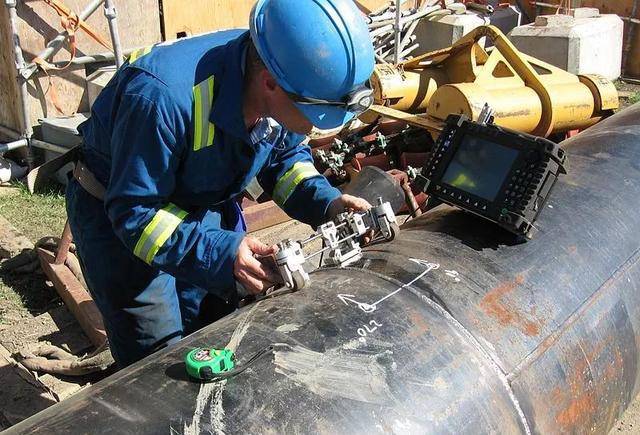
UT is the abbreviation of Nondestructive Testing. It is the most widely used, most frequently used and fastest growing nondestructive testing technology in industrial nondestructive testing. It uses a transmitting probe to transmit ultrasonic waves to the surface of the component through a coupling agent. When the ultrasonic wave propagates inside the component, it will have different reflection signals (echoes) when encountering different interfaces. The defects inside the component can be detected by using the time difference between different reflection signals transmitted to the probe.
Detection capability range
It can detect defects inside the plate, such as: delamination, folding, heavy skin, white spots, inclusions;
It is suitable for the detection of the interface bonding state between the substrate and the cladding of composite plates with a substrate thickness greater than or equal to 6mm;
It can detect defects inside forgings, such as: white spots, cracks, inclusions, segregation, and hairline;
It can detect defects inside castings, such as: slag, looseness, cold shut, tearing, shrinkage cracks, inclusions;
It can detect internal defects in welded joints, such as pores, inclusions, cracks, lack of fusion, and lack of penetration.
Advantages of ultrasonic testing:
1. Applicable to non-destructive testing of various parts such as metals, non-metals and composite materials
2. Accurate defect positioning
3. High detection rate for area defects
4. High sensitivity, capable of detecting small defects inside the test piece
5. Harmless to the human body and the environment
6. No damage to the sample
Ultrasonic testing of steel pipes