




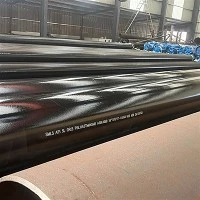
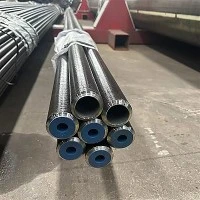


API 5CT K55 Petroleum Casing Pipes
Grade: K55 (Group 1)
Yield: 379-552 MPa
Tensile: ≥ 655 MPa
PSL: PSL1 / PSL2
Forms: Seamless / ERW
API 5CT K55 is a Group 1 casing grade in the American Petroleum Institute's specification for oil-country tubular goods. Unlike line-pipe grades that carry a single yield figure, K55 is defined by a yield window of 55,000-80,000 psi (379-552 MPa) with a minimum tensile strength of 95,000 psi (655 MPa). That wide, controlled yield band - shared with J55 - is what keeps casing ductile enough to survive the running, bending and axial tension of being lowered and cemented in a wellbore. This page is the grade-focused K55 overview for petroleum casing; the general petroleum-casing page and the K55 well-drilling page (linked in related reading) cover the well-string context and the drilling use respectively.
K55 vs J55: K55 and J55 share the same 379-552 MPa yield window, but K55's minimum tensile is 95 ksi (655 MPa) versus 75 ksi (517 MPa) for J55. The higher tensile gives K55 better burst and collapse margin for the same wall, which is why it is the preferred step-up when a job wants more reliability than J55 without moving to the costlier, heat-treated grades such as N80 or P110. API 5CT does not fix a chemical composition for K55; the mill selects the heat analysis that meets the mechanical and hardness requirements.
API 5CT K55 Oil Casing Pipe specification
The table below consolidates the parameters that define an API 5CT K55 casing order. Casing is dimensioned by outside diameter and nominal weight design (which sets the wall) rather than by a schedule number, so both are shown:
| Parameter | API 5CT K55 specification |
|---|---|
| Standard | API 5CT (OCTG); latest edition in force |
| Product | Casing (oil-country tubular goods) |
| Grade / group | K55 / Group 1 (H40-J55-K55 family) |
| Manufacturing | Seamless; ERW permitted (full-body or seam heat treatment per API 5CT) |
| Outside diameter | 4-1/2 in to 20 in (114.3-508 mm); larger on request |
| Wall (weight design) | nominal weight 9.5-133 lb/ft; wall set by weight design |
| Length range | R1, R2 or R3 |
| Ends & thread | plain-ended (PTC); STC / LTC / BTC; premium on request |
| Product specification level | PSL1 and PSL2 only (PSL3 not offered) |
| Heat treatment | seamless as-rolled or normalized; ERW ≥540°C or seam-normalized |
| Wall tolerance | 0 to -12.5% of nominal wall |
| Service basis | conventional, non-sour petroleum, geothermal and water wells |
| Mill certificate | EN 10204 3.1; 3.2 with third-party inspection on request |
The mechanical values are the API 5CT grade requirements; the size, weight and length ranges follow the invoked edition. All dimensions are project- and order-specific - confirm against the applicable API 5CT edition and the operator's casing-design program.
Where K55 sits in the API 5CT casing grade ladder
Casing grades are chosen by the loads a string must carry - collapse, burst and tension - and by the well fluid. K55 occupies the moderate-strength band of Group 1, between the lighter H40/J55 and the heat-treated N80/L80 grades:
| Grade | Yield MPa (ksi) | Tensile min MPa (ksi) | Typical casing role |
|---|---|---|---|
| H40 | 276-552 (40-80) | 414 (60) | conductor and shallow, low-load strings |
| J55 | 379-552 (55-80) | 517 (75) | surface and intermediate, conventional wells |
| K55 | 379-552 (55-80) | 655 (95) | surface/intermediate needing higher burst margin |
| N80-1 | 552-758 (80-110) | 689 (100) | deeper intermediate and production strings |
| L80-1 | 552-655 (80-95) | 655 (95) | sour-service and corrosive wells |
Yield is shown as the API 5CT min-max window; tensile is the minimum. Grade selection also depends on PSL, heat treatment and the operator's casing-design program. The values are indicative of the API 5CT grade bands; confirm against the invoked edition.
Mechanical properties of K55 casing
K55 is set by its strength window and hardness cap rather than by composition. The table below summarizes the requirements that define the grade:
| Property | Requirement |
|---|---|
| Yield strength | 379 MPa (55 ksi) min, 552 MPa (80 ksi) max |
| Tensile strength | 655 MPa (95 ksi) min |
| Hardness | 22 HRC max (H40/J55/K55 group) |
| Elongation | per API 5CT table by size and wall |
| Heat treatment | seamless as-rolled or normalized; ERW full-body ≥540°C or seam-normalized |
| Product level | PSL1 and PSL2 only (not PSL3) |
The 22 HRC hardness cap keeps K55 within the envelope generally recognized for mildly sour conditions, but K55 remains a conventional grade for non-sour service; specify L80-1, C90, T95 or a corrosion-resistant alloy where hydrogen sulfide is present.
Typical chemistry (not fixed by API 5CT)
Because API 5CT does not prescribe a fixed chemistry for K55, mills choose the heat analysis that delivers the strength and hardness. The ranges below are typical mill practice, not mandatory limits - the actual heat analysis for each heat is recorded on the mill test certificate:
| Element | Typical range / max |
|---|---|
| Carbon (C) | 0.34-0.39 (typical) |
| Manganese (Mn) | 1.25-1.50 (typical) |
| Phosphorus (P) | 0.030 max |
| Sulfur (S) | 0.015 max |
| Silicon (Si) | 0.20-0.35 (typical) |
The composition is a carbon-manganese steel with tight phosphorus and sulfur control, which supports field weldability for connections made up by welding. Final values are project- and mill-specific and appear on the EN 10204 3.1 certificate.
Manufacturing routes for K55 casing
Both API 5CT routes reach the K55 grade, and the choice follows the size, wall and project specification:
| Route | How it is made | Typical casing role |
|---|---|---|
| Seamless (SMLS) | billet pierced, rolled and sized; dominant for casing | all diameters; preferred for pressure integrity |
| ERW / HFW | skelp formed and resistance-welded; full-body or seam heat treatment required | smaller and medium diameters, cost-effective strings |
Sizes, wall (weight design) and lengths
K55 casing is produced in the standard API size series. Outside diameters run from about 4-1/2 in (114.3 mm) to 20 in (508 mm), with larger sizes on request. Wall is normally expressed through the nominal weight per foot, which sets the wall for a given outside diameter; the table lists representative weights for common sizes:
| OD (in) | OD (mm) | Representative nominal weight (lb/ft) |
|---|---|---|
| 4-1/2 | 114.3 | 9.5 - 15.1 |
| 5-1/2 | 139.7 | 14.0 - 20.0 |
| 7 | 177.8 | 20.0 - 29.0 |
| 9-5/8 | 244.5 | 36.0 - 53.5 |
| 13-3/8 | 339.7 | 48.0 - 68.0 |
| 20 | 508.0 | 94.0 - 133.0 |
The nominal weight design - not a separate schedule number - determines the wall; state the required OD and weight (or wall) on the order. Lengths are supplied in API 5CT ranges R1 (shortest), R2 (about 8.5-9.8 m, the most common for casing to reduce the number of joints) and R3 (longest); exact range limits follow the invoked edition.
Connections and threads
K55 casing ends are prepared to the API 5B thread forms: short round thread (STC), long round thread (LTC) and buttress thread (BTC), supplied plain-ended and threaded-and-coupled or with an integral joint. The coupling is furnished in the matching grade and is subject to the same 22 HRC hardness limit. Buttress thread is favored for higher joint strength on deeper or heavier strings, while round threads suit lighter strings. Where gas-tight sealing is required, proprietary premium connections can be supplied on request.
Well-construction role and service limits
K55 is a workhorse for conventional, non-sour petroleum wells: it is used for conductor, surface and intermediate strings where the collapse, burst and tension loads are within its strength band, and for geothermal and water wells in non-corrosive environments. It is replaced by N80-1 or P110 when the loads exceed what K55's yield and tensile provide at a practical wall, and by L80-1, C90, T95 or a corrosion-resistant alloy where sour (H2S) service or severe corrosion applies. The selection is made from the casing-design loads and the well fluid rather than from a fixed depth.
PSL levels for K55
K55 is offered in PSL1 and PSL2 only; API 5CT does not provide PSL3 for this grade because PSL3 is aimed at the most severe acidic and corrosive applications that a conventional carbon-manganese grade is not intended for. PSL1 is the basic delivery state (as-rolled or normalized, standard mechanical and dimensional requirements); PSL2 adds mandatory heat treatment, full-length volumetric and surface NDE, impact testing where specified, and tighter surface and dimensional controls. For a program needing PSL3-level assurance, a grade such as T95 or a corrosion-resistant alloy is selected instead.
Acceptance testing and documentation
Hydrostatic or NDE. Each pipe is hydrostatically tested or, as the order permits, full-length volumetric NDE is applied in lieu of the hydrostatic test, per API 5CT.
Seam and body inspection. Seamless: full-length volumetric NDE of the body. ERW: inspection of the longitudinal weld plus surface examination.
Flattening and drift. Flattening tests and drift (internal clearance) checks verify formability and running clearance.
Impact and hardness. PSL2 adds impact testing where specified; hardness is controlled to the 22 HRC group limit.
Mill certificate. EN 10204 3.1 as standard; 3.2 with SGS / BV / DNV / TUV or other third-party inspection on request, reporting heat analysis, tensile, impact and dimensions.
Marking. Manufacturer, specification, grade, size, weight design, heat number and thread type, per API 5CT.
Petroleum-casing ordering checklist
Provide the following so the mill documents match the well program:
Specification & grade: API 5CT (Edition), Grade K55, PSL1 or PSL2.
Size & wall: outside diameter (or NPS) and nominal weight design (sets the wall), or wall directly.
Length range: R1, R2 or R3; cutting lengths by agreement.
Ends & thread: STC, LTC, BTC or premium; plain-ended and threaded-and-coupled or integral joint.
Quantity & coupling: total quantity and coupling grade/requirement.
Service basis: non-sour conventional service; state sour (H2S) restriction - K55 is not the grade for H2S service.
Certificate: EN 10204 3.1; 3.2 or third-party inspection on request.
test and inspection


Packaging and shipping

FAQ
What mechanical properties define API 5CT K55 petroleum casing?
K55 is an API 5CT Group 1 casing grade defined by a wide yield window rather than a single value: the specified yield is 55,000-80,000 psi (379-552 MPa) and the minimum tensile strength is 95,000 psi (655 MPa). The standard also caps hardness at 22 HRC for the H40/J55/K55 group, and elongation is taken from the API 5CT table by size and wall. The broad yield band is intentional - it keeps the pipe ductile for the running, bending and tensile loads of being lowered and cemented in a well, while the higher minimum tensile than J55 gives better burst and collapse margin. Confirm the invoked API 5CT edition, as the property tables are edition-specific.
How is K55 casing manufactured, seamless or welded?
K55 casing is most commonly produced by the seamless route - a round billet is heated, pierced, rolled and sized, giving uniform circumferential properties with no longitudinal weld. API 5CT also permits electric-resistance-welded (ERW) manufacture for this grade; ERW K55 must receive full-pipe-body heat treatment at 540 deg C (1000 deg F) or above, or the weld seam must be normalized after welding, so the seam reaches the grade properties. Seamless dominates casing supply because of pressure integrity and the absence of a seam in the body; the manufacturing route is selected on the order together with the size and wall.
What wall thickness and collapse or burst design considerations apply to K55 casing?
Casing wall is usually expressed through the nominal weight per foot rather than a bare millimeter wall, because the same outside diameter has several weight designs (for example 9-5/8 in at 36.0, 40.0, 43.5, 47.0 or 53.5 lb/ft) that set thicker or thinner walls. The wall actually used is the one that satisfies the well's collapse, burst and axial-tension design loads for the setting depth, not a stock schedule. K55's 379-552 MPa yield and 655 MPa minimum tensile give moderate burst and collapse capacity, so it is selected for shallower and lower-pressure strings where a higher grade such as N80 or P110 is not required. The collapse and burst are calculated with the API 5CT (or operator) formulas using the selected weight design, the mud and formation pressures, and the axial load.
Does K55 casing require a specific thread type, or can it be supplied with any API 5B connection?
K55 is not tied to one connection; it can be supplied with any of the standard API 5B threads - short round thread (STC), long round thread (LTC) or buttress thread (BTC) - as plain-ended and threaded-and-coupled, or with an integral joint on request. The coupling is furnished in the matching grade and is subject to the same 22 HRC hardness limit. Buttress thread is often chosen for deeper or higher-load strings because of its higher joint strength, while round threads are common on lighter strings. Where gas-tight performance is needed, proprietary premium connections can be supplied on request; the thread type is stated on the order along with the grade and size.
Which wells is K55 casing suited to, and when should a higher grade replace it?
K55 is a conventional, non-sour-service grade used for surface, conductor and intermediate strings in shallow-to-medium depth oil and gas wells, and for geothermal and water wells where the environment is not corrosive. It is stepped up to N80-1 or L80-1 when the collapse, burst or tension loads exceed what K55's yield and tensile provide at the required wall, and to L80-1, C90, T95 or a corrosion-resistant alloy when hydrogen sulfide (sour) service or severe corrosion is present. The grade is therefore chosen from the casing-design loads and the well fluid, not from a fixed depth number. This page covers the K55 grade; the general petroleum-casing and the K55 well-drilling pages cover the well-string context and drilling use respectively.
Why is API 5CT K55 limited to PSL1 and PSL2 and not PSL3?
API 5CT defines K55 only in Product Specification Levels 1 and 2; PSL3 is not offered for this grade because PSL3 is reserved for grades and quality levels intended for the most severe acidic and corrosive applications, and K55 is a conventional carbon-manganese grade for non-sour service. PSL1 is the basic level (as-rolled or normalized, with the standard mechanical and dimensional requirements), and PSL2 adds mandatory heat treatment, full-length volumetric and surface NDE, and impact testing where specified, plus tighter surface and dimensional controls. For a well that needs PSL3-level assurance, a grade such as T95 or a corrosion-resistant alloy is selected instead.
What information should a purchase order include for API 5CT K55 petroleum casing?
Provide the specification (API 5CT, Edition), grade K55, PSL1 or PSL2, outside diameter (or NPS) and nominal weight design (which sets the wall), length range (R1, R2 or R3), end finish and thread type (STC, LTC, BTC or premium), quantity, and the certificate (EN 10204 3.1; 3.2 with third-party inspection on request). Because this is casing, also state the coupling requirement, any sour-service restriction (K55 is for non-sour service), the inspection and NDE level, and the packing and marking basis so the mill documents match the well program. Prices and lead times are quoted against the specific bill of materials.
Hot Tags: API 5CT K55 Petroleum Casing Pipes, China API 5CT K55 Petroleum Casing Pipes manufacturers, suppliers, factory, octg upgrade, casing for oil and gas wells, octg o ring, octg cost, octg in oil exploration, octg drill collars
You Might Also Like


Send Inquiry