




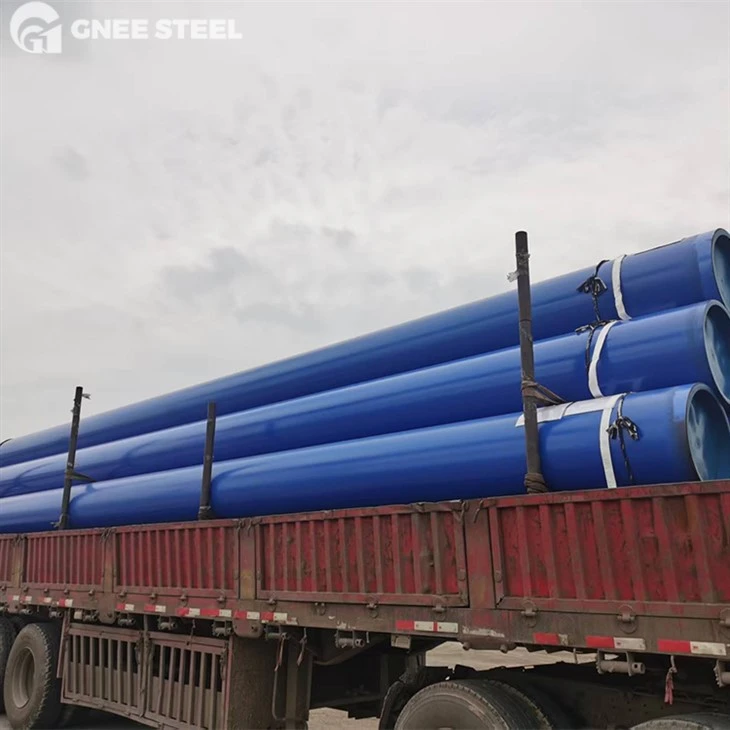
FBE Coated Line Pipe
FBE Coated Line Pipe: Complete Industry Guide (Specifications, Process, Standards & Applications)
FBE Coated Line Pipe refers to carbon steel line pipe (typically manufactured in accordance with API 5L, ISO 3183 or equivalent standards) protected by a Fusion Bonded Epoxy (FBE) thermosetting powder coating. As a mature, high-reliability pipeline solution with over 40 years of industrial application, FBE coated line pipe has become one of the most widely adopted coating systems for buried and submerged pipelines worldwide for buried, subsea and submerged transmission pipelines in oil & gas, municipal water, wastewater and chemical sectors. This authoritative guide complies with the latest international coating standards, summarizes manufacturing workflows, performance data, product categories, pros & cons, selection rules and frequently asked questions for engineers, procurement managers and EPC contractors.
FBE coated line pipe is a type of pipe that uses FBE (fused epoxy powder) anti-corrosion coating.
FBE coating is an anti-corrosion coating composed of epoxy resin, curing agent, pigment, filler, etc. It is coated on the surface of the pipeline through electrostatic spraying or thermal spraying. After curing, it forms a layer of hard, smooth and corrosion-resistant coating. The protective layer.
Fusion Bonded Epoxy line pipe has excellent corrosion resistance, abrasion resistance, impact resistance, and anti-aging properties. It can effectively protect the pipeline from erosion and damage from the external environment and extend the service life of the pipeline.
FBE coated line pipes are widely used in pipeline projects in the fields of petroleum, natural gas, chemical industry, water supply, drainage and other fields. Especially in pipelines that need to be buried or used underwater for a long time, their anti-corrosion effect is more significant.
| Property | Description |
|---|---|
| Pipe Material | Carbon steel, stainless steel, etc. |
| FBE Coating Thickness | Typically 200-400 micrometers |
| Coating Color | Varies depending on manufacturer and application |
| Application | Oil and gas pipelines, water pipelines, chemical pipelines, etc. |
| Advantages | Good corrosion resistance, durability, smooth finish, environmentally friendly |
| Disadvantages | Sensitive to moisture during application, requires proper pretreatment of pipe surface |
| Coating Process | Typically applied by electrostatic spraying or thermal spraying |
| Inspection & Testing | Visual inspection, thickness measurement, adhesion testing, etc. |
| Compliance Standards | API 5L, ASTM A106, ISO 3183, etc. |
Standard Technical Performance Parameters of FBE Coated Line Pipe
| Performance Item | Typical Standard Value | Test Reference Standard |
|---|---|---|
| Single FBE Coating Thickness | 300 – 500 μm | CSA Z245.20, NACE SP0394 |
| Working Temperature Range | -40°C to +110°C | AWWA C213, ISO 21809-2 |
| Cathodic Disbondment (65°C, 24h) | Disbond radius < 6.5 mm | CSA Z245.20 |
| Impact Resistance | ≥ 1.5 Joules | ASTM G14 |
| Hot Water Adhesion Grade | Grade 1 (No peeling, no blister) | CSA Z245.20 |
| VOC Content | 0 (Solvent-free epoxy powder) | Global environmental coating regulations |
Request a free quote with pricing, coating specifications, and delivery time within 24 hours.
FBE anti-corrosion coating steel pipes

Standard FBE Coating Manufacturing Process (5 Core Steps)
Step 1: Steel Surface Abrasive Blast Preparation (Most Critical Procedure)
Poor surface cleaning is the No.1 root cause of FBE coating failure in field service. All line pipe substrates undergo abrasive blasting to reach Sa 2.5 / SSPC-SP10 near-white metal finish. Blasting creates a uniform anchor profile roughness between 40μm – 100μm, eliminating mill scale, rust, grease, hydrocarbon contaminants and soluble ionic salts completely to avoid later peeling or blistering.
Step 2: Uniform Induction Heating
The cleaned line pipe passes through induction heating coils for even heating, typically controlled within 180°C–250°C depending on the coating formulation and manufacturer's process requirements. Temperature precision is non-negotiable: insufficient heat leads to incomplete powder fusion; excessive heating triggers coating bubbling and degradation.
Step 3: High-Voltage Electrostatic Powder Spraying
Negatively charged FBE powder particles are ejected from electrostatic spray guns and firmly attracted to grounded hot steel pipe surfaces. The powder melts instantly on contact with high-temperature steel, fully flowing into the anchor texture and starting cross-link chemical reactions simultaneously.
Step 4: Full Chemical Curing
The coating continues curing through residual pipe heat or an additional curing stage, depending on the coating process.
Step 5: Controlled Cooling & Post-Processing QC
Fully cured pipe is rapidly cooled via water quenching to solidify the hard epoxy protective shell, then transferred to the quality inspection station for full range performance testing before storage and delivery.
Latest Valid International & National Standards for FBE Coated Line Pipe
All specifications below are up-to-date active standards:
Oil & Gas External Pipeline Coating: ISO 21809-2:2021, CSA Z245.20-2020, API 5L (Line Pipe Specification)
Potable Water & Wastewater Lining / Outer Coating: AWWA C213-2021 (NSF 61 certified for drinking water contact)
Coating Construction & Quality Control Guidelines: NACE RP0394
China Industrial Standards: SY/T 0315-2017, GB/T 23257-2017
3LPE / 3LPP Composite System Matching Standard: DIN 30670, CAN/CSA-Z245.21
Three Main Types of FBE Coated Line Pipe & Applications
Single-Layer Standard FBE Coated Line Pipe
The most cost-effective universal FBE solution, with typical dry film thickness 300μm – 500μm. Suitable for regular buried municipal water pipelines, common natural gas distribution lines and low-corrosion soil environments. Typical continuous operating temperature up to approximately 110°C, depending on coating grade and project specification.
Limitations: Moderate impact resistance, sensitive to long-term direct UV sunlight exposure.
Dual-Layer ARO Abrasion Resistant Overlay FBE Line Pipe
Consists of a base standard FBE layer plus an outer modified abrasion-resistant overlay (ARO), total coating thickness 400μm – 800μm. Primarily designed for HDD horizontal directional drilling, river/road pipeline crossing projects and backfill with sharp rock fragments. Dual-layer FBE greatly improves scratch resistance, gouge protection and cathodic disbondment performance during pipe pulling construction.
FBE Primer Layer for 3LPE / 3LPP Composite Coated Line Pipe
FBE acts as the adhesion and primary anti-corrosion base coat inside three-layer polyethylene or polypropylene systems, with controlled thickness 150μm – 300μm. The outer PE/PP layer provides superior mechanical shock resistance and water barrier performance, widely adopted for long-distance onshore trunk lines and subsea oil & gas pipelines. This composite structure compensates FBE's weakness in abrasion and moisture isolation.
Advantages of FBE Coated Line Pipe
Ultra-strong dual adhesion (mechanical anchor interlock + chemical fusion), resistant to large-area coating peeling under soil stress;
Industry-leading cathodic disbondment resistance, perfectly compatible with pipeline cathodic protection (CP) systems; helps minimize corrosion propagation beneath the coating when used together with cathodic protection systems
When used as an internal lining, the smooth coating surface may reduce fluid friction and improve hydraulic efficiency.
Excellent chemical resistance against acid soil, saltwater, sewage and industrial corrosive media, can provide a design service life exceeding 30–50 years under appropriate design, installation and operating conditions.
Eco-friendly solvent-free formula, no heavy metal additives, NSF 61 compliant for safe drinking water transportation;
Generally offers higher temperature resistance than conventional 3LPE coating systems.
Inherent Limitations of FBE Coated Line Pipe (Selection Reference)
Thermoset epoxy coating is rigid and brittle; rough transportation, rocky backfill and heavy mechanical impact may cause coating damage if proper handling procedures are not followed;
Poor UV resistance: long-term outdoor sunlight exposure triggers surface chalking (powdering); pipes must be buried underground or fully covered during outdoor storage;
Single-layer FBE lacks heavy abrasion protection; HDD crossing and rocky terrain projects require dual-layer ARO FBE or 3LPE composite coating instead.
Global Application Fields of FBE Coated Line Pipe
Onshore & subsea crude oil, natural gas trunk and distribution pipelines;
Municipal potable water transmission network and wastewater / storm sewer pipeline systems;
Petrochemical plant corrosive medium process pipelines;
Power plant cooling water and waste heat recovery circulation lines;
Agricultural underground irrigation piping systems.
Quality Control Tests for FBE Coated Line Pipe
Reputable manufacturers implement full batch inspection before shipment to guarantee long-term underground performance:
holiday detection using the test voltage specified by the applicable coating standard and coating thickness;
Full-point coating thickness measurement for single-layer, dual-layer and composite primer FBE;
Coating Adhesion testing to verify compliance with AWWA / CSA grade 1 standard;
Periodic sampling type tests: cathodic disbondment, impact resistance and thermal stability;
Visual appearance inspection with complete repair record traceability for all surface defects.
FBE Coated Steel Pipe Certificate

FBE Coated steel pipe supplier

GNEE Pipe participated in the NECC exhibition

FBE Coated Steel Pipe Customer

FBE Coated Pipe Process Line

Coated Steel Pipe Packaging and shipping

FAQ
FAQ 1: What does FBE stand for in FBE Coated Line Pipe?
FBE is the abbreviation of Fusion Bonded Epoxy, a solvent-free thermosetting epoxy powder coating material specially developed for steel pipeline anti-corrosion.
FAQ 2: What is the difference between single-layer FBE and dual-layer ARO FBE line pipe?
Single-layer FBE is the standard economical type for common buried pipelines with mild soil corrosion. Dual-layer ARO FBE adds an extra abrasion-resistant overlay layer, greatly improving scratch and gouge resistance, specially customized for horizontal directional drilling, river and road crossing construction projects.
FAQ 3: Can FBE coating be used as internal lining for drinking water pipelines?
Yes. Qualified FBE coating complies with AWWA C213-2021 and NSF 61 standards, non-toxic, heavy-metal-free and solvent-free, fully suitable for potable water internal lining and outer anti-corrosion coating.
FAQ 4: Why cannot FBE coated line pipe be stored outdoors for a long time without covering?
FBE epoxy material has weak UV resistance. Continuous direct sunlight will cause coating surface chalking, which gradually damages the complete anti-corrosion barrier and shortens pipeline service life. Outdoor stored FBE pipes need waterproof tarpaulin full coverage or temporary soil backfill protection.
FAQ 5: What is the main reason for FBE coating failure after pipeline burial?
A significant proportion of field coating failures come from incomplete steel surface pretreatment: residual rust, mill scale, grease or soluble salt contaminants prevent effective mechanical and chemical fusion between epoxy powder and steel substrate, leading to peeling, bubbling and local corrosion penetration after several years of operation.
FAQ 6: Can FBE serve as the primer layer of 3LPE three-layer polyethylene coating system?
Certainly. FBE is the serves as the primer layer of standard 3LPE composite coating, with controlled thickness 150μm to 300μm. It provides stable adhesion between steel substrate and middle adhesive layer, and undertakes primary anti-corrosion function before the outer PE barrier layer.
FAQ 7: What temperature range can FBE coated line pipe work stably?
Typical service temperature window of standard FBE coated line pipe is -40°C to +110°C, which is wider than the temperature limit of conventional 3LPE coating systems.
FAQ 8: When should engineers choose 3LPE instead of FBE coated line pipe?
Select 3LPE coating if the project involves long-distance buried trunk pipelines, subsea laying, rocky backfill with high mechanical damage risk, or long-term low-temperature operating environments where strong abrasion and water barrier performance are top priorities. Note that 3LPE cannot be applied to pipe internal lining.
Hot Tags: fbe coated line pipe, China fbe coated line pipe manufacturers, suppliers, factory, coated pipe for sewage, coated pipe for construction, coated pipe for gas transportation, polyurethane coated steel pipe, coated pipe for high pressure applications, galvanized steel pipe
You Might Also Like



Send Inquiry