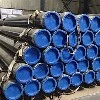
What ASTM A500 Actually Covers
ASTM A500/A500M is the product specification for cold-formed welded and seamless carbon steel structural tubing in round, square, rectangular and special shapes. It is a structural tubing standard, not a pressure-pipe standard, and that distinction drives almost every clause a buyer has to check. The specification applies to tubing with an outside diameter of 88 in (2235 mm) and below and a nominal wall thickness of 0.875 in (22 mm) and below, which covers the overwhelming majority of hollow sections used in building frames, racking, trailers, machine bases and sign structures.
Because the section is cold formed from steel strip and then welded, the finished tube carries work hardening in its corners and a weld seam that has not seen a full-section normalizing treatment. The standard recognises this and sets its mechanical properties on the finished tube rather than on the coil, which is why A500 properties cannot be inferred from the strip certificate alone. A purchase order that names only a steel grade such as Q355 or S355 without naming A500 will not automatically deliver the same finished-tube properties, because the reference properties of the two systems are measured on different product forms.
Three consequences follow for procurement. First, the tensile requirements in A500 are stated for the tube as supplied, so a mill certificate quoting coil properties does not demonstrate compliance. Second, section properties depend on the actual measured wall, and cold forming thins the wall at the corners, so the nominal wall is not the design wall. Third, the shape tolerances in A500 are noticeably tighter than those of hot-formed tubing, and they are the tolerances that decide whether a fabrication jig closes without shimming.
Grade Range and Mechanical Requirements
A500 defines four grades, A, B, C and D, distinguished purely by minimum yield and tensile strength on the finished tube. Round tubing and shaped tubing are tabulated separately because the cold working of corners raises strength in square and rectangular sections; purchasers must therefore state the shape when they quote a grade, otherwise the mill is entitled to certify against the round-section table.
| Grade | Minimum yield strength, round | Minimum tensile strength, round | Typical use |
|---|---|---|---|
| A | 33 ksi (230 MPa) | 45 ksi (310 MPa) | General fabrication, guards, low-load frames |
| B | 42 ksi (290 MPa) | 58 ksi (400 MPa) | Structural frames, racking, trailer chassis |
| C | 46 ksi (317 MPa) | 62 ksi (427 MPa) | High-load columns, heavily loaded beams |
| D | 36 ksi (250 MPa) | 58 ksi (400 MPa) | Welded assemblies needing toughness and ductility |
Elongation limits in A500 are expressed against a gauge length related to the section and are tabulated separately for round and shaped tubing; they are not a fixed percentage for all sizes. Grade C should not be read as simply "stronger Grade B": its higher strength comes with reduced elongation and a narrower welding window, and heat input during fabrication has to be controlled accordingly. Where a design mixes grades in one welded assembly, the lower-strength grade governs the weld procedure unless a qualified procedure for the dissimilar joint is used.
Chemical Composition and Weldability
The chemistry limits are deliberately loose compared with line pipe specifications, because A500 is a formability specification and is expected to be met from plain carbon steel without micro-alloying or controlled rolling. Copper may be added for atmospheric corrosion resistance, but only when copper steel is ordered, and the copper range is then mandatory rather than optional.
| Element, % max | Grades A, B, D (heat) | Grades A, B, D (product) | Grade C (heat) | Grade C (product) |
|---|---|---|---|---|
| Carbon | 0.26 | 0.30 | 0.23 | 0.27 |
| Manganese | 1.35 | 1.40 | 1.35 | 1.40 |
| Phosphorus | 0.035 | 0.045 | 0.035 | 0.045 |
| Sulfur | 0.035 | 0.045 | 0.035 | 0.045 |
| Copper, copper steel | 0.20 | 0.18 | 0.20 | 0.18 |
The product-analysis allowances matter in practice. A heat analysis sitting at 0.26 % carbon can legally be delivered at 0.30 % carbon in the product, and the difference is visible at the arc: a 0.30 % C tube with 1.4 % Mn has a carbon equivalent high enough to need preheat on thick-wall corner welds and to suffer hydrogen cracking if electrodes are damp. Buyers welding thick square sections should ask for the product analysis rather than the heat analysis, and should set an internal carbon equivalent ceiling in the technical annex if the fabrication involves restraint.
Sulfur and phosphorus at the permitted maxima also affect corner cracking during cold forming. Mills producing thin-wall square tube from strip normally run well below the limits to protect the forming rolls, so a certificate that shows S at 0.030 % is a warning sign on thin sections even though it is fully compliant.
How Cold-Formed Tubing Is Made
Round tube is formed from slit coil through a series of breakdown, forming and sizing rolls, joined by high-frequency electric resistance welding or, on heavier walls, by electric flash welding, then sized and straightened. Square and rectangular sections are produced in one of two ways. The direct-square route forms the strip into a square shape with a seam on one flat, which is efficient but concentrates forming strain at four corners. The round-then-square route forms and welds a round tube first and then reshapes it through Turks-head rolls, which gives a more uniform corner radius and better concentricity on heavy walls.
Inside and outside weld flash is normally removed on the outside for dimensional and coating reasons, and the weld zone is either left as-welded or given a localized normalizing pass. Seam annealing is not mandatory under A500, but it changes the weld-zone hardness and the bend performance of the tube, and therefore should be stated explicitly if downstream bending, flaring or swaging is planned. A tube that formed and welded cleanly can still fail a tight bend because the seam was left in the as-welded condition with a hardness spike.
Seam orientation on square and rectangular tube is a legitimate contractual point. Placing the seam on a face rather than a corner changes both the appearance after painting and the fatigue behaviour under repeated loading on that face, and on architectural work the seam position should be agreed before rolling starts, not sorted out at the yard.
Dimensions, Tolerances and Section Properties
A500 tolerances are tighter than hot-formed hollow section tolerances in the same size range, which is the main technical reason specifiers accept the cold-forming residual stresses. The tolerances that actually cause site problems are not the obvious ones. Outside dimension tolerance governs whether a coupling or clamp fits. Wall tolerance and corner thinning govern the real moment capacity. Twist and straightness govern whether a long member can be erected without forcing.
Corner geometry deserves separate attention. Cold forming produces an outside corner radius that is a multiple of the wall thickness, and a weld deposited into that radius follows a curved path with variable heat sink. Detailing a fillet weld that assumes a sharp 90 degree corner, or a corner radius smaller than the tube can physically deliver, leads to either weld rejection or a dimensional concession. Corner radius and squareness of the section should be confirmed against the standard's tables before connection details are frozen.
Section properties published in handbooks are calculated on nominal dimensions with sharp corners, so they overstate the real stiffness slightly. For deflection-sensitive members, the effective wall after corner thinning and the rounded-corner geometry should be used, or the design should carry a margin. For members loaded in compression, the flat-width-to-thickness ratio governs local buckling, and thin-wall large-format square tube can be limited by local buckling long before the yield strength of Grade B or C is reached.
Finishing, Coating and Fabrication Behaviour
Tubing is normally supplied black, varnished, oiled or hot-dip galvanized. Where galvanizing is required, the purchaser must state whether the tube is to be galvanized after fabrication or supplied pre-galvanized, because the two routes have different consequences. Post-fabrication galvanizing to ASTM A123/A123M requires vent and drain holes in every closed member and a steel chemistry that responds predictably to the zinc bath; silicon and phosphorus levels that are perfectly acceptable for welding can produce an excessively thick, dull and brittle coating. Pre-galvanized tube avoids the venting problem but leaves every cut end, weld and drilled hole unprotected unless it is repaired with a zinc-rich coating.
Cold-formed tube is dimensionally stable but carries residual stress, and machining one face of a square tube releases that stress. Components that must stay flat after milling are often stress relieved before machining, which is an additional operation outside the base requirements of A500 and therefore has to be written into the order. Similarly, tube to be bent should be specified with a bend radius, a mandrel requirement and an acceptance criterion for ovality and wall thinning, because the standard's dimensional tolerances apply to straight lengths as delivered, not to formed parts.
Testing, Inspection and Documentation
A500 requires the tube to be tested for soundness of the weld and for compliance with the mechanical requirements, and the mill is normally allowed to choose between a pressure test and a nondestructive electric test for the weld soundness check. That option is important to a buyer: a certificate of compliance alone does not tell you which route was used, so where weld soundness is critical, the test method should be named in the purchase order.
A usable receiving inspection for structural tubing is short and mechanical. Measure the outside dimension at both ends and at mid-length on two axes. Measure the wall at four points on each face, including near the corners, with an ultrasonic thickness gauge that has been zeroed on a known step. Lay the length on a flat bed and check straightness and twist. Check the seam position against the agreed drawing. Cut a short coupon and bend it flat on itself to expose seam quality, or run a dye penetrant check on the seam ends. Each of these takes minutes and catches the failures that a certificate review cannot.
The mill test certificate should be checked for three things beyond chemical and tensile values: whether the values are product analysis or heat analysis, whether the tensile test was taken from the finished tube, and whether the grade was certified against round or shaped section requirements. Where third-party inspection is required, the inspection release should be tied to the heat number actually shipped, not to a generic approval of the mill.
Applications and Selection Guidance
ASTM A500 tubing is the default choice for welded building frames, mezzanine and racking structures, guardrail and handrail, agricultural implements, trailer and chassis work, sign gantries, solar mounting and general machine guards. It is a poor choice where the bore carries pressure, where the service temperature drops below the Charpy-tested range of ordinary structural grades, or where the member will be dynamically loaded in a fatigue-critical detail without a proper weld detail and inspection plan.
Selection is usually decided by three questions. Is the member governed by yield, by stiffness, or by local buckling? Stiffness-governed members gain nothing from upgrading to Grade C and gain everything from a larger depth or thicker wall. Yield-governed members should compare the delivered cost per unit of moment capacity rather than price per tonne. Buckling-governed members must check the flat width to thickness ratio, because the grade does not postpone local buckling. Once those three are answered, the coating system and the end preparation usually determine the rest of the cost.
Comparing A500 with alternatives is straightforward. Hot-formed structural tube to ASTM A501 offers more generous tolerances and better performance after severe forming, at the cost of dimensional control. Cold-formed hollow sections to EN 10219 offer a parallel grade system (S235JRH to S355J2H) and are the natural reference for European projects, while hot-finished sections to EN 10210 sit in the same space as A501. Mechanical tubing standards, and pressure pipe standards such as API 5L or ASTM A106, address different acceptance criteria and should not be substituted on the assumption that "steel tube is steel tube".
Common Specification Mistakes
The most frequent error is specifying a strip grade instead of a tube grade, then rejecting the delivered tube for properties that the strip grade never promised on the finished product. The second is quoting a single grade without stating the shape, leaving the mill free to certify against the round-section table. The third is omitting the weld-soundness test method and later discovering that no test record exists for the welds that matter.
Two further errors appear at the fabrication stage rather than at purchase. Designers often use sharp-corner section properties and then find the connection detail cannot be welded into the actual corner radius. And buyers who galvanize after fabrication frequently discover that no vent holes were detailed, which turns a finished frame into a rework job. Both are preventable by exchanging a section drawing and a coating route with the mill before the order is confirmed.
FAQ
Q: Is ASTM A500 the same as ASTM A53 pipe?
No. A500 is a structural tubing specification for cold-formed welded and seamless tubing in round, square and rectangular shapes, graded on finished-tube yield and tensile strength. A53 covers pipe for mechanical and pressure applications in nominal pipe sizes with threaded or plain ends, and its acceptance criteria, threading and hydrostatic requirements differ from A500.
Q: What is the minimum yield strength of A500 Grade B square tubing?
Grade B round tubing requires 42 ksi (290 MPa) minimum yield and 58 ksi (400 MPa) minimum tensile. Square and rectangular tubing of the same grade is tabulated separately in the standard because cold working the corners raises strength, so the applicable table must be identified on the certificate.
Q: Can A500 tubing be hot-dip galvanized after welding?
Yes, and ASTM A123/A123M covers the coating. The frame must be detailed with vent and drain openings, the steel chemistry must suit the zinc bath, and threads or machined faces must be masked. Coating thickness and adhesion are verified on the finished part, not on the tube as delivered.
Q: Why does the wall measure thin near the corners?
Cold forming stretches the strip as it turns through each corner, so the wall thins there while the flat faces stay close to nominal. This is inherent to the process and is why ultrasonic wall checks should include corner locations, and why deflection calculations should not rely on nominal wall at the corners.
Q: Does A500 require heat treatment?
Grades A, B and C are supplied in the cold-formed welded condition without a mandatory heat treatment. If a purchaser needs stress-relieved tubing for machining stability, or a normalized weld seam for forming, that requirement is added to the purchase order and must be certified separately.
Q: How should the mill certificate be checked on arrival?
Confirm that the heat number matches the markings on the bundles, that the tensile test is from finished tube rather than coil, that product analysis is reported where the order demands it, and that the grade is certified against the correct round or shaped section table. Then verify dimensions and wall thickness physically rather than accepting the certificate as dimensional evidence.