


In the realm of oil and natural gas pipelines, the PSL1 and PSL2 grades of the API 5L standard function as two parallel technical tracks, each corresponding to engineering requirements associated with distinct risk levels. This classification system does not merely represent a simple distinction between superior and inferior quality; rather, through systematic differences in chemical composition, mechanical properties, and testing requirements, it establishes safety margins tailored to suit a diverse range of service environments.
Don't overspend on your pipeline project. Learn when API 5L PSL1 is sufficient and when PSL2 is mandatory for safety. Get our expert selection advice now.
API 5L PSL1 vs. PSL2 Chemical Composition Comparison Table (Heat Analysis %)
| Steel Grade | Specification Level (PSL) | Manufacturing Type | Carbon (C) Max % | Manganese (Mn) Max % | Phosphorus (P) Max % | Sulfur (S) Max % | Micro-alloying / Notes |
| Grade B | PSL1 | SMLS / WLD | 0.26 | 1.20 | 0.030 | 0.030 | None |
| PSL2 | SMLS / WLD | 0.22 | 1.20 | 0.025 | 0.015 | Nb, V, Ti additions | |
| X42 | PSL1 | SMLS / WLD | 0.26 | 1.30 | 0.030 | 0.030 | None |
| PSL2 | SMLS / WLD | 0.22 | 1.30 | 0.025 | 0.015 | Nb, V, Ti | |
| X52 | PSL1 | SMLS / WLD | 0.26 | 1.40 | 0.030 | 0.030 | None |
| PSL2 | SMLS / WLD | 0.22 | 1.40 | 0.025 | 0.015 | Nb, V, Ti | |
| X60 | PSL1 | SMLS / WLD | 0.26 | 1.40 | 0.030 | 0.030 | None |
| PSL2 | SMLS / WLD | 0.22 | 1.45 | 0.025 | 0.015 | Nb, V, Ti | |
| X65 | PSL1 | SMLS / WLD | 0.26 | 1.45 | 0.030 | 0.030 | Micro-alloying suggested |
| PSL2 | SMLS / WLD | 0.22 | 1.45 | 0.025 | 0.015 | Mandatory Nb, V, Ti | |
| X70 | PSL1 | SMLS / WLD | 0.26 | 1.65 | 0.030 | 0.030 | Micro-alloying suggested |
| PSL2 | SMLS / WLD | 0.22 | 1.65 | 0.025 | 0.015 | Mandatory Nb, V, Ti |
Mandatory Carbon Equivalent (CE) Limits for PSL2
| Steel Grade | CEiiw (For C > 0.12%) Max % | CEpcm (For C ≤ 0.12%) Max % |
| Grade B / L245 | 0.43 | 0.25 |
| X42 / L290 | 0.43 | 0.25 |
| X52 / L360 | 0.43 | 0.25 |
| X60 / L415 | 0.43 | 0.25 |
| X65 / L450 | 0.43 | 0.25 |
| X70 / L485 | 0.43 | 0.25 |
Quick Comparison: API 5L PSL1 vs. PSL2
| Technical Feature | API 5L PSL1 | API 5L PSL2 |
| Steel Grade Range | A25 through X70 | Grade B through X120 |
| Chemical Composition | Standard industry limits | Stricter limits (Reduced Carbon, P, and S) |
| Mechanical Properties | Minimum Yield & Tensile only | Specified range (Min/Max) for Yield & Tensile |
| Impact Testing | Not Mandatory | Mandatory (Charpy V-Notch testing) |
| Repair Welding | Permitted on pipe body | Strictly prohibited on pipe body |
| Traceability | Basic batch traceability | Full traceability (Heat-to-individual pipe) |
| Certification | EN 10204 3.1 | EN 10204 3.2 (Commonly required) |
| Yield-to-Tensile Ratio | No Requirement | Max 0.93 (Ensures ductility) |
GNEE API 5L PSL1 and PSL2 pipeline test and inspection
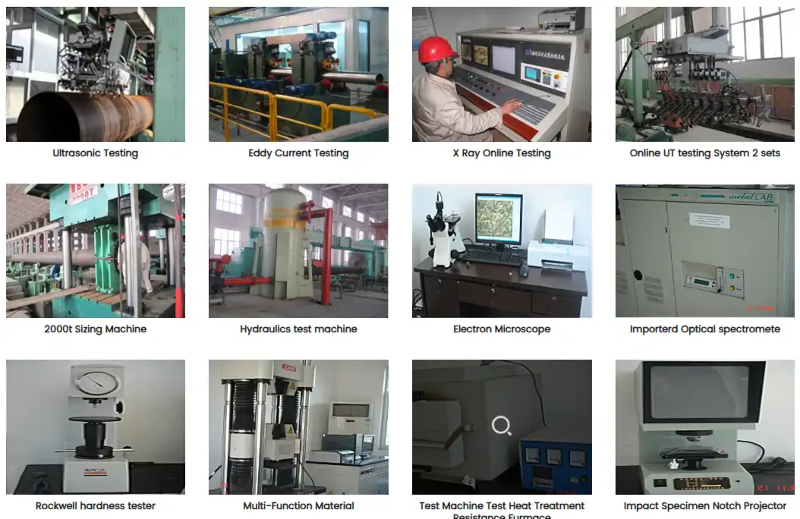
API 5L PSL1 and PSL2 pipeline packaging and shipping

FAQ
What does PSL2 mean on pipe?
These pipes are manufactured at two product specification levels known as PSL-1 and PSL-2. PSL-1 provides a standard quality level for line pipes. However PSL-2 pipes have additional requirements for chemical composition, mechanical properties, notch toughness and additional NDT requirements.
What is API spec 5L PSL1?
API 5L Grade B Pipe PSL1 Chemical Composition
For 0.01% reduce of maximum carbon, an increase of 0.05% Mn is permitted, up tp a maximum of 1.65% for grade ≥ L245 or B, but ≤ L360 or X52; up to a maximum of 1.75% for grade > L360 or X52, but < L485 or X70; and up to a maximum of 2.00% for grade L485 or X70.


