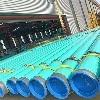
What a Drill Pipe Does
Drill pipe is the threaded tubular string that connects the surface drilling equipment to the bottom hole assembly and the bit. Its duties are to transmit rotation and torque, to carry the weight of the string, to guide the string along the borehole and to deliver drilling fluid from surface to the bit at the flow rate required for hole cleaning. In service the pipe sees combined tension, torsion, internal pressure, bending over doglegs and vibration, so the wall thickness, grade and tool joint design must be matched to the drilling programme rather than chosen on diameter alone.
Grades, Upsets and Connections
Standard grades: E75, X95, G105 and S135 as specified for drill pipe in API 5DP
Upset styles: internal upset (IU), external upset (EU) and internal-external upset (IEU)
Rotary shouldered connections: NC26, NC31, NC38, NC40, NC46, NC50, 5-1/2 FH and 6-5/8 FH
Range length: range 1, range 2 and range 3 lengths as defined for drill pipe
End finish: tool joints welded to the pipe body, with hardbanding applied where specified
Upset style determines how much wall thickness is available at the ends to receive the tool joint weld, and therefore which connection can safely be applied to a given pipe body. Higher grades allow a thinner wall for the same load, but they also demand closer control of welding and heat treatment at the tool joint.
Drill Pipe Size and Weight Reference
| Pipe body OD | Nominal weight | Upset | Connection | Tool joint OD | Tool joint ID |
|---|---|---|---|---|---|
| 2-3/8 in | 6.65 lb/ft | EU | NC26 | 3-3/8 in | 1-3/4 in |
| 2-3/8 in | 10.40 lb/ft | EU | NC31 | 4-1/8 in | 2-1/8 in |
| 3-1/2 in | 13.30 lb/ft | EU | NC38 | 4-3/4 in | 2-11/16 in |
| 4 in | 14.00 lb/ft | IU / EU | NC40 / NC46 | 5-1/4 to 6 in | 2-13/16 to 3-1/4 in |
| 4-1/2 in | 16.60 lb/ft | EU / IEU | NC46 / NC50 | 6-1/4 to 6-5/8 in | 3-1/4 to 3-3/4 in |
| 5 in | 19.50 lb/ft | IEU | NC50 / 5-1/2 FH | 6-5/8 to 7 in | 3-1/2 to 3-3/4 in |
| 5-1/2 in | 21.90 lb/ft | IEU | 5-1/2 FH | 7 to 7-1/4 in | 3-1/2 to 4 in |
| 6-5/8 in | 25.20 lb/ft | IEU | 6-5/8 FH | 8 to 8-1/2 in | 4-1/4 to 5 in |
Tool joint outside diameters shown for each pipe body size reflect the common range supplied for that connection family. Larger tool joint outside diameters increase torsional capacity and reduce wear on the casing, but they also increase pressure losses in the annulus, so the selection is a balance between torque capacity and hydraulics.
Applications
Drill pipe sizes from 2-3/8 in to 6-5/8 in cover the majority of oilfield requirements. Small sizes are used for slim hole drilling, water well and geothermal work, coring and workover operations, while 5 in and 5-1/2 in strings dominate conventional rotary drilling. Larger sizes are employed in top hole sections and where high torsional capacity is needed. Outside the oilfield, similar strings are used for mine blasting holes, forepoling and mineral exploration.
Selection and Inspection Points
Match the connection to the torque and pressure demand of the well plan, then confirm that the pipe body wall can accept that connection with the chosen upset.
Set the hardbanding grade with the operator, balancing tool joint wear against casing wear.
Verify that the pipe body yield strength, tensile capacity and torsional capacity are stated on the certificate and are consistent with the grade.
Inspect threads with the correct gauges, check make-up torque values and confirm that tool joint welds have been heat treated and examined as required.
Record accumulated rotation and inspection history so that the rejected lengths are removed before the fatigue limit is reached.
FAQ
Q: Which grades are used for API drill pipe?
The standard grades are E75, X95, G105 and S135, named after their minimum specified yield strength in thousands of pounds per square inch.
Q: What does IEU upset mean?
IEU stands for internal-external upset. Wall thickness is increased on both the inside and the outside at the pipe ends, which gives more material for the tool joint weld while keeping the bore as open as possible.
Q: What is the difference between NC and FH connections?
NC connections are the rotary shouldered connection family with a nominal size designation, while FH denotes full hole connections that provide a larger internal diameter for a given tool joint outside diameter.
Q: How is drill pipe weight expressed?
Drill pipe weight is normally expressed in pounds per foot of the pipe body and is quoted together with the tool joint data, because the total string weight also depends on the joints and the upset design.
Q: What is the standard length of a drill pipe joint?
Drill pipe is supplied in range lengths, with range 2 joints being the most common for conventional rotary drilling and range 3 joints used where fewer connections are preferred.
Q: Why is hardbanding applied to tool joints?
Hardbanding reduces abrasive wear of the tool joint against the casing and the open hole, extending the service life of the string when it is rotated through abrasive formations.