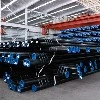
ASTM A192/SA192 Seamless Carbon Steel Boiler Tubes
ASTM A192, also published as ASME SA192, is the standard specification for seamless carbon steel boiler tubes for high-pressure service. The designation "minimum-wall" means the tube is ordered and manufactured to a specified minimum wall thickness, which is the dimension used in pressure-part design. A192 tubes are the workhorse of water-tube boilers, serving as furnace wall tubes, generating tubes, superheater sections and economizer tubes where internal pressure and elevated temperature demand a sound, weldable seamless product.
Chemical Composition
| Element | Requirement |
|---|---|
| Carbon | 0.06% – 0.18% |
| Manganese | 0.27% – 0.63% |
| Phosphorus (max.) | 0.035% |
| Sulfur (max.) | 0.035% |
| Silicon (max.) | 0.25% |
The composition is deliberately low in carbon and residuals, providing the ductility and weldability needed when tubes are joined into headers, drums and membrane walls. For boiler service the steel is normally supplied fully killed and fine grained to give predictable strength and toughness.
Manufacturing and Heat Treatment
A192 tubes are made by hot working solid round billets to produce a seamless tube, then finished by cold drawing where required for size and surface quality. The tubes receive a final heat treatment - typically normalizing or full annealing - that refines the grain structure and ensures uniform mechanical properties. The internal surface must be clean and free of loose scale so that steam side fouling and localized overheating are minimized.
Mechanical Properties
| Property | Requirement |
|---|---|
| Tensile strength | 47 ksi (325 MPa) min. |
| Yield strength | 26 ksi (180 MPa) min. |
| Elongation in 50 mm | 35% min. |
| Hardness | 77 HRB max. |
The relatively modest strength reflects the low-carbon composition; boiler design compensates through wall thickness and membrane construction, while the excellent ductility allows tight-radius bending during panel assembly.
Testing and Quality Assurance
Hydrostatic test:
each tube is pressure tested to verify soundness, or an equivalent nondestructive electrical test is applied by agreement.
Flattening test:
verifies that the tube wall can deform without cracking, confirming adequate ductility.
Flaring test:
confirms the tube end can be expanded into a tube sheet or drum opening.
Tension test:
performed per lot to confirm tensile and yield strength.
Inspection is documented on the mill test certificate in accordance with EN 10204 3.1 or 3.2, and independent third-party inspection can be arranged for boiler-code projects. Each bundle is marked with the specification, size, heat number and manufacturer identification.
Typical Boiler Applications
Furnace water-wall and membrane wall tubes
Generating tubes and riser/downcomer circuits
Economizer and low-temperature superheater sections
Heat-recovery steam generator (HRSG) tubing
Frequently Asked Questions (FAQ)
What does "minimum wall" mean for A192 tubes?
The tube is specified and manufactured to a minimum wall thickness; the actual wall is at least this value, and this minimum is the dimension used in pressure design calculations.
What is the difference between A192 and A179?
A179 is for heat exchanger and condenser tubes with an OD range of 1/8 to 3 inches, while A192 is for boiler tubes for high-pressure service with a similar chemistry but boiler-specific requirements and size range up to 7 inches OD.
Can A192 tubes be used above 400°C?
For metal temperatures above roughly 400°C, carbon steel loses strength through creep; designers select alloy grades such as ASTM A335 P11/P22 for high-temperature superheater duty.
Is the hydrostatic test performed on every tube?
Yes, every tube is hydrostatically tested unless the purchaser agrees to substitute a nondestructive electrical test.
Why is surface cleanliness important for boiler tubes?
Scale or debris on the bore reduces heat transfer and can cause localized overheating and tube failure; the standard therefore requires a clean interior surface.
What sizes are available in A192?
Typical production ranges from 1/2 inch to 7 inches OD with walls from 0.085 inch up, depending on the boiler design requirements.