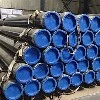
What an API 5CT Casing Coupling Does
A coupling is the internally threaded sleeve that joins two lengths of pipe or tubing. In a well completion the connection is a pressure containing element, so API 5CT treats the coupling as a product in its own right, with its own material grade, dimensions, thread form and inspection requirements. A 2 7/8 in coupling with external upset ends and 8 round threads is the standard connection used on 2 7/8 in tubing strings and, in the same design, on many small diameter casing and work strings.
Couplings are machined from seamless tube, threaded, phosphated and inspected, then either screwed onto the pipe at the mill and delivered as made-up joints with thread protectors, or supplied loose as separate couplings for field make-up.
Reading the Specification: 2 7/8 in, EUE, 8RD
2 7/8 in is the nominal outside diameter of the pipe that the coupling joins, equal to 73.02 mm. The size identifies the connection, not the sleeve outside diameter, which follows the dimensional tables of the standard.
EUE means external upset ends. The wall thickness at the pipe end is increased by upsetting before threading, so that cutting the thread does not remove more metal than the pipe body can afford. Non-upset ends are used on thinner, lower pressure strings.
8RD means an 8 threads per inch round thread. The thread has a 1 in 16 taper on diameter, is truncated (round) in form, and is cut on the outside of the pipe and on the inside of the coupling. Full thread dimensions and gauging practice for API round threads are given in API Spec 5B.
| Item | Value |
|---|---|
| Product | Coupling for 2 7/8 in pipe, externally to be made up onto EUE pipe ends |
| Product standard | API 5CT |
| Thread standard | API Spec 5B, round thread form |
| Nominal pipe outside diameter | 2 7/8 in, 73.02 mm |
| End finish of pipe | External upset ends, EUE |
| Thread | 8 round, 8 threads per inch, 1 in 16 taper on diameter |
| Material grade | J55 |
| Protection | Thread protectors on both ends, couplings identified by grade and size |
J55 Grade Properties
J55 is one of the basic API 5CT grades for casing and tubing. It is a carbon-manganese steel without deliberate alloy additions and it is specified through minimum mechanical properties rather than through a narrow chemistry window. The mandatory minimum yield strength is 379 MPa (55 000 psi) and the mandatory minimum tensile strength is 517 MPa (75 000 psi), measured by the 0.5 % total extension under load method for yield and on the basis of the original cross sectional area for tensile strength.
Because the grade is comparatively soft and ductile, it is selected for moderate duty: shallow and medium depth wells, water injection and disposal wells, surface casing, and as the matching coupling material for J55 tubing. Where higher collapse or internal yield pressure is required, higher API 5CT grades with controlled hardness are used instead.
Make-Up, Handling and Inspection
Clean and dry both threads and apply a thread compound suited to the service before make-up; contaminated dope is a frequent cause of leaking connections.
Make up with power tongs to the torque corresponding to the pipe size and weight, following the make-up torque tables of API RP 5C1. Under-torque gives a loose connection, over-torque galling and cracked couplings.
Stab squarely to avoid cross threading, and never use a coupling that has been dropped or struck on the thread.
Inspect thread form, pitch diameter and taper with API gauges, check coupling outside diameter and length, and look for cracks with magnetic particle or liquid penetrant testing.
Keep protectors in place during transport and storage; store couplings off the ground, stacked so that the threads cannot be deformed.
Field Notes
Coupling performance is limited by the connection rather than by the pipe body, so the joint is where most well failures begin. Three practical rules reduce the risk: match the coupling grade to the pipe grade and record it on the mill certificate; keep make-up torque within the tabulated window rather than aiming at the maximum; and repeat make-up of the same connection only within the limits allowed for the thread form, because repeated make-up and break-out progressively removes material from the thread crests.
FAQ
Q: What does 8RD mean on a coupling?
8RD describes an 8 threads per inch round thread, the truncated round thread form used on API tubing and casing connections, with a 1 in 16 taper on diameter and dimensions given in API Spec 5B.
Q: What does EUE stand for?
EUE stands for external upset ends. The pipe ends are thickened by upsetting before the thread is cut so that the threaded section can carry the load without weakening the pipe wall.
Q: What are the mechanical properties of J55?
API 5CT requires a minimum yield strength of 379 MPa or 55 000 psi and a minimum tensile strength of 517 MPa or 75 000 psi for J55 casing and tubing, together with the elongation requirements of the standard for the size and wall thickness.
Q: Can a J55 coupling be used in sour service?
J55 is commonly accepted for mild sour service when the hardness is controlled, because ISO 15156 limits carbon and low alloy steels in sour service to a maximum hardness of 22 HRC. For more severe conditions a grade with controlled hardness and a verified heat treatment is selected.
Q: How is a coupling made up correctly?
Clean the threads, apply a suitable thread compound, stab squarely and make up with power tongs to the torque tabulated for the size and weight in API RP 5C1. Torque should be recorded, and over-torque must be avoided to prevent galling and coupling cracks.
Q: How are API 5CT couplings inspected before delivery?
Inspection covers thread gauging of form, pitch diameter and taper, verification of coupling dimensions, visual examination of the thread and seal surfaces, and crack detection by magnetic particle or liquid penetrant testing, supplemented by the mechanical testing of the material heat.