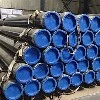
What Separates an Alloy Tube from a Carbon Steel Tube
An alloy tube is a tubular product whose heat analysis carries deliberate additions of chromium, molybdenum, vanadium, tungsten, niobium or boron well above the residual levels tolerated in plain carbon steel. Those additions are functional rather than cosmetic: they raise hardenability, creep strength, scaling resistance and - with the right heat treatment - low-temperature toughness. The practical dividing line for a buyer is not the mill's marketing label but the specification on the purchase order. A tube ordered to ASTM A335, ASTM A213, ASTM A333, GB/T 5310 or EN 10216-2 in a Cr-Mo grade is an alloy tube. A tube ordered to ASTM A106 Grade B or ASTM A53 Grade B is a carbon steel tube, even if it shows small residual chromium and molybdenum in the certificate.
The distinction matters because the two families are designed by different rules. Carbon steel pressure tube is sized on allowable stress that falls predictably with temperature up to roughly 400 degrees C. Chromium-molybdenum tube is sized on allowable stress that is governed by creep rupture and by the metallurgical stability of the carbides at temperature, which is why the same nominal wall can carry a design pressure at 540 degrees C in 1.25Cr-0.5Mo that would be impossible in carbon steel. When an article describes alloy tube with strip coil feeding, squeeze rolls and a 1 mm to 3 mm welding gap, it is describing welded pipe production, not the seamless route that supplies most boiler and heat exchanger alloy tube. A longitudinal weld in a creeping wall is a metallurgical discontinuity and a stress concentration, and the boiler and piping codes treat it conservatively; welded alloy tube does exist under ASTM A691 and in some ERW low-alloy grades, but it is a specified choice for a defined duty rather than the default supply route.
Grade Families and the Chemistry That Drives Them
The Cr-Mo family dominates high-temperature tube supply, and the grades are separated by chromium content because chromium controls both oxidation resistance and carbide stability. Roughly 1.25 percent chromium with 0.5 percent molybdenum (T11/P11) is the entry grade for moderate elevated-temperature duty. Adding chromium to about 2.25 percent (T22/P22) widens the creep margin and improves resistance to hydrogen attack in refinery service. The 5 percent and 9 percent chromium grades (T5/P5, T9/P9) move into aggressive scaling and sulfidation environments. The modern 9Cr grades (T91/P91 and T92/P92) add vanadium, niobium and nitrogen so that a tempered martensitic microstructure with fine MX carbonitrides carries strength to the highest steam conditions used in modern boilers.
| Grade designation | Product standard | C, % | Cr, % | Mo, % | Other deliberate additions | Typical service role |
|---|---|---|---|---|---|---|
| T11 / P11 (UNS K11597) | ASTM A213 / ASTM A335 | 0.05-0.15 | 1.00-1.50 | 0.44-0.65 | Si 0.50-1.00, Mn 0.30-0.60 | Superheater and reheater tube, moderate creep duty |
| T22 / P22 (UNS K21590) | ASTM A213 / ASTM A335 | 0.05-0.15 | 1.90-2.60 | 0.87-1.13 | Si max 0.50, Mn 0.30-0.60 | Main steam pipe, header, high-pressure process line |
| T5 / P5 (UNS K41545) | ASTM A213 / ASTM A335 | max 0.15 | 4.00-6.00 | 0.45-0.65 | Si max 0.50, Mn 0.30-0.60 | Refinery transfer line, scaling resistance |
| T9 / P9 (UNS K90941) | ASTM A213 / ASTM A335 | max 0.15 | 8.00-10.00 | 0.90-1.10 | Si 0.25-1.00, Mn 0.30-0.60 | Sulfidation and oxidation resistant tubing |
| T91 / P91 (UNS K91560) | ASTM A213 / ASTM A335 | 0.08-0.12 | 8.00-9.50 | 0.85-1.05 | V 0.18-0.25, Nb 0.06-0.10, N 0.030-0.070 | High-energy boiler superheater, hot reheat line |
| T92 / P92 (UNS K92460) | ASTM A213 / ASTM A335 | 0.07-0.13 | 8.50-9.50 | 0.30-0.60 | W 1.50-2.00, V 0.15-0.25, Nb 0.04-0.09, B 0.001-0.006 | Ultra-supercritical boiler tubing, highest steam temperature |
| 15CrMoG | GB/T 5310 | 0.12-0.18 | 0.80-1.10 | 0.40-0.55 | Mn 0.40-0.70, Si 0.17-0.37 | Boiler tube and header in domestic power projects |
| 12Cr1MoVG | GB/T 5310 | 0.08-0.15 | 0.90-1.20 | 0.25-0.35 | V 0.15-0.30, Mn 0.40-0.70 | Superheater tube with improved creep rupture life |
Every range in that table is a heat-analysis window, not a target. A mill that reports carbon at the top of the window and chromium at the bottom is technically compliant, yet the tube will behave closer to the lower grade in creep and closer to the upper grade in weld cracking risk. That is why experienced buyers ask for the actual product analysis on the mill test certificate rather than reading the grade symbol alone, and why a purchaser specifying P22 for a hydrogen service line asks for chromium and molybdenum on the high side of the range.
Mechanical Property Requirements and How They Are Verified
Room-temperature tensile properties are the acceptance gate that every alloy tube passes before dispatch, and they are minimum values for the pipe body, not averages.
| Grade | Minimum tensile strength, MPa | Minimum yield strength, MPa | Minimum elongation, % | Governing product standard |
|---|---|---|---|---|
| T11 / P11 | 415 | 205 | 22 | ASTM A213 / ASTM A335 |
| T22 / P22 | 415 | 205 | 22 | ASTM A213 / ASTM A335 |
| T5 / P5 | 415 | 205 | 22 | ASTM A213 / ASTM A335 |
| T9 / P9 | 415 | 205 | 22 | ASTM A213 / ASTM A335 |
| T91 / P91 | 585 | 415 | 20 | ASTM A213 / ASTM A335 |
| T92 / P92 | 620 | 440 | 20 | ASTM A213 / ASTM A335 |
| 15CrMoG | 440 to 640 | 235 | 21 | GB/T 5310 |
| 12Cr1MoVG | 470 to 640 | 255 | 21 | GB/T 5310 |
Two verification details decide whether a certificate is worth anything. First, the test specimen location: for tube the tensile specimen is taken longitudinally from the tube wall, and for heavy-wall pipe the standard defines whether the specimen is transverse. Second, the heat-treatment condition at the time of test. A P91 tube tested after normalising and tempering at the specified temperature is a different product from the same tube tested in the as-rolled condition and then re-treated by the fabricator. Where a specification imposes a hardness ceiling, the hardness survey becomes a second, cheaper screen against an under-tempered or incorrectly cooled product, and it is the first test to request when a batch shows tensile results that scatter more than the process should allow.
Manufacturing Routes: Seamless Primary, Cold Finished Where Needed
The seamless route starts with a round billet cut to weight and heated to a controlled austenitising temperature. It is pierced on a rotary piercer to make a thick-walled shell, then elongated on a plug mill, mandrel mill or Assel mill until the wall approaches the ordered dimension. Sizing and stretch reducing bring outside diameter and wall into tolerance, after which the tube is cooled, cut, straightened and heat treated. Each of those steps leaves a fingerprint on quality. Piercing at excessive temperature produces internal scabs and a rough bore. Insufficient elongation reduction leaves heavy wall eccentricity, which shows up later as an off-centre bore on a machined component. Poorly controlled reheating before stretch reducing produces the overlapping surface laps that appear in finished tube as the peak-shaped or longitudinal marks a buyer sees on delivery.
When the ordered wall is thin relative to diameter, when tolerance is tight, or when surface finish must be controlled for a heat exchanger, the hot-finished tube is cold drawn. Cold drawing passes the tube over a plug or mandrel through a die, with an intermediate anneal between passes and a final anneal or supplied-condition treatment at the end. Cold drawing delivers better concentricity, a smoother surface and a tighter wall band, but it stores work in the metal, so every cold-drawn alloy tube must be delivered in a defined heat-treatment condition. A cold-drawn 2.25Cr-1Mo tube delivered without a final anneal is a hard, brittle product that will fail on a tube-sheet expansion rather than in service.
Heat Treatment States and Their Effect on Microstructure
The single largest cause of disputed alloy tube deliveries is a mismatch between the heat-treatment state ordered and the state delivered. Four conditions cover most purchase orders. Normalising gives a ferrite-pearlite or bainitic structure and is applied to the lower Cr-Mo grades. Normalise and temper refines that structure and restores toughness, and is the standard delivery condition for T11, T22, T5 and T9. Quench and temper, normally with a fully martensitic transformation, is mandatory for T91 and T92 so that the fine tempered martensite with MX precipitates produces the creep strength the grade is specified for. Subcritical anneal or isothermal anneal is used before cold drawing and for stress relief after forming.
For the 9Cr grades the heat treatment is not a finishing step but the product definition. The austenitising temperature window is narrow, the cooling rate after austenitising must be fast enough to avoid ferrite, and the tempering temperature must sit inside a band that is high enough to soften the martensite yet low enough to preserve precipitate strength. A tube that misses the tempering window shows hardness above the specified ceiling and low toughness; a tube tempered twice at an excessive temperature shows compliant hardness but a creep life far below what the grade promised. Suppliers who cut cost by shortening or skipping final heat treatment are effectively selling a tube that will pass a room-temperature tensile test and fail a long-term creep assessment, which is why the certificate must state the austenitising temperature, the tempering temperature, the holding times and the cooling method, and why a buyer of P91 or P92 material should insist on those values rather than accept a bare "heat treated" stamp.
Tolerances, Surface Quality and Non-Destructive Testing
Dimensions for pipe are governed by ASME B36.10M for welded and seamless wrought pipe and by ASME B36.19M for stainless. The product standard adds the acceptance band: outside diameter, wall thickness, length, straightness, ovality and wall eccentricity each have a permitted deviation, and the deviations differ between hot-finished and cold-drawn tube. A purchase order that names only the grade and the size leaves the tolerance open to the widest band the standard permits, which is rarely what the fabricator needs. State the dimensional standard, the tolerance class and the length range, and state whether the tube is to be supplied with plain ends, bevelled ends or threaded ends.
Non-destructive testing is where alloy tube buyers gain or lose the most value for the least money. The relevant references are ASTM A1016 for general requirements for ferritic and martensitic tube, ASTM E213 for ultrasonic examination, ASTM E309 for ultrasonic examination of austenitic and ferritic-austenitic tubing, ASTM E709 for magnetic particle, ASTM E165 for liquid penetrant and the ISO 10893 series for the individual NDT methods applied to steel tube. A hydrostatic test proves the wall can hold pressure and detects through-wall leaks; it does not detect a tight longitudinal lap or an internal scab. Ultrasonic testing with a longitudinal and transverse scan detects those discontinuities, and eddy current testing is the efficient screen for heat exchanger tube where the full length must be covered. Drift testing proves internal diameter clearance and is specified for tube that will be expanded or that must pass a defined plug. In practice a competent order specifies the NDT method, the reference standard, the acceptance level and who performs the test, because "tested" without a level is not a specification.
Welding and Field Fabrication Considerations
Alloy tube is rarely used as a bare tube; it is welded into headers, bent into coils and connected to fittings, and the fabrication behaviour is part of the technical characteristic set a buyer should understand. The 1.25Cr-0.5Mo and 2.25Cr-1Mo grades require preheat before welding and a post-weld heat treatment after it, because the hardenability of the weld heat-affected zone produces untempered martensite that is both hard and crack susceptible. Preheat temperature, interpass temperature and post-weld heat treatment temperature and hold time are all defined by the applicable construction code, and the tube supplier's role is to deliver material with a documented composition and heat treatment so the fabricator can set those parameters correctly.
The 9Cr grades are less forgiving still. T91 and T92 require controlled preheat, a narrow interpass window, and a post-weld heat treatment that must be started before the weld cools below a defined temperature; a joint left to cool to ambient and re-heated hours later can crack. Bending is the other common operation: cold bending of alloy tube beyond a modest strain requires a subsequent stress relief, and the bend radius and ovality acceptance limits come from the construction code rather than from the tube standard. Fabricators who purchase on grade alone, and then discover that the delivered tube was cold drawn without an adequate final anneal, end up with bends that crack or with hardness readings at the bend extrados that no procedure can rescue.
Application Mapping and a Workable Acceptance Sequence
Boiler superheater and reheater tubing in T11, T22, T91 and T92 is selected on creep rupture data at the metal temperature, and the design calculation converts that data into an allowable stress that decreases with temperature. Heat exchanger tubing is selected on a combination of corrosion resistance to the process stream, thermal conductivity and the ability to be expanded into a tube sheet, and here the cold-drawn condition, the concentricity and the surface finish matter as much as the grade. Refinery process lines in P5, P9 and P22 are frequently selected against hydrogen partial pressure and sulfidation criteria rather than temperature alone. Furnace and reformer tube in the higher nickel alloy range sits outside the Cr-Mo family and is specified through the appropriate ASTM product standard for the alloy concerned.
A purchase and acceptance sequence that reliably avoids disputes reads as follows. Define the grade by product standard and edition, not by trade name. State the delivery heat-treatment condition and require the austenitising and tempering parameters on the certificate. State the dimensional standard and tolerance class. State the NDT method, reference standard and acceptance level. State the test certificate type and whether a third-party inspection witness is required. Require the heat number to be traceable by stamp on the tube and repeated on the certificate. On receipt, verify the stamp against the certificate, measure wall at four points on each end of a sample tube, confirm hardness on a sample from each heat, and review the NDT report for the actual acceptance level rather than the word "acceptable".
Common Misconceptions Worth Correcting Before Ordering
The first misconception is that an alloy tube is defined by its colour or by its hardness. Neither is a specification. The second is that a higher grade is always safer. Substituting T91 for T22 in a system designed for T22 changes the welding procedure, the post-weld heat treatment, the dissimilar joint design and the creep assessment at every support, and a substitution made without engineering review introduces more risk than it removes. The third is that a room-temperature tensile pass proves the tube will survive at temperature; for Cr-Mo grades the property that governs service life, creep rupture strength, is established by long-term testing of the grade and by the correctness of the heat treatment, not by a single tensile test on a delivered length. The fourth is that a hydrostatic test replaces NDT. It does not, and a specification that relies on pressure testing alone will accept tubes with tight laminar defects that open only after years of thermal cycling.
FAQ
Q: What chromium and molybdenum content defines a 1.25Cr-0.5Mo alloy tube?
Under ASTM A213 and ASTM A335 the T11 and P11 grades require chromium 1.00 to 1.50 percent, molybdenum 0.44 to 0.65 percent and carbon 0.05 to 0.15 percent, with manganese 0.30 to 0.60 percent and silicon 0.50 to 1.00 percent.
Q: Why must T91 and T92 tube be supplied in the normalised and tempered condition?
Because the specified strength of the 9Cr grades depends on a tempered martensitic microstructure with fine vanadium and niobium carbonitrides; without the correct austenitising, cooling and tempering sequence the tube loses creep rupture strength even if its room-temperature tensile results look acceptable.
Q: Does a hydrostatic test prove that an alloy tube is free from laminations?
No. A hydrostatic test proves pressure tightness and detects through-wall defects, while laminations and tight laps require ultrasonic examination to ASTM E213 or an equivalent method in the ISO 10893 series at a defined acceptance level.
Q: What wall thickness tolerance should be written on the order?
Name the dimensional standard, normally ASME B36.10M for the size, together with the tolerance class in the product standard, and state whether cold-drawn tube with a tighter wall band is required, because an unqualified order defaults to the widest band the standard permits.
Q: Can a P22 tube be welded in the field without preheat?
No. The 2.25Cr-1Mo grade has sufficient hardenability for the weld heat-affected zone to form untempered martensite, so the construction code requires preheat, controlled interpass temperature and post-weld heat treatment to restore toughness and relieve residual stress.
Q: Which document proves the heat-treatment condition of an alloy tube?
The mill test certificate must state the heat number, the product analysis, the tensile and yield results, and the heat-treatment parameters including austenitising temperature, tempering temperature, holding time and cooling method, so the values can be checked against the product standard.