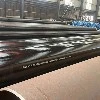
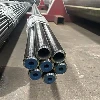
What Is Q345 LSAW Steel Pipe?
Q345 LSAW (longitudinal submerged arc welded) steel pipe is a large-diameter welded pipe made from Q345 low-alloy high-strength structural steel plate. Under GB/T 1591, the Q stands for yield strength and 345 means a minimum yield strength of 345 MPa for plate up to 16 mm thick. The plate is formed into a cylinder by the JCOE (J-forming, C-forming, O-forming, expansion) or UOE process and welded along a single longitudinal seam with double-sided submerged arc welding (DSAW), giving high weld integrity, uniform properties and tight tolerances.
International Grade Equivalents
| Region | Standard | Equivalent Grade |
|---|---|---|
| China | GB/T 1591 | Q345 (B/C/D/E by impact grade) |
| USA | ASTM | A572 Grade 50 |
| Europe | EN 10025 | S355JR / S355J2 |
| Japan | JIS | SM490 |
JCOE and UOE Forming
JCOE:
the plate is progressively pressed into a J-shape, then a C-shape, then an O-shape, welded, and finally mechanically expanded to the target diameter.
UOE:
the plate is formed into a U-shape, then an O-shape, welded, and expanded; UOE suits very thick walls and the largest diameters.
Expansion:
the final expansion step improves roundness, straightness and fatigue performance by reducing residual stresses.
Chemistry (GB/T 1591, Ladle Analysis)
Key limits for the common grades: carbon up to 0.20% (0.18% for D/E), manganese 1.00–1.70%, phosphorus and sulfur from 0.045% down to 0.020–0.025% for the tougher grades, plus micro-alloying with niobium, vanadium and titanium for grain refinement. The B to E suffixes reflect increasing Charpy impact requirements at lower temperatures.
Typical Supply Range and Tolerances
Outside diameter:
400–1626 mm (smaller by agreement).
Wall thickness:
8–60 mm or per design.
Length:
6–12.5 m.
Tolerances:
OD ±1%; wall +12.5%/-10% (per standard).
Surface:
black or coated (3PE, FBE, etc.).
Quality Assurance
Every Q345 LSAW pipe passes 100% ultrasonic testing of the weld seam and heat-affected zone, radiographic inspection of the weld, a hydrostatic pressure test at not less than 85% of specified minimum yield strength, and mechanical tests (tensile, Charpy V-notch, flattening, guided bend). Welders and procedures are qualified, and each pipe carries traceable markings with the heat number.
Applications
Oil and gas:
long-distance transmission, offshore flowlines, high-pressure gas transport.
Structural engineering:
bridge piling, high-rise foundations, port structures.
Petrochemical:
process piping and pressure-vessel-related pipework.
Power:
hydropower penstocks and cooling water systems.
Water:
municipal transmission mains.
Frequently Asked Questions
What is the difference between Q345 and Q355?
Q355 is the successor grade in GB/T 1591-2018 with essentially equivalent mechanical properties and slightly tightened yield requirements for thin plates.
What does LSAW stand for?
Longitudinal Submerged Arc Welded-pipe formed from plate and welded along a single straight longitudinal seam using submerged arc welding.
Why choose LSAW over SSAW?
LSAW offers the highest pressure capacity for its diameter, the shortest weld per unit length, easier 100% NDT of a straight seam, and superior roundness for field girth welding.
Can Q345 LSAW pipe be used for gas transmission?
Yes, where the project code accepts structural-grade pipe; for hydrocarbon pipelines the equivalent API 5L or ISO 3183 grades with pipeline-specific toughness requirements are usually specified instead.
What is mechanical expansion in JCOE?
After welding, the pipe is expanded radially by internal tooling to correct ovality, straighten the profile and reduce residual stress, improving fatigue performance.
Which inspection is most important for the seam?
100% ultrasonic testing supplemented by radiographic examination of the full seam, because both methods together detect planar and volumetric defects.