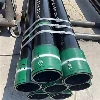
Classification by Production Method
Seamless steel pipes are divided into two broad families according to the way the tube is shaped: hot-rolled seamless steel pipes and cold-rolled, also called cold-drawn, seamless steel pipes. The choice between them is driven by the required outside diameter, wall thickness, dimensional accuracy, surface condition and cost, and both families feed into a wide range of end products described below.
Hot-Rolled Seamless Pipes and Their Product Types
Hot-rolled seamless pipes are produced from a round billet that is heated and pierced, then rolled to size on a cross rolling, continuous or plug mill before sizing, straightening and inspection. The hot-rolled family includes general purpose steel pipes, low and medium pressure boiler steel pipes, high pressure boiler steel pipes, alloy steel pipes, stainless steel pipes, petroleum cracking pipes and geological steel pipes.
Typical standards behind these products are GB/T 8162 for structural use, GB/T 8163 for fluid transport, GB 3087 for low and medium pressure boilers, GB 5310 for high pressure boilers, GB/T 9948 for petroleum cracking and ASTM A106, ASTM A335 or API 5L for export orders.
Cold-Drawn and Cold-Rolled Seamless Pipes
The cold-drawn family covers the same basic categories as the hot-rolled family, and in addition includes precision steel pipes, carbon thin-walled steel pipes, alloy thin-walled steel pipes, stainless steel thin-walled steel pipes and special-shaped steel pipes. Cold drawing and cold rolling are carried out over multiple passes with intermediate annealing, pickling and lubrication, and the finished tube is heat treated and straightened before delivery.
| Family | Outside diameter | Wall thickness | Accuracy |
|---|---|---|---|
| Hot-rolled seamless | Generally above about 32 mm | Approximately 2.5 mm to 75 mm | Standard mill tolerance |
| Cold-drawn / cold-rolled | Down to a few millimetres | From about 0.25 mm upward | Tighter tolerance and finer finish |
| Thin-walled cold-drawn | From a few millimetres | Below 0.25 mm in the lightest sizes | Highest dimensional control |
Size Ranges and Dimensional Accuracy
The outside diameter of hot-rolled seamless pipe generally starts above 32 mm with wall thickness in the range of about 2.5 mm to 75 mm. Cold-drawn and cold-rolled pipe reaches much smaller outside diameters, down to only a few millimetres, with wall thicknesses from roughly 0.25 mm upward, and thin-walled pipe is supplied with walls below that figure. Cold working delivers a higher dimensional accuracy, a better surface finish and a more uniform wall than hot rolling.
How to Choose Between Hot-Rolled and Cold-Drawn
In pipeline and general engineering practice, pipes with an outside diameter above about 57 mm are usually supplied hot-rolled, while pipes below that size are more often cold-drawn or cold-rolled. The rule reflects mill economics rather than a technical limit: small diameter tube is difficult to roll hot with acceptable tolerance, and large diameter tube is uneconomical to draw cold.
Other selection factors include the pressure and temperature of service, the need for a specific surface roughness for hydraulic or pneumatic components, the machinability required by the customer, and the acceptance criteria of the applicable standard. Precision tube for hydraulic cylinders, for example, is normally ordered cold-drawn and then honed or skived to a defined internal surface finish, while boiler tube for a power plant is ordered hot-rolled to the relevant boiler standard with the required non-destructive examination.
FAQ
Q: What are the two main categories of seamless steel pipe?
Hot-rolled seamless steel pipe and cold-rolled or cold-drawn seamless steel pipe, classified by the production method used to shape the tube.
Q: Which product types belong to the hot-rolled family?
General purpose pipe, low and medium pressure boiler pipe, high pressure boiler pipe, alloy pipe, stainless pipe, petroleum cracking pipe and geological pipe.
Q: What extra types does the cold-drawn family include?
It also covers precision steel pipe, carbon and alloy thin-walled pipe, stainless thin-walled pipe and special-shaped sections such as square, rectangular and hexagonal tubes.
Q: Which family gives better dimensional accuracy?
Cold drawing and cold rolling give tighter diameter and wall tolerances, better roundness and a smoother surface than hot rolling.
Q: When is hot-rolled pipe normally preferred?
For larger sizes, where the outside diameter exceeds roughly 57 mm, and where standard mill tolerance and lower cost are acceptable.
Q: Are standard sizes listed per pipe size?
Yes. Outside diameter and wall thickness combinations are listed in the dimensional tables of the applicable standard, which also fixes the permissible deviations for each size.