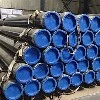
Why X52 Pipe Needs a Coating System Rather Than a Single Coating
API 5L X52 (ISO 3183 L360) is a carbon steel with a specified minimum yield strength of 360 MPa. Its corrosion resistance is essentially the corrosion resistance of iron: in soil, water or atmosphere it will oxidise, and in the presence of chlorides it will pit. Nothing in the grade protects the surface. Every hour of service life beyond the first wet season is bought by the coating system, and the system is not one material but a stack of decisions: surface preparation, primer or barrier layer, adhesion layer, mechanical protection layer, and the field joint that ties coated joints together.
Because the coating, not the steel, sets the life, coating selection has to start from the exposure rather than from habit. Buried soil, immersed service, splash zone, industrial atmosphere, potable water and abrasive slurry each load the coating differently, and a system that performs in one environment can fail quickly in another. The four families below cover most X52 orders, but they are not interchangeable.
Three-Layer Polyethylene: Structure, Standards and Thickness Classes
Three-layer polyethylene, normally written 3PE or 3LPE, is the default external coating for buried transmission lines. It is genuinely three materials working in series. A fusion bonded epoxy layer, typically 60 to 150 micrometres, bonds chemically to the blast-cleaned steel and provides the corrosion barrier. A copolymer adhesive layer, typically 150 to 250 micrometres, bridges the polar epoxy and the non-polar polyethylene. The outer polyethylene layer, commonly 1.8 to 3.0 mm depending on the class, supplies mechanical protection against rock, handling and soil stress.
The system is specified by standard rather than by description. DIN 30670 remains the widely used reference for polyethylene coatings on steel pipes, ISO 21809-1 covers external polymer coatings for pipeline transportation systems, and GB/T 23257 is the Chinese equivalent used on domestic projects. Each of these defines coating classes by pipe diameter and by mechanical duty, and defines the tests that prove the coating meets the class: thickness, holiday detection, peel strength at defined temperatures, indentation resistance, impact resistance, cathodic disbondment and, for 3PE, ageing behaviour of the polyethylene.
The design consequence is that 3PE is a mechanical barrier plus an adhesion layer. It tolerates soil movement, backfill impact and field handling well, and it remains the lowest life-cycle cost option for long buried lines in most soils. Its limits are equally clear. The epoxy layer is thin, so coating damage that penetrates the polyethylene exposes a small cathodic area surrounded by a large coated area, which concentrates cathodic protection current at the holiday; this is manageable with a properly designed cathodic protection system and with coating defect survey after construction, but it makes holiday detection and field joint quality critical rather than optional.
Fusion Bonded Epoxy: Single Layer Behaviour and Temperature Limits
Fusion bonded epoxy is a powdered thermoset applied electrostatically to a heated, blast-cleaned pipe, where it melts, flows and cures into a continuous film. Because it is chemically bonded across the whole surface rather than relying on a separate adhesive, it has no interlayer to disbond, and it resists cathodic disbondment well when applied within its process window. Standard grades are commonly rated for continuous service in the region of 85 degrees Celsius, with high-temperature grades extending above that, and the exact limit belongs to the product data sheet and to the qualifying standard rather than to the purchase order text.
FBE is used in three ways: as a standalone external coating on buried and some above-ground lines, as the primer layer of a three-layer system, and as an internal flow coating or internal corrosion barrier. As a standalone external coating it is thinner than 3PE, so it is more sensitive to mechanical damage during handling and backfill, and it is usually specified with a higher film build and stricter damage tolerance where rocky backfill is expected. Its strength is high-temperature service and resistance to disbondment, which is why it is the reference coating for lines operating above the temperature band where polyethylene softens.
Application quality decides performance more than the product does. The pipe must reach the specified preheat temperature and the powder must be applied before the surface cools below the flow point; film thickness must be uniform within the specified range, because thin spots fail the holiday test and thick spots can crack on bending. Cure is verified by differential scanning calorimetry or by solvent rub, not by visual inspection, and gel time and degree of cure records should be traceable to the coating run.
Hot-Dip Galvanizing: Where It Fits and Where It Does Not
Hot-dip galvanizing immerses the prepared steel in molten zinc, conventionally in the range of 445 to 465 degrees Celsius, producing a metallurgically bonded zinc-iron alloy coating. It protects by barrier action plus sacrificial action: zinc corrodes preferentially and protects exposed steel at scratches and cut ends within a limited distance. ISO 1461 defines the minimum coating requirements for general galvanizing, ASTM A123/A123M covers zinc coatings on structural steel products, and ASTM A153/A153M covers hardware and fasteners.
For pipe, the relevant numbers are thickness and mass. Under ISO 1461 the minimum mean coating thickness for steel at least 6 mm thick is in the order of 85 micrometres, corresponding to roughly 610 grams of zinc per square metre, with a lower local minimum permitted on individual readings; thinner base metal takes a correspondingly thinner coating. The coating grows by reaction with the steel, so it is thicker over silicon-killed or heavily worked surfaces and can be uneven at welds, and the coating must be inspected by magnetic thickness gauge and by adhesion or knife test rather than by appearance.
Galvanizing suits above-ground structural, utility and low-pressure water piping, handrails, platforms and supports where atmospheric exposure dominates. It is a poor choice for continuously buried high-pressure lines, because the zinc is consumed at a rate set by soil resistivity and moisture, and any coating damage on a large buried structure cannot be economically replenished. It is also unsuitable where the pipe will be subsequently coated with a barrier system without an intermediate treatment, because adhesion between zinc and many paints requires a specific pre-treatment such as a zinc phosphate conversion or an epoxy primer compatible with zinc.
Internal Protection: Linings Chosen by Medium, Not by Preference
An X52 line usually needs internal protection only when the medium is corrosive, when flow efficiency matters, or when the product must be kept clean. Dry sales gas is normally left uncoated; wet gas, produced water, seawater injection, slurry and potable water are not. For gas transmission service, API RP 5L2 provides a recommended practice for internal coating of line pipe and defines the surface preparation, coating application and inspection requirements. For water service, epoxy lining gives a smooth bore and low friction loss, while cement mortar lining, specified in references such as AWWA C205, provides an alkaline, abrasion-resistant barrier well matched to raw and potable water.
Lining selection must be matched to the fluid chemistry and to the operating temperature, and the internal coating must be continuous over the full length including the pipe ends, because a bare end strip invites preferential corrosion at every girth weld. Where the pipe will be internally inspected after construction, the lining must also be compatible with the inspection method and with any subsequent pigging programme.
Comparing the Four Systems on the Criteria That Matter
| System | Protection mechanism | Typical external thickness | Temperature ceiling | Best fit | Principal weakness |
|---|---|---|---|---|---|
| 3PE | Epoxy barrier plus polyethylene mechanical layer | Approx. 2.0 to 3.7 mm total | Set by the polyethylene grade, below FBE | Buried long-distance lines, rocky backfill | Thin epoxy underlayer; holidays concentrate CP current |
| FBE | Chemically bonded epoxy barrier | Approx. 300 to 600 micrometres | Standard grades near 85 C, high-temperature grades higher | Higher temperature lines, girth weld coating, internal flow coating | Mechanical damage tolerance at low film build |
| Hot-dip galvanizing | Sacrificial zinc plus barrier | From about 85 micrometres on 6 mm steel | Atmospheric service | Above-ground structural and utility pipe | Consumed in soil; not for buried pressure lines |
| Internal lining | Epoxy or cement mortar barrier | Per lining standard | Per lining product data | Water, slurry, wet gas, flow assurance | Ends and field joints need separate protection |
Note what the table does not do: it does not rank the systems. A galvanized structural pipe is not a worse product than a 3PE line pipe, it is a different answer to a different question. Most purchasing errors come from treating coating selection as a grade of quality rather than as a fit to exposure.
Surface Preparation: The Step That Decides Everything After It
Every system above depends on the steel surface. Abrasive blast cleaning to the near-white grade defined in ISO 8501-1 removes mill scale, rust and oil and, more importantly, creates the angular anchor profile that gives mechanical key to the coating. A specified profile depth range is agreed with the coating supplier, and both over-profile and under-profile are defects: too shallow gives insufficient adhesion area, too deep can leave peaks protruding through a thin film.
Two further conditions are non-negotiable. The surface must be dry and above the dew point by a defined margin before blasting and before coating, because condensation under a fresh film produces blistering that appears months later. Soluble salt contamination, mainly chlorides from marine exposure or from handling, must be limited and measured, because salts under a barrier coating draw water osmotically and cause disbondment regardless of how good the coating is. Blast media must be clean and dry, and blasted steel should be coated within the specified holding period before any rust bloom appears.
Field Joints: The Weakest Metre of Every Coated Line
A factory coating is continuous until the pipe is cut for tie-in. At every girth weld the coating is removed, the weld is made, and the joint must be re-coated on site under conditions the factory never faced. Heat-shrink sleeves, tape systems, spray-applied epoxy and, for internal surfaces, weld-area lining patches are the usual solutions, and each requires its own surface preparation, preheat and inspection. The specification should state the field joint system, its standard, and the tests to be performed at site, including holiday detection and adhesion checks on a sampling basis.
Compatibility is the item most often missed. A three-layer field joint over a three-layer mainline coating behaves differently from a tape joint over an epoxy mainline coating, and a joint that is merely continuous is not necessarily cathodically compatible. Where cathodic protection is used, the field joint must resist disbondment at the protection potentials actually applied, and the coating system as a whole must be considered when calculating current demand.
Inspection and Test Plan for Coated X52 Pipe
A coating inspection plan should be written per system and per standard, with acceptance criteria rather than descriptions. Thickness is measured at defined points per pipe length, and both minimum local and mean values are recorded. Holiday detection is carried out over the full coated surface with an electrode voltage set to suit the coating thickness, because excessive voltage perforates thin films and creates defects instead of finding them. Adhesion is checked by the method prescribed for the system, at the temperatures prescribed, since peel strength falls as temperature rises. Cathodic disbondment is evaluated on coupons exposed at a defined potential and temperature for a defined period, following methods such as ASTM G8 or ASTM G95, or the annex of the applicable coating standard.
Two cautions about accelerated testing deserve a place in the plan. Salt spray testing to ASTM B117 is useful for ranking a family of coatings but it does not predict buried service life, and a long salt spray result should not be used to omit the cathodic disbondment and peel tests that reflect the real mechanism. Similarly, impact and indentation results are only comparable at the same temperature and the same indentor geometry, so a supplier who quotes an impact figure without stating the test temperature has quoted nothing usable.
Coating Choice When the Line Is in Sour or Abrasive Service
Coating neither creates nor removes resistance to sulphide stress cracking. That property belongs to the steel and is addressed by selecting a PSL2 material qualified under ISO 15156 / NACE MR0175, with hardness limited, for carbon steels typically to 22 HRC, sulphur restricted and a sulphide stress cracking and hydrogen induced cracking test programme documented. What coating does in sour service is prevent the external or internal corrosion that would otherwise raise local stress and generate hydrogen. The two requirements are additive, not alternatives, and a purchase order that specifies a premium coating while leaving the steel at PSL1 hardness freedom has solved the wrong half of the problem.
In abrasive service such as slurry or tailings lines, the coating must be selected for wear as well as corrosion. Internal epoxy linings reduce friction but are not a wear solution at high solids loading, cement mortar lining performs better in many slurry duties, and in the most severe cases the answer is a thicker wall or a different material rather than a better coating. External abrasion in rocky terrain is handled by increasing the polyethylene thickness class or by adding a protective layer, and the rock shield requirement should be stated explicitly because it changes the factory coating class and the price.
Specification Checklist for Coating an X52 Order
State the exposure category first: buried, immersed, splash zone, above ground, internal medium. State the system by name and standard, with the class or grade designation, so that 3PE means a defined class rather than a nominal description. State the total and individual layer thickness requirements. State the surface preparation standard, the cleanliness grade and the anchor profile range. State the acceptance criteria for holiday, adhesion, impact and cathodic disbondment, with the test temperatures. State the field joint system and its tests. State the repair procedure for damaged coating, including the maximum damage size that may be repaired rather than cut out. State the handling requirements: pipe saddles, padded slings, end caps, and the ban on dragging coated pipe. State the records to be supplied, coating by coating and pipe by pipe.
A quotation that answers all of these can be compared line by line with another. A quotation that answers none of them will usually be the cheapest, and will usually be the most expensive by the time the spread is complete.
FAQ
Q: Which coating is standard for a buried API 5L X52 pipeline?
Three-layer polyethylene over fusion bonded epoxy is the standard for buried transmission lines because it combines a corrosion barrier with mechanical protection against soil and handling damage, and it is normally used together with a cathodic protection system designed to a stated current density and design life.
Q: What is the real difference between FBE and 3PE?
FBE is a single chemically bonded epoxy film, roughly 300 to 600 micrometres thick, with no interlayer and good resistance to cathodic disbondment. 3PE uses FBE as the primer, adds a copolymer adhesive and then an outer polyethylene layer of about 1.8 to 3.0 mm, which buys mechanical toughness but also introduces two interfaces that must bond reliably.
Q: Can X52 pipe be galvanized for a buried line?
It can be galvanized, but zinc is consumed at a rate set by soil resistivity and moisture, so hot-dip galvanizing is used for above-ground structural and utility piping rather than for continuously buried pressure lines, where a barrier coating with cathodic protection is the appropriate system.
Q: Why does surface preparation matter more than coating brand?
Because every coating mechanism depends on adhesion to a clean, correctly profiled surface. Residual mill scale, oil, moisture or soluble salts cause disbondment and blistering that no premium product can prevent, and the cleanliness grade in ISO 8501-1 plus a controlled anchor profile is the cheapest single guarantee of coating life.
Q: Does a coating allow X52 pipe to be used in sour service?
No. Sour service acceptability is a property of the steel, qualified under ISO 15156 / NACE MR0175 with hardness control and cracking tests. A coating controls external and internal corrosion but does not change the susceptibility of the pipe wall to sulphide stress cracking or hydrogen induced cracking.
Q: How is coating quality verified after application?
By a documented test plan: layer and total thickness measurement, full-surface holiday detection at a voltage suited to the film thickness, adhesion or peel testing at the specified temperature, and cathodic disbondment testing to the applicable standard, with results traceable to pipe number and coating run.