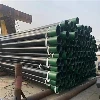
Why delivery condition is a purchasing variable, not a footnote
A line pipe order that reads only "API 5L X52 PSL2" leaves the most consequential metallurgical decision open. Grade X52 fixes a minimum yield strength of 52 000 psi, or 359 MPa, but several production routes can reach that number, and each one produces a different grain structure, a different toughness scatter band, a different hardness ceiling and a different response to field welding. API SPEC 5L captures these routes as delivery condition codes that are written into the grade designation and, for PSL2, into the stencil, the mill test certificate and the traceability package. Two pipes certified as X52 PSL2 can therefore differ in Charpy absorbed energy at -20 degrees C by a factor of three, in surface hardness by 40 HB, and in the ovality they develop after a girth weld.
For a buyer the delivery condition is a specification input rather than a mill preference. It should be selected from the design pressure, the design temperature, the installation method and the qualified welding procedure, and then verified line by line on the certificate. The sections below explain what the four condition codes mean for X52, how each one changes the steel, and what to write into a purchase order so that the certificate and the physical pipe agree.
The four delivery condition codes used with X52
API 5L identifies delivery conditions with a letter appended to the grade designation, for example X52R or X52M for as-rolled and thermomechanical material, and X52N or X52Q for normalized and quenched and tempered material. For PSL2 pipe the letter is mandatory; for PSL1 it is optional and is normally stated on the order because the two levels carry different testing obligations.
R, as-rolled. The pipe is finished by hot working without a subsequent deliberate heat treatment. Strength comes from the finishing temperature, the total reduction and the natural cooling rate. For X52 this is the lowest-cost and most common route, and it is the natural fit for seamless pipe rolled on a mandrel mill and finished in a stretch reducing mill.
N, normalized or normalizing rolled. The product is heated above the upper critical temperature and air cooled, either as a separate furnace operation or as a controlled finishing sequence in the normalizing range. Normalizing refines and homogenizes the grain structure and flattens property scatter along the length of a coil or a heat of bar stock.
M, thermomechanical rolled. Final passes are made in a narrow window below the recrystallization stop temperature, so the austenite is pancaked and the ferrite that forms on cooling is fine and equiaxed. Thermomechanical rolling reaches X52 strength without a separate heat treatment and typically delivers better toughness than as-rolled material of identical chemistry.
Q, quenched and tempered. The product is austenitized, water quenched and then tempered to the required strength. Q is technically available for X52 but rarely economic at this grade, because X52 does not need the strength that quenching delivers. It appears mainly where a hardness ceiling, a heavy wall or a sour service requirement drives the selection.
Comparison of the four conditions at a glance
| Code | Process route | Grain structure | Toughness behaviour | Where it is normally chosen |
|---|---|---|---|---|
| R | Hot rolled, no post-treatment | Mixed ferrite and pearlite, banded | Acceptable at ambient, scatter increases at low temperature | General oil, gas and water lines, standard wall |
| N | Normalized in a furnace or in-line | Uniform fine ferrite and pearlite | Stable and predictable, low scatter | Heavy wall, fittings, hot-bent sections, repairs |
| M | Controlled rolling plus accelerated cooling | Very fine acicular and polygonal ferrite | Best combination of strength and low temperature toughness | Long distance transmission, low design temperature |
| Q | Austenitize, quench, temper | Tempered martensite and bainite | High strength with controlled hardness | Heavy wall, sour service, hardness-limited joints |
What the delivery condition actually changes inside the wall
X52 is a ferrite-pearlite steel with a carbon content normally below 0.22 percent and a manganese content below 1.45 percent. In the as-rolled condition the austenite grain size at the end of rolling controls the ferrite grain size after transformation, and that grain size controls both the yield strength through the Hall-Petch relationship and the ductile to brittle transition temperature. A coarse as-rolled structure can still pass a room temperature tensile test while having a transition temperature well above the design minimum, which is exactly why impact testing is a separate requirement and not an optional extra.
Normalizing removes the inheritance of the rolling schedule. The steel is re-austenitized, so the prior grain structure is erased and the finished grain size depends only on the holding temperature, the holding time and the cooling rate. The practical consequence for a buyer is repeatability: two heats with slightly different residual element levels will converge to closer mechanical properties after normalizing than after as-rolled processing, and the through-thickness gradient is reduced on wall thicknesses above about 20 mm.
Thermomechanical rolling is a different mechanism rather than a stronger version of as-rolled processing. Because the final passes are made below the recrystallization stop temperature, the austenite grains are elongated and contain a high density of deformation bands that act as nucleation sites for ferrite. The result is a grain size in the range of a few micrometres without any heat treatment, plus a higher dislocation density that adds strength. This is why an X52M order with a low carbon and low carbon equivalent chemistry can meet toughness requirements that would force an N or Q route in a conventionally rolled product.
Quenching and tempering trades toughness for hardness control. The quench produces a hard martensitic or bainitic structure, and the tempering temperature sets the final strength. For X52 the tempering temperature is high, which restores ductility and produces a uniform hardness distribution across the wall; that uniformity is the reason Q material is sometimes specified for wet sour service where the acceptance criterion is expressed as a maximum hardness rather than a minimum strength.
Chemistry and carbon equivalent limits that apply to X52 PSL2
Delivery condition and chemistry are linked, and the purchase order should constrain both. For PSL2 pipe at X52 level, API 5L applies mass fraction limits of approximately 0.22 percent maximum carbon for seamless pipe and 0.24 percent maximum for welded pipe, 1.40 percent maximum manganese, 0.025 percent maximum phosphorus and 0.015 percent maximum sulfur. The microalloying elements vanadium, niobium and titanium are individually limited and their sum is capped at 0.15 percent. PSL1 allows more generous limits, in the region of 0.26 percent carbon for seamless and 0.28 percent for welded product, with phosphorus and sulfur at 0.030 percent maximum.
Carbon equivalent is what ties the chemistry to the delivery condition. The two expressions in common use are the IIW carbon equivalent, CE = C + Mn/6 + (Cr + Mo + V)/5 + (Ni + Cu)/15, and the cracking parameter Pcm = C + Si/30 + (Mn + Cu + Cr)/20 + Ni/60 + Mo/15 + V/10 + 5B. X52 PSL2 orders are commonly written with CE at or below 0.43 and Pcm at or below 0.25. Thermomechanical material usually meets these figures comfortably because it reaches strength through grain refinement rather than through carbon, whereas a normalized X52 with the same strength may sit closer to the CE limit and require preheat on thick wall girth welds.
Two practical consequences follow. First, a buyer who accepts a substitution from M to R at the same grade is accepting a chemistry change as well, because the mill will have to raise carbon or manganese to hold the yield strength, and that raises hardenability in the heat affected zone. Second, when the design calls for a maximum hardness in the heat affected zone, the carbon equivalent limit is a more useful purchasing lever than the grade itself.
Mechanical property targets and their practical meaning
| Property | X52 PSL1 | X52 PSL2 |
|---|---|---|
| Yield strength, minimum | 359 MPa (52 000 psi) | 359 MPa (52 000 psi) |
| Yield strength, maximum | Not specified | 530 MPa (76 900 psi) |
| Tensile strength, minimum | 455 MPa (66 000 psi) | 455 MPa (66 000 psi) |
| Tensile strength, maximum | Not specified | 760 MPa (110 200 psi) |
| Yield to tensile ratio | Not specified | 0.93 maximum for pipe with D above 323.9 mm, otherwise 0.95 maximum |
The upper yield limit and the yield to tensile ratio cap are the two clauses that make PSL2 more than a documentation upgrade. A thermomechanically rolled or quenched and tempered X52 can easily overshoot 460 MPa yield, and a pipe that is too strong for its grade is a legitimate rejection point under PSL2 because the ratio of yield to tensile strength governs how much the material can deform before it fractures. On a strain based design, particularly one crossing permafrost or seismic ground, an over-strength pipe is as much of a non-conformity as an under-strength one.
Impact testing is where the delivery condition shows most clearly in the paperwork. PSL2 requires Charpy V-notch testing of the pipe body, and for welded pipe of the weld metal and heat affected zone, at a temperature agreed at the time of order. A common specification for an X52 transmission line is a minimum average absorbed energy of 27 J at 0 degrees C with no single value below 20 J, and colder designs move the test temperature to -20 degrees C or -30 degrees C. As-rolled X52 will usually need a tighter chemistry and a higher manganese level to meet a -30 degrees C requirement, which is the point at which thermomechanical rolling becomes cheaper than fighting the transition temperature with alloying.
Reading the certificate: what to check against the code
The mill test certificate for an X52 PSL2 pipe should carry the grade with its delivery condition suffix, the heat number, the chemical analysis of the heat including carbon equivalent, the tensile results with yield and tensile strength and the yield to tensile ratio, the Charpy results with test temperature and specimen size, the hydrostatic test pressure and duration, the non-destructive examination method applied to the weld, and the dimensional results. The first check is arithmetic: confirm that the certificate actually states the condition that was ordered and that the chemistry is consistent with that condition. An X52M certificate showing 0.24 percent carbon and a carbon equivalent of 0.46 is a contradiction and should be queried before the pipe leaves the mill.
The second check is the impact test. Verify the test temperature against the order, the specimen size against the wall thickness, and whether the values are averages of three specimens with a stated minimum single value. A certificate that reports only an average without individual values, or that reports a subsize specimen without stating the reduction factor, does not demonstrate compliance. The third check is the tensile test: for pipe with an outside diameter above 323.9 mm the yield to tensile ratio must be 0.93 or lower in PSL2, and the reported value should be traceable to a specific test frequency rather than to a single qualification test at the start of the campaign.
Dimensional verification is the fourth check and it is where delivery condition and process route interact most visibly. Seamless pipe in the 4 mm to 25 mm wall range is permitted a wall thickness tolerance of about plus 15 percent and minus 12.5 percent, while welded pipe carries a tighter symmetrical band in most sizes. A normalized heavy wall seamless pipe will generally show better roundness and less wall eccentricity than an as-rolled pipe of the same size because the heat treatment relieves the residual stresses left by the piercer and the sizing mill.
Matching the condition to the service
For a standard onshore gas gathering line at ambient temperature, X52R or X52M with a 27 J minimum at 0 degrees C is the normal and economic choice; the difference between them comes down to whether the design temperature or the strain demand justifies the tighter grain size of thermomechanical material. For a transmission line with a design temperature below -20 degrees C, thermomechanical rolling is the practical default, and the chemistry should be written with a low carbon, niobium microalloyed specification rather than left to the mill.
For sour service in accordance with ISO 15156 and NACE MR0175, the governing acceptance criterion for carbon steel is hardness rather than strength: a maximum of 22 HRC or 250 HV is the usual ceiling, and the pipe must be supplied in a condition that guarantees it through the wall and in the seam and heat affected zone. Quenched and tempered X52 with a controlled tempering temperature is one route to that guarantee, and normalized material with a restricted carbon equivalent and a verified hardness survey is another. As-rolled X52 is a poor fit for sour service unless a hardness traverse on the actual pipe demonstrates compliance, because banded pearlite can produce hard spots that a single spot check will miss.
For pipe that will be hot bent, the delivery condition determines how much of the original strength survives the bend. Normalized or thermomechanically rolled material retains a predictable fraction of its yield strength after induction bending followed by a controlled temper, while as-rolled material can show a wider spread between the intrados and the extrados. Where the design requires the bend to be requalified by test, the purchase order should require bend tests on production bends rather than accept a procedure qualification alone.
Common misunderstandings when buying X52
"PSL2 means heat treated." It does not. PSL2 raises the chemistry control, the testing and the documentation, but a pipe can be PSL2 in the as-rolled condition. Buyers who need a heat treated structure must specify the N or M suffix explicitly.
"The delivery condition is the mill's business." It becomes the buyer's problem at the first girth weld. A change of condition changes the hardenability of the heat affected zone, and a welding procedure qualified on X52N is not automatically valid for X52M of the same grade.
"A higher yield strength is better." Under PSL2 the maximum yield strength and the ratio cap are conformance requirements. Over-strength pipe can be rejected, and mixing pipe from two conditions in one spread makes the welding procedure and the strain demand analysis unreliable.
"Thermomechanical rolling is just faster rolling." It requires a specific chemistry, a specific finishing temperature window and accelerated cooling equipment. A mill that lacks accelerated cooling cannot produce M material, so a substitution offer of "M or equivalent R" is not a like-for-like substitution and should be rejected on a low temperature or strain based design.
FAQ
Q: What is the difference between X52R and X52N in API 5L?
R designates as-rolled delivery, where the properties come from the rolling schedule alone, and N designates normalized or normalizing rolled delivery, where the steel is re-austenitized and air cooled to refine and homogenize the grain structure. Normalized material carries lower property scatter and is preferred for heavy wall and hot bent sections.
Q: Does X52 PSL2 have a maximum yield strength?
Yes. PSL2 caps the yield strength of X52 at 530 MPa and the tensile strength at 760 MPa, and it also limits the yield to tensile ratio to 0.93 for pipe with an outside diameter above 323.9 mm and 0.95 for smaller sizes, so an over-strength pipe is a valid ground for rejection.
Q: Can as-rolled X52 meet a -30 degrees C Charpy requirement?
It can, but usually only with a restricted chemistry, a higher manganese content and a low sulfur level, which erodes the cost advantage of the as-rolled route. Thermomechanical rolling is generally the more reliable way to combine X52 strength with low temperature toughness, because the fine ferrite grain size moves the transition temperature down.
Q: Which delivery condition should be specified for sour service?
The condition must be able to demonstrate a maximum hardness of 22 HRC or 250 HV through the wall, in the seam and in the heat affected zone, as required by ISO 15156 and NACE MR0175. Quenched and tempered or normalized X52 with a restricted carbon equivalent and a documented hardness survey is the usual solution; as-rolled pipe is acceptable only on the basis of a hardness traverse on the actual delivered pipe.
Q: What carbon equivalent is normally specified for X52 PSL2?
Orders commonly cap the IIW carbon equivalent at 0.43 and the Pcm parameter at 0.25. Thermomechanical material usually meets those figures without difficulty because it gains strength from grain refinement, while a normalized X52 of the same grade may sit closer to the limit and require preheat on thick wall welding.
Q: Is a change from M to R the same grade for a welding procedure?
No. The grade designation stays X52, but the chemistry needed to hold strength in the as-rolled condition raises hardenability, so the heat affected zone hardness and the cooling time window change. A procedure qualification carried out on thermomechanical X52 should be repeated or at least reviewed before it is applied to as-rolled material of the same nominal grade.