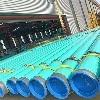
Where X52 Sits in the Line Pipe Grade Range
API 5L X52 is a medium strength carbon steel line pipe grade with a minimum yield strength of 52,000 psi, about 359 MPa, and a maximum of 530 MPa at PSL2. It is the workhorse of moderate to high pressure transmission because it combines a strength level that allows reasonable wall thickness with toughness and weldability that remain forgiving in field conditions. Above it sit X60, X65, X70 and X80, which save steel on large diameter high pressure lines but demand tighter chemistry control, better toughness and more disciplined welding.
The correct question for a project is not which grade is strongest but which grade lets the wall thickness, the welding cost, the fracture control plan and the available supply envelope all work together. On a 323.9 mm line at moderate pressure, X52 and X60 may both satisfy the design, and the deciding factors become price, lead time and whether the pipe can be sourced with the required Charpy values at the design minimum temperature.
Applications fall into a small number of well defined service categories, and each category imposes its own combination of code, coating, toughness and inspection requirements. Treating them as one market is the most common source of mis-specified orders.
Oil and Gas Transmission Pipelines
This is the primary application. X52 carries crude oil, natural gas, condensate and produced water from gathering systems to treatment plants, compressor or pump stations and onward to custody transfer points. The design basis is normally a transmission pipeline code, with ASME B31.8 for gas and ASME B31.4 for liquids, and the pipe itself is ordered to API 5L, with ISO 3183 or GB/T 9711 as the equivalent national or international route where the project specifies it.
Wall thickness comes out of the hoop stress equation, with the design factor set by location class or by area classification, and then adjusted upward for road and river crossings, for installation by horizontal directional drilling and for corrosion allowance. On gas lines the fracture control requirement is the constraint that often decides the grade: a higher strength grade permits a thinner wall, but it also requires higher Charpy energy to arrest a running shear fracture, and the two effects must be evaluated together rather than in sequence.
For offshore and subsea work the governing document is frequently DNV-ST-F101, which adds collapse, buckle propagation and fatigue requirements that onshore codes do not address. X52 in the thermomechanically rolled condition is a common choice for reeled and towed installations because it keeps the strength and toughness balance after the strain imposed by installation.
Gathering Systems, Well Pads and Flowlines
Upstream gathering lines operate at pressures from a few bar to well over one hundred bar and carry a mixture of gas, condensate, water and sometimes sand. X52 is widely used here in small to medium diameters with threaded, coupled or welded connections, and the practical selection driver is availability of the size and the end finish rather than the grade itself.
The presence of water and hydrogen sulphide changes the material requirement completely. Wet sour service is governed by ISO 15156 and NACE MR0175, which limit hardness, chemistry and heat treatment and require the material to be qualified against the actual partial pressure of hydrogen sulphide, the chloride content, the temperature and the pH of the produced fluid. An X52 pipe accepted on a general pipeline order is not automatically acceptable in sour gathering service, and the two requirements must be stated separately.
Flowlines that will be pulled, coiled or repeatedly moved need a wall thick enough to resist handling damage and a toughness level that tolerates plastic strain. In those cases the delivery condition suffix matters as much as the grade: quenched and tempered X52Q and thermomechanically rolled X52M behave differently after straining than as rolled X52.
Water Transmission, Utilities and Infrastructure
Large diameter X52 pipe is used for raw water and treated water transmission mains, for cooling water circuits, for outfalls and for industrial water networks. Pressure is usually much lower than on a gas transmission line, so the design is often governed by surge pressure, external load and handling rather than by hoop stress, and wall thickness is frequently set by minimum practical thickness instead of by calculation.
In these applications internal and external corrosion control dominates the life cycle cost. Cement mortar lining, epoxy lining and polyethylene or polyurethane lining are all used internally, while externally the pipe may be three layer polyethylene, fusion bonded epoxy, tape wrap or a cement mortar coating with reinforcing mesh for buried service. The coating choice interacts with the pipe surface preparation and with the field joint system, so the coating specification belongs in the same document as the pipe specification.
Utility work also brings interface constraints that a pure pipeline project does not have. Tie-ins to existing mains, valve and hydrant connections, thrust and anchor design, and the ability to cut and fit on site in an urban trench all push the specification towards tight diameter and ovality tolerances and a predictable weld procedure.
Plant Piping, Stations and Compressor Facilities
Inside compressor stations, pump stations, metering skids and tank farms, X52 appears as station piping and as headers, manifolds and pig trap piping. Here the governing code is usually a process piping code such as ASME B31.3 rather than a transmission pipeline code, and the consequences are significant: impact testing exemptions differ, the allowable stress basis differs, and the weld examination requirements are set by the service category of the fluid.
Plant piping also demands a much wider range of fittings, flanges and branch connections than a plain pipeline spread, and each of those items has its own material standard. A carbon steel fitting for a matching joint is normally ordered to ASTM A234, a flange to ASTM A105 or ASTM A182 depending on the product form, and the dimensional standards are ASME B16.9 for butt welded fittings and ASME B16.5 or B16.47 for flanges. The grade of the fitting must be compatible with X52 in strength and in weldability, and the mill certificate must show it.
Hot service in stations raises a separate question. Carbon steel line pipe in the X52 grade is normally applied within a moderate temperature band, and where operating temperature rises into the creep range of carbon steel, the material selection moves to a chromium or chromium molybdenum alloy pipe such as ASTM A335 P11 or P22 with a correspondingly different design basis. That transition should be visible in the line list, not discovered at procurement.
Structural, Marine and Piling Duty
X52 pipe is also used where a circular hollow section is wanted for its structural properties: piling for jetties and foundations, bracing, conveyor galleries, bridge falsework, monopiles for near shore structures and guard rails. In these uses the pipe functions as a structural member, so the governing documents are more likely to be a structural steel specification such as ASTM A500 or EN 10219 for cold formed sections, with the line pipe grade used where availability and wall thickness range are favourable.
Design here is driven by axial and bending capacity, slenderness and the diameter to thickness ratio, plus fatigue where cyclic loading applies. Corrosion protection is by coating, by concrete or by a corrosion allowance, and in the splash zone by a combination of coating and cathodic protection with a defined current density. Structural applications rarely need PSL2 toughness, but they do need a stated yield strength, straightness and weldability, which is why the order should not simply copy a pipeline specification.
Where the pipe will be driven, the wall thickness, the end squareness and the hardness at the ends deserve more attention than the grade. A driven pile fails by local buckling at the tip or by fatigue at the toe, not by hoop stress, so the acceptance criteria should be written around those failure modes.
How Application Changes the Purchase Specification
The same grade name covers very different delivered products. The table below maps the main service categories to the parameters that change between them, which is the practical checklist for converting an application into a purchase order.
| Service category | Governing design code | Pipe order standard | Typical delivery condition | Decisive extra requirement |
|---|---|---|---|---|
| Onshore gas transmission | ASME B31.8 | API 5L PSL2 | X52M or X52N | Charpy energy for fracture arrest at design temperature |
| Liquid transmission | ASME B31.4 | API 5L PSL2 | X52N or X52Q | Surge pressure and column separation analysis |
| Wet sour gathering | ASME B31.8 plus ISO 15156 | API 5L PSL2 with hardness control | X52N, hardness limited | Sulphur level, inclusion control, hardness verification |
| Water transmission main | Local water supply code | API 5L PSL1 or PSL2 | X52 as rolled | Internal lining and external coating system |
| Station and plant piping | ASME B31.3 | API 5L plus ASTM A234 fittings | X52N | Weld examination by service category, fitting traceability |
| Offshore and subsea | DNV-ST-F101 | API 5L PSL2 or ISO 3183 | X52M | Collapse, buckle arrest and fatigue data |
| Structural and piling | Structural code | ASTM A500 or EN 10219 as applicable | As supplied structural grade | Slenderness, driveability, tip detail |
Two rows in that table are frequently confused in practice. A project that specifies a transmission pipeline code for what is actually station piping will apply the wrong impact testing and weld examination regime, and a project that specifies a structural section standard for a pressurised line will omit pressure testing entirely. The application, not the pipe, decides the code.
Misconceptions About Chemical and Process Service
Carbon steel line pipe is sometimes described as suitable for chemical plant service because it resists corrosion. That is misleading. X52 is a carbon manganese steel with limited alloy content and no deliberate corrosion resistance; it is acceptable in neutral, dry or appropriately inhibited environments and unacceptable in strong acids, in many strong alkalis and in chloride bearing streams where pitting or stress corrosion cracking can initiate. Where aggressive chemistry is involved, the material selection moves to stainless steel such as ASTM A312 TP316L, to a duplex stainless steel under ASTM A789 or A790, or to a nickel alloy, and the decision is made on corrosion data rather than on strength.
A related misconception is that a thicker wall solves a corrosion problem. Wall thickness buys time against general wastage but does nothing against pitting, crevice attack or stress corrosion cracking, all of which penetrate locally. Where those mechanisms are credible, the answer is a change of material, an internal lining or an inhibitor programme with monitoring, not a heavier wall.
A third is that one certificate covers all applications. A mill certificate to API 5L states what was tested and to which specification level; it does not certify suitability for sour service, for low temperature duty or for a particular coating system. Each of those is a separate requirement with its own evidence.
Coating, Installation and Service Life
For buried transmission lines, external coating is normally three layer polyethylene or fusion bonded epoxy, applied to a blast cleaned surface with the anchor pattern and cleanliness grade specified in the coating standard. Field joints are coated with a compatible system after welding, and the completed coating is holiday tested. For above ground and station piping, a paint system selected against an atmospheric corrosivity category is more common, and the surface preparation standard is the single largest factor in how long that system lasts.
Installation method changes the pipe requirement. Horizontal directional drilling and reeling impose bending strain, so the specification needs a strain capacity statement and a toughness that survives it. Open trench installation with a padded bed is far more forgiving. Cold field bending of X52 is permitted within limits set by the bend radius and the diameter to thickness ratio, and the order should state the minimum bend radius so the mill can confirm the delivery condition has margin.
Cathodic protection is normally applied to buried coated steel lines. The coating provides the primary barrier and the cathodic system covers coating defects; neither is a substitute for the other. In stray current areas, interference testing and a drainage design belong in the project scope, because a well coated line can concentrate interference at a small holiday and fail quickly.
Acceptance Checks Before Dispatch
For any of the applications above, the acceptance package should contain the mill certificate with heat numbers and product analysis, tensile results with specimen orientation, Charpy results with test temperature and location, hydrostatic test pressure and duration, non-destructive inspection method and coverage, dimensional inspection records, and the specification, grade and delivery condition suffix. Where a third party or a classification society is involved, the release note must reference the inspection scope actually performed.
On receipt, verify the grade and heat numbers against the certificate, check the ends for damage and ovality, check coating continuity and recorded thickness, and confirm that the lengths and wall thicknesses match the order. Discrepancies found at the laydown yard are cheap to resolve; the same discrepancies found after the pipe is in the trench are not.
FAQ
Q: What are the main applications of API 5L X52 line pipe?
The main applications are oil and gas transmission and gathering lines, water transmission mains, station and plant piping, offshore and subsea flowlines, and structural or piling duty where a circular hollow section is required.
Q: Is X52 suitable for sour service?
Only when the pipe has been ordered and qualified for that duty under ISO 15156 and NACE MR0175, with hardness, chemistry and heat treatment controlled against the actual hydrogen sulphide partial pressure, chloride level, temperature and pH.
Q: Can X52 pipe be used for chemical plant piping?
For neutral, dry or inhibited streams it can. It has no deliberate corrosion resistance, so strong acids, strong alkalis and chloride bearing streams that cause pitting or stress corrosion cracking require a stainless, duplex or nickel alloy selection instead.
Q: Which delivery condition should be ordered for a buried gas transmission line?
Normalised X52N or thermomechanically rolled X52M are the usual choices, because both give a predictable toughness transition and consistent field weldability. Quenched and tempered X52Q is selected where a higher strength and toughness combination is needed.
Q: Does a higher grade such as X60 or X70 always reduce project cost?
No. A higher grade allows a thinner wall for the same pressure, but minimum thickness rules for handling, buckling and corrosion allowance often set the wall anyway, and the higher grade raises welding qualification and toughness requirements.
Q: What coating is used on buried X52 transmission pipe?
Three layer polyethylene and fusion bonded epoxy are the most common external systems for buried transmission lines, applied to a blast cleaned surface, with a compatible field joint coating and holiday testing on completion.