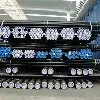
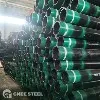
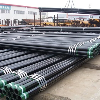
Heavy Weight Drill Pipe (HWDP) is a crucial transitional component within the drill string. It is positioned between the standard drill pipe above and the drill collars below.
Unlike standard drill pipe, which is classified by API 5DP grades (like E-75, G-105, or S-135), Heavy Weight Drill Pipe (HWDP) is typically manufactured to different material standards because it is a transitional tool between flexible drill pipe and stiff drill collars.
Looking for the industry standard? Inquire about our API 7-1 compliant HWDP solutions today!
The Material Standard: AISI 4145H (Modified)
Most HWDP is manufactured from AISI 4145H (Modified) alloy steel. This is a Chromium-Molybdenum (Cr-Mo) quenched and tempered steel.
Why? This material is chosen for its excellent deep-hardening characteristics, toughness, and resistance to fatigue. It is the same high-strength material used for Drill Collars.
Yield Strength Specs
While it doesn't always use the "Letter" grades of standard pipe, its mechanical properties are very high:
Yield Strength: Typically 110,000 psi to 120,000 psi minimum.
Tensile Strength: Usually around 140,000 psi minimum.
Performance: In terms of strength, it is comparable to or stronger than API Grade S-135, but with much thicker walls to provide weight.
API Specification 7-1
Standard drill pipe follows API 5DP, but Heavy Weight Drill Pipe is governed by API Spec 7-1 (Specification for Rotary Drilling Equipment). This standard focuses on the mechanical properties and dimensions of the thicker tool joints and the integral center wear pad.
Can it come in "Standard" Grades?
Occasionally, you will see HWDP referred to in terms of standard pipe grades for the sake of simplicity in a drill string design:
Standard HWDP: Often treated as equivalent to G-105 or S-135 performance levels.
Sour Service HWDP: If the pipe is meant for H2S environments, it may be manufactured to lower hardness levels (like Grade L-95 or specialized proprietary grades) to prevent sulfide stress cracking.
HWDP vs. Standard Drill Pipe
| Feature | Standard Drill Pipe | Heavy Weight Drill Pipe (HWDP) |
| API Standard | API 5DP | API Spec 7-1 |
| Common Material | Carbon/Alloy Steel | AISI 4145H (Modified) |
| Yield Strength | 75k – 135k psi | 110k – 120k psi |
| Construction | Pipe welded to tool joints | Usually Integral (one piece) or welded |
| Primary Goal | Torque & Fluid Flow | Weight on Bit & Transition |
Heavy weight drill pipe factory

Heavy weight drill pipe test equipment

Heavy weight drill pipe certificate

FAQ
What is the use of heavy weight drill pipe?
Heavy weight drill pipe (HWDP) is primarily used to mitigate the abrupt change in stiffness between the drill collars and the regular drill pipe, thereby reducing fatigue damage in the drill string. Installed between the drill collars and the conventional drill pipe as a transitional section, HWDP effectively distributes bending stress and prevents fractures at connections caused by stress concentration.
Additionally, HWDP serves several key functions:
Partial replacement of drill collars: In directional or slimhole drilling, HWDP can substitute for part of the drill collars, reducing the overall weight of the bottom hole assembly and enhancing operational flexibility.
Hole angle and trajectory control: The wear-resistant bands located in the middle of the pipe body act as stabilizers, helping to control the inclination and azimuth angles, thereby minimizing wellbore deviation.
Enhanced drilling capability: Under the same hook load, using HWDP increases the drilling depth capacity of the rig.
Improved fishing and tripping efficiency: Compared to drill collars, HWDP is easier to retrieve in fishing operations, results in shorter tripping times, and is more convenient to handle.
What are the different grades of drill pipe?
API drill pipe steel grades are primarily classified into five types: D, E, X95, G105, and S135. These grades are categorized based on the minimum yield strength of the steel material-the higher the grade, the greater the strength, making them suitable for more complex or deeper well conditions.
Grade D: Minimum yield strength is 379 MPa, suitable for shallow wells or light-loading conditions.
Grade E: Minimum yield strength is 517 MPa, commonly used for medium-depth wells.
Grade X95: Minimum yield strength is 655 MPa, offering a high balance of strength and toughness.
Grade G105: Minimum yield strength is 724 MPa, widely used in deep wells and high-pressure environments.
Grade S135: Minimum yield strength reaches 931 MPa, representing the current highest strength grade, suitable for ultra-deep wells, horizontal wells, and high-stress complex formations.