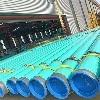
What the Grade B ERW Combination Actually Specifies
Grade B ERW line pipe is often ordered as if it were one product, but it is really two separate decisions joined together. The first is the steel grade defined in API Specification 5L: Grade B is the baseline carbon-manganese grade of that standard, with a specified minimum yield strength of 245 MPa (35,500 psi) and a specified minimum tensile strength of 415 MPa (60,200 psi). The second is the manufacturing route, electric resistance welding, which in modern mills means high-frequency induction or contact welding of a longitudinal seam formed from a continuous steel coil. A buyer who understands only one half of that pair will usually either pay for toughness the service does not require or accept a seam quality the design code never permitted.
The distinction matters because the grade governs the pipe body while the welding process governs the seam. Grade B chemistry and strength can be verified from a mill test certificate and a tensile test taken from the pipe body. The seam can only be verified by non-destructive examination of every length, by flattening or bend tests, and by hydrostatic testing at a pressure derived from the hoop stress formula. Two mills can both ship pipe marked API 5L Grade B ERW and still deliver very different seam reliability, which is why a purchase order must state the product specification level, the examination standard and the acceptance criteria instead of stopping at the grade name.
Grade B Chemistry and Strength in PSL1 and PSL2
API 5L Grade B is the same nominal grade at both product specification levels, but the verification burden is not the same. Under PSL1 the standard sets minimum strength values and a chemistry table with comparatively wide limits, and impact testing is not mandatory unless the purchaser orders it. Under PSL2 the standard adds upper strength limits, a carbon equivalent ceiling, mandatory Charpy testing and full-length non-destructive examination of the weld seam. For welded pipe the PSL2 chemistry limits for Grade B are typically carbon 0.22 percent maximum, manganese 1.20 percent maximum, phosphorus 0.025 percent maximum and sulphur 0.015 percent maximum, with a carbon equivalent limit of 0.43 in the IIW formula or a Pcm limit of 0.25 as an alternative route. PSL1 pipe of the same grade normally permits higher carbon, phosphorus and sulphur and carries no mandatory carbon equivalent requirement.
| Property | Grade B | X42 | X52 |
|---|---|---|---|
| Minimum yield strength, MPa | 245 | 290 | 359 |
| Maximum yield strength under PSL2, MPa | 450 | 495 | 530 |
| Minimum tensile strength, MPa | 415 | 415 | 455 |
| Maximum tensile strength under PSL2, MPa | 760 | 760 | 760 |
| Typical PSL2 carbon equivalent ceiling | 0.43 | 0.43 | 0.43 |
Those numbers explain most of the commercial behaviour of the grade. Because Grade B carries the lowest strength floor in the standard, a Grade B pipe needs the thickest wall of any API 5L grade to hold the same internal pressure, so the material cost advantage of the grade can be cancelled by the extra wall thickness and the extra welding time on site. The maximum yield limit under PSL2 is a weldability control as much as a strength control: a pipe that drifts far above 450 MPa yield tends to be harder, less ductile in the seam heat-affected zone and more sensitive to hydrogen-assisted cracking in wet or sour service.
Grade B is normally supplied fully killed and fine grain, with aluminium or niobium and vanadium microalloying used to reach the strength floor without excessive carbon. Niobium additions in the range of 0.02 to 0.05 percent are common in coil destined for high-frequency welding because they retard austenite recrystallisation and refine the ferrite grain size, which improves both the yield to tensile ratio and the Charpy upper shelf energy. A Grade B heat with a yield to tensile ratio above about 0.90 should trigger a question at acceptance, because such a steel has little work hardening reserve left for strain-based loading, bending during installation or soil movement in service.
How the ERW Seam Is Made and What Limits It
In an ERW mill the coil is uncoiled, slit to width, edge trimmed, formed through a series of rolls into a circular section, and closed under pressure while a high-frequency current, usually in the 100 to 450 kHz band, concentrates at the edges through the skin and proximity effects. The edges reach welding temperature without the bulk of the strip melting, and the squeeze rolls forge the two faces together. Immediately downstream the outside and inside flash is trimmed, the weld zone is often normalised in line by induction heating to about 900 to 950 degrees Celsius to remove the as-welded microstructure, and the pipe is sized, straightened, cut to length and then tested.
The seam is the part of an ERW pipe that fails first when the process drifts. Typical defects include cold welds from insufficient heat input, stitch or lack of fusion from unstable edge alignment, oxide or penetrator inclusions at the weld line, hook cracks associated with edge trimming, and heat-affected zone softening or hardening. Because these defects are narrow and planar, they are difficult to find with visual inspection, and this is precisely why the standard requires non-destructive examination of the weld seam and why an ERW pipe without reliable seam examination is a poor bargain at any price.
Size Range, Wall Thickness and Tolerances That Affect Fit-Up
High-frequency welded pipe is commercially produced from roughly 21.3 mm (NPS 0.5) up to about 610 mm (NPS 24) outside diameter, with wall thickness commonly between 2 mm and 20 mm, and larger diameters handed over to longitudinal or helical submerged arc welding. The economic sweet spot for Grade B ERW is 60.3 mm to 323.9 mm outside diameter, where the coil cost, the forming speed and the seam examination cost are all favourable.
Tolerances decide whether the pipe can actually be installed. API 5L limits straightness to 0.2 percent of length, and bevelled ends are required to be square within a small fraction of a millimetre, so a coil-welded pipe that has been poorly straightened will show gaps at the root of a girth weld and consume extra welding consumable on site. Diameter and out-of-roundness tolerances are specified separately for the pipe body and for the pipe ends because the ends govern alignment during tie-in. PSL2 pipe is also ordered to tighter wall thickness tolerance than PSL1 pipe, and where the design uses a thin-wall, high-pressure combination the negative wall tolerance becomes a direct derating of the calculated pressure containment. Lengths are normally supplied in single random or double random ranges, commonly 10.7 m to 13.7 m for double random, and a project using automatic girth welding should fix the length range and the end squareness in the specification before the coil is rolled.
Where Grade B ERW Pipe Is the Right Choice
The classic use of Grade B ERW is oilfield gathering. Flowlines that gather crude from a cluster of wells to a tank battery or a processing facility run at modest pressure, carry largely aqueous production with limited carbon dioxide, and are frequently replaced or rerouted as the field develops. Grade B ERW gives the required pressure containment at the lowest material grade, and the high-frequency seam is well suited to the small and medium diameters used in these networks.
Water service is the second large application. Raw water transmission, cooling water headers, irrigation mains, fire water loops and plant utility water all run at pressures that a moderate wall Grade B pipe carries comfortably, and the pipe can be supplied with a cement mortar lining to ISO 4179 or an epoxy lining where water chemistry demands it. Produced water and disposal lines, slurry lines in mining, geothermal reinjection at moderate temperature, compressed air headers and general industrial utility piping follow the same logic: pressure is defined, temperature is moderate, and the fluid is not aggressively corrosive.
A third application is structural rather than pressure duty. Grade B pipe is used for piling casings, handrail and guardrail, conveyor idler frames, temporary works, and as a duct or sleeve for road and rail crossings. In these duties the pipe is selected for section properties and stiffness rather than for internal pressure, and the ERW route offers an economical round hollow section with good dimensional consistency along the length.
Where Grade B ERW Stops Being the Right Choice
Grade B ERW is the wrong answer as soon as one of four conditions appears. The first is high design pressure combined with a large diameter, where the wall thickness needed to hold pressure at 245 MPa yield becomes uneconomic and a higher grade such as X52 or X65 is cheaper per kilometre installed. The second is low temperature service: standard Grade B impact testing is normally carried out at 0 degrees Celsius, and duty below about minus 20 degrees Celsius generally calls for a fully killed, fine grain grade with tested toughness, or for a low temperature specification such as ASTM A333 Grade 6.
The third condition is sour service. Wet hydrogen sulphide service is governed by ISO 15156 and NACE MR0175, which limit both steel strength and hardness and require the heat treatment and the chemical composition to be qualified for the partial pressure of the acid gas. A carbon steel line pipe can be used in sour service where hardness is controlled at or below 22 HRC and the strength level remains within the permitted window, but the qualification must be demonstrated on the actual delivery condition, not assumed from the grade name. The fourth condition is cyclic or high consequence duty, where fatigue, fracture arrest and strain capacity matter, and where PSL2 pipe with specified impact energy at a defined test temperature is the minimum sensible starting point.
Field Welding, Coating and End Preparation
Girth welding of Grade B pipe is usually performed to API 1104 or to a project specification that references it, using a qualified welding procedure and procedure qualification record. Grade B with a carbon equivalent near 0.35 welds with few precautions, and preheating is normally unnecessary for thin and medium wall thickness in mild ambient conditions. Heavier wall sections, low ambient temperature and high joint restraint change that: a preheat of about 100 degrees Celsius is a common requirement above roughly 25 mm wall or below 5 degrees Celsius ambient, primarily to drive off moisture and slow the cooling rate in the heat-affected zone.
External protection depends on the environment. Buried pipe is usually coated with fusion bonded epoxy to ISO 21809-2 or with a three layer polyethylene system to DIN 30670, with the cutback at the ends left bare for welding and later closed with a heat shrink sleeve or a field applied tape. Above-ground and atmospheric exposure falls under ISO 12944, with the corrosivity category of the site deciding the coating system and the dry film thickness. Internal protection ranges from a simple epoxy lining for water to a cement mortar lining for raw water and to nothing at all for dry gas. Ends are normally bevelled to 30 degrees plus or minus 2.5 degrees with a root face of about 1.6 mm, and the bevelled surface must be free of the coating, of laminations and of seam flash.
Inspection, Testing and Documents at Acceptance
A hydrostatic test is performed on every length of finished pipe. The test pressure follows the hoop stress formula of API 5L, and the holding time is 5 seconds for pipe below 508 mm outside diameter and 10 seconds at 508 mm and above, with no leakage permitted. Seam examination for PSL2 pipe is carried out over the full length of every pipe, using ultrasonic testing to ISO 10893-11 for the weld seam or magnetic flux leakage examination to ISO 10893-3, with acceptance criteria drawn from Annex E of API 5L. Additional flattening, bend and weld tensile tests are completed on the frequency defined by the standard, and the weld tensile test is particularly informative on ERW pipe because it isolates the strength of the seam from the strength of the body.
At acceptance the buyer should expect a mill test certificate that traces heat number, coil number, chemical composition, tensile and yield results, elongation, Charpy energy and test temperature where applicable, hydrostatic test pressure and duration, non-destructive examination results, dimensions and coating reports. The certificate must be reconcilable to the pipe markings, which for PSL2 pipe include the specification level, the grade, the size, the heat number and the manufacturer's identification. Where a third party inspection is specified, the inspection release note should be issued against the same heat numbers and should record the actual test values rather than the standard minimum only. A certificate that shows every tensile result sitting exactly on the minimum, with no scatter, is a signal to look more closely at the sampling rather than a sign of quality.
FAQ
Q: What is the minimum yield strength of API 5L Grade B pipe?
Grade B has a specified minimum yield strength of 245 MPa (35,500 psi) and a specified minimum tensile strength of 415 MPa (60,200 psi); under PSL2 the yield strength is also capped, typically at 450 MPa, so the delivered steel must sit inside a defined window.
Q: What does ERW mean in steel pipe?
ERW means electric resistance welded. The pipe is formed from steel coil and the longitudinal seam is joined by high-frequency resistance heating of the strip edges followed by squeezing, without the addition of filler metal.
Q: Can Grade B ERW pipe be used for natural gas?
Yes, for gathering, distribution and moderate pressure transmission where the design code accepts Grade B. High pressure, large diameter transmission lines nearly always specify a higher grade with PSL2 impact testing, because the required wall thickness at 245 MPa yield becomes uneconomic.
Q: Is Grade B ERW pipe corrosion resistant?
No. It is a carbon-manganese steel that corrodes in wet or aggressive media. Protection comes from internal lining, external coating, cathodic protection or corrosion allowance, and sour service requires qualification under ISO 15156 rather than an assumption based on the grade.
Q: What size range does Grade B ERW pipe cover?
Commercially from about 21.3 mm (NPS 0.5) to 610 mm (NPS 24) outside diameter, with wall thickness typically 2 mm to 20 mm. Above that diameter the industry moves to longitudinal or helical submerged arc welded pipe.
Q: What is the difference between Grade B and X42?
X42 has a specified minimum yield strength of 290 MPa against 245 MPa for Grade B, so it carries the same pressure with a thinner wall. Both share a 415 MPa minimum tensile strength, but X42 is normally ordered with impact testing when the design needs toughness.
Q: How is the ERW seam verified before shipment?
By full length non-destructive examination of the weld seam, usually ultrasonic testing to ISO 10893-11 or magnetic flux leakage to ISO 10893-3, supported by flattening or bend tests, a weld tensile test and a hydrostatic test on every length.