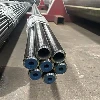
Density of X52 Pipe
The density of X52 steel pipe is 7850 kg/m³, or 7.85 g/cm³. X52 is the API 5L grade with a specified minimum yield strength of 52 000 psi, equivalent to 360 MPa, and it is one of the most widely used grades for oil and gas transmission. Because it is a carbon steel, its density is the same as that of every other line pipe grade; the figure depends on the iron base and the small alloying additions, not on the strength level.
Density is the link between the geometry of the pipe and its weight. Once the cross-sectional area is known, density converts volume into mass, and mass governs lifting capacity, transport cost, laying equipment and the structural loads that the supports must carry.
Calculating Mass from Density
Two routes give the same answer. The first is a direct volume calculation for a hollow cylinder:
V = π × (OD² − ID²) × L / 4, then mass = V × 7850 kg/m³
The second, and the one used daily in mills and trading, is the standard carbon steel factor:
W = 0.02466 × S × (D − S)
where W is kg per metre, D is the nominal outside diameter in mm and S is the nominal wall thickness in mm. Worked example: for a pipe of 323.9 mm outside diameter and 9.53 mm wall thickness, W = 0.02466 × 9.53 × (323.9 − 9.53) = 73.88 kg/m. The same pipe in a 12 m length weighs about 886 kg.
Mass per Metre for Common X52 Sizes
| Outside diameter, mm | Wall thickness, mm | Theoretical mass, kg/m |
| 168.3 | 7.11 | 28.26 |
| 219.1 | 8.18 | 42.55 |
| 323.9 | 9.53 | 73.88 |
| 406.4 | 9.53 | 93.27 |
| 508.0 | 11.13 | 136.37 |
These values are calculated from nominal dimensions and the standard density of steel. Actual mass varies slightly with the permissible tolerances on wall thickness and outside diameter, so the calculated figure is a theoretical mass and not a guaranteed shipping weight. API 5L sets tolerance limits on both wall thickness and single length mass, and the purchase order normally states the basis of the mass calculation.
Mechanical Properties of X52 Pipe
| Property | PSL1 | PSL2 |
| Yield strength, min | 360 MPa | 360 MPa |
| Yield strength, max | 530 MPa | 530 MPa |
| Tensile strength, min | 460 MPa | 460 MPa |
| Tensile strength, max | 760 MPa | 760 MPa |
| Impact testing | Not required | Required |
| Non-destructive examination | Basic | Extended, including weld seam inspection |
PSL2 pipe also carries restricted chemistry, carbon equivalent control and full traceability, which is why transmission projects with toughness requirements specify PSL2 even when PSL1 would satisfy the pressure calculation.
What Density Means for Ordering and Logistics
Mass per metre drives the practical side of a pipe order. It sets the number of joints per truck or container, decides the rating of the side boom or crane used for laying, and determines the coating and handling equipment needed. Wall thickness selection is therefore a balance: a heavier wall raises the pressure rating and the collapse resistance, but it also raises mass per metre, transport cost and welding time. Because all steel grades share the same density, the only way to reduce mass per metre for the same pressure duty is to move to a higher strength grade and a thinner wall.
FAQ
Q: What is the density of X52 pipe in kg/m³?
7850 kg/m³. The same figure applies to X42, X60, X65 and X70 pipe, since density is a property of carbon steel rather than of the strength grade.
Q: How is the weight of one length of X52 pipe calculated?
Calculate the mass per metre with W = 0.02466 × S × (D − S) and multiply by the length. A 323.9 mm by 9.53 mm pipe gives 73.88 kg/m, so a 12 m length weighs about 886 kg.
Q: Is the theoretical weight the same as the delivered weight?
Not exactly. Theoretical weight uses nominal dimensions and a density of 7850 kg/m³, while delivered pipe varies within the standard tolerances on wall and diameter, and may also carry a coating or end protection that adds mass.
Q: Why does a higher grade allow a lighter pipeline?
A higher yield strength permits a thinner wall for the same internal pressure, and since density is unchanged, the reduced cross section translates directly into less steel per metre of line.
Q: What is the difference between X52 PSL1 and PSL2?
PSL2 adds restricted chemistry, carbon equivalent limits, mandatory charpy impact testing and more extensive non-destructive examination, giving a higher and more predictable level of toughness and weldability.
Q: Does the density of steel change with the delivery condition?
No. Normalized, thermo-mechanically rolled and quenched and tempered X52 have the same density. The delivery condition changes the microstructure and the mechanical properties, not the mass of a given volume.