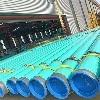
X42 and X70 are separated by four grade steps and by roughly two decades of line pipe metallurgy. X42 is the workhorse carbon-manganese grade of gathering, distribution and low pressure transmission systems. X70 is the mid-to-high strength grade that became the default for large diameter, high pressure onshore trunk lines because it carries more pressure per kilogram of steel than any lower grade while remaining weldable with qualified construction procedures. The comparison below is organised around the questions a purchaser actually asks: what is in the steel, what is guaranteed, how much wall thickness is saved, how the pipe is made, how it is welded, and what has to be written into the order.
Grade designation and the strength gap
The number after the X is the minimum specified yield strength of the pipe body in ksi. X42 is 42 ksi, tabulated as 290 MPa; X70 is 70 ksi, tabulated as 485 MPa. The ratio of minimum yield strengths is 1.67, but the ratio that governs wall thickness design is applied to the strength actually guaranteed under the chosen product specification level, and both grades are quoted in PSL1 and PSL2 versions with different test obligations.
PSL1 X70 and PSL2 X70 are not the same product. PSL2 adds carbon equivalent limits, mandatory charpy testing of body, weld and heat affected zone, tighter sulfur and phosphorus, and dimensional and non-destructive testing obligations that are largely optional at PSL1. Most X70 sold into transmission projects is PSL2, because the design codes used for such lines assume a toughness that only PSL2 testing demonstrates.
Chemical composition compared
X42 reaches its strength by a combination of carbon and manganese with a ferrite-pearlite microstructure. X70 cannot, because a ferrite-pearlite steel at that strength level would have a carbon content so high that the heat affected zone would harden and crack and the toughness would collapse. X70 is therefore a low carbon, micro-alloyed steel whose strength comes from grain refinement and from precipitation of niobium, vanadium and titanium carbonitrides, with manganese providing hardenability and, in thermomechanically processed product, a small amount of ferrite-bainite constituent.
| Parameter | X42, typical heat | X70, typical heat |
|---|---|---|
| Carbon, % | 0.12 - 0.20 | 0.05 - 0.09 |
| Manganese, % | 0.90 - 1.45 | 1.50 - 1.75 |
| Silicon, % | 0.15 - 0.35 | 0.15 - 0.30 |
| Niobium, % | 0 - 0.03 | 0.03 - 0.06 |
| Vanadium, % | 0 - 0.05 | 0 - 0.06 |
| Titanium, % | 0 - 0.02 | 0.010 - 0.025 |
| Molybdenum, % | not normally added | 0 - 0.25 |
| Sulfur, max % at PSL2 | 0.015 | 0.010 |
| Phosphorus, max % at PSL2 | 0.030 | 0.020 |
| Microstructure | ferrite and pearlite | fine ferrite with bainite, acicular ferrite fraction |
The PSL1 chemistry limits for X70 allow carbon up to roughly 0.28 percent in seamless product, but no competent mill uses that latitude, because the resulting toughness and weldability would not pass the PSL2 tests that follow the same pipe through the same line. The practical lesson is that the chemistry table in the standard is an envelope, not a recipe: two certificates of analysis can both conform to X70 and behave completely differently during welding.
Specified mechanical properties
| Property, pipe body | X42 PSL2 | X70 PSL2 |
|---|---|---|
| Yield strength minimum, MPa | 290 | 485 |
| Yield strength maximum, MPa | 495 | 635 |
| Tensile strength minimum, MPa | 415 | 570 |
| Tensile strength maximum, MPa | 760 | 760 |
| Yield to tensile ratio, maximum | 0.93 | 0.93 |
| Typical as-delivered yield spread | 310 - 400 MPa | 520 - 590 MPa |
Note the narrow manufacturing window implied by the X70 tolerances: the permitted band between minimum and maximum yield is 150 MPa, and in thermomechanically rolled pipe with a low carbon content the natural scatter of yield strength across a coil or plate can consume most of it. That is why X70 pipe is tested more frequently than X42, why the pipe body tensile test is taken after expansion, and why an order that adds a tighter internal yield range, such as capping the maximum at 600 MPa, is a real manufacturing constraint rather than a paperwork detail.
Wall thickness, tonnage and cost per kilometre
The economic case for X70 is a hoop stress calculation. Using the ASME B31.8 design equation, wall thickness equals design pressure times outside diameter, divided by twice the specified minimum yield strength times the design factor, joint factor and temperature derating factor. At 610 mm outside diameter, 10 MPa design pressure and a design factor of 0.72, the results are shown below, with mass per metre from the standard line pipe formula of 0.02466 times wall thickness times the diameter less the wall thickness.
| Item | X42 | X70 | Difference |
|---|---|---|---|
| Required wall, mm | 14.6 | 8.7 | - 5.9 mm |
| Mass per metre, kg/m | 214 | 129 | - 40 % |
| Steel for a 100 km line, tonnes | 21,400 | 12,900 | - 8,500 t |
| Girth welds per 100 km at 12 m joints | about 8,300 | about 8,300 | unchanged |
The tonnage table explains the commercial behaviour of the two grades. X70 usually carries a moderate premium per tonne over X42, because the steel requires micro-alloying, thermomechanical rolling, more intensive testing and tighter process control. That premium is normally far smaller than the 40 percent reduction in steel mass, which is why X70 wins on long large diameter lines and loses on short runs, small diameters, station piping and spools where fabrication cost dominates and tonnage is irrelevant. On a 100 km line the wall reduction also lowers freight, coating area and handling weight, all of which scale with mass or surface, not with strength.
Pipe making routes
X42 is produced by every route: seamless on a plug mill or mandrel mill, electric resistance welded from hot rolled coil, and submerged arc welded from plate in either longitudinal or helical seams. Heavy wall X42 for compressor station piping and low temperature duty is regularly normalised after forming, which produces uniform ferrite-pearlite and predictable toughness at the cost of strength margin.
X70 is produced mainly by two routes. Electric resistance welded pipe from thermomechanically rolled, accelerated cooled coil covers the range up to about 610 mm diameter and is the standard product for medium diameter transmission and gathering lines. Longitudinal submerged arc welded pipe from thermomechanically rolled plate, formed by UOE or JCOE and hydraulically expanded, covers the large diameter range used for trunk lines. In both cases the mill must preserve the microstructure delivered by the steelmaker: forming strain is limited, seam welding heat input is controlled so the heat affected zone does not coarsen, and the final expansion is set to land the pipe body yield inside the permitted band rather than merely above the minimum.
Toughness, fracture control and low temperature duty
PSL2 requires charpy V-notch testing of the pipe body, the weld and the heat affected zone, with minimum average absorbed energy values set by the standard as a function of pipe size and grade, and a limit on the lowest individual specimen. For high pressure gas lines, the fracture control design also needs resistance to ductile fracture propagation, which is assessed by drop weight tear testing to the method referenced in API 5L. X70 large diameter pipe in gas service is routinely ordered with a minimum shear area at the design temperature, and the requirement is normally tied to the arrest toughness calculated for the specific gas composition and operating pressure.
Low temperature duty is expressed through the charpy test temperature, not through the grade. A minus twenty degree Celsius requirement on X70 changes the steel: nickel may be added, the finish rolling temperature is lowered, and the heat affected zone toughness of the seam weld becomes the limiting property. Buyers who need minus forty-five degrees should expect a different, more expensive product even though the grade name stays the same.
Sour service and hardness control
Wet H2S service is governed by ISO 15156 / NACE MR0175, which caps carbon steel hardness at 250 HV10, approximately 22 HRC, and requires the material to be qualified for the specific partial pressure of H2S, the in-situ pH and the temperature. X42 meets that cap comfortably in the pipe body, seam and heat affected zone, which is why it remains a standard choice for sour gathering lines, flowlines and injection headers.
X70 meets the hardness cap only with deliberate control: a low carbon equivalent, a Pcm limit written into the order, a hardness survey across the seam and heat affected zone, and in many cases a restriction on the maximum specified yield strength. Sour service X70 is a qualified product with a documented hardness map, not a catalogue item, and the qualification applies to a specific heat treatment condition and wall thickness range.
Field welding and constructability
X42 is welded with cellulosic stick electrodes in the downhill pass, with gas metal arc welding, or with flux cored processes, and the procedure is tolerant of moderate preheat variation and of the fit-up deviations common on small diameter and tie-in work.
X70 requires a qualified procedure with a defined heat input range, controlled preheat and interpass temperature, low hydrogen consumables and a hardness check on the qualification coupon. The heat affected zone is the critical region: too much heat input coarsens the grain and reduces toughness, too little produces hard constituents and raises cracking risk. On large diameter high pressure lines, girth welds are frequently assessed by engineering critical assessment so that the acceptance criteria applied by automated ultrasonic inspection reflect measured toughness and expected flaw populations rather than a generic workmanship standard. The difference in construction cost is real, but it is small compared with the steel saving on a long line and decisive on a short one.
Inspection, testing and documentation
Both grades should be delivered with a mill test certificate to EN 10204 type 3.1 that ties each heat to the pipe, states the grade, product specification level, delivery condition and dimensions, and reports pipe body tensile results, charpy results with test temperature and specimen orientation, the hydrostatic test pressure and hold time, and the non-destructive testing standard and extent applied to the seam. For PSL2 pipe, non-destructive inspection of the weld seam is normally performed to the ISO 10893 series, with ultrasonic or radiographic methods selected according to wall thickness and seam type.
Hydrostatic test pressure is computed from the hoop stress relationship in which pressure equals twice the yield strength times wall thickness divided by outside diameter, with the allowable hoop stress factor set by the specification level. PSL1 pipe is tested at a lower hoop stress fraction than PSL2 pipe, and in both cases the test pressure may be capped by the mill test head; a purchaser should confirm which criterion governed the reported pressure rather than reading the number on the certificate as a material property.
Dimensional acceptance deserves its own line in the order. Wall thickness tolerance is asymmetric in API 5L, with the minus tolerance controlling pressure containment, and end dimensions, bevel angle, root face and ovality are governed separately from pipe body tolerances so that girth welding can be mechanised. Coating, if specified, is a separate standard: three layer polyethylene to DIN 30670 or fusion bonded epoxy to ISO 21809-2, with holiday testing and coating thickness measurement recorded per length.
Common selection mistakes
The first mistake is treating the grade as a pure cost decision. The correct comparison is installed cost per kilometre at the required pressure class, which includes steel, coating, freight, welding, inspection and, on high strength grades, the cost of procedure qualification and of tighter field tolerances. The second mistake is specifying X70 and then accepting a PSL1 certificate, which removes the toughness evidence the design assumed. The third is ignoring the strength match at transitions: where an X70 line ties into X42 station piping, the transition joint, the fitting ratings and the welding procedure all need to be reviewed, because a mismatch concentrates strain exactly where restraint is highest. The fourth is writing a charpy requirement without a test temperature, which makes the requirement unenforceable.
Order parameters that decide the product
The following list is the minimum needed for a comparable offer: standard and edition; grade and product specification level; outside diameter and wall thickness with tolerance class; delivery condition, stating whether thermomechanical rolling is required; specified minimum and maximum yield strength if a narrower band is needed; tensile and yield to tensile limits; charpy test temperature and absorbed energy for body, weld and heat affected zone; drop weight tear test requirement and design temperature; carbon equivalent or Pcm limit; sulfur and phosphorus limits; hardness survey requirement for sour duty; extent of non-destructive testing; end finish and bevel; internal and external coating standard; marking and heat traceability; and the purchaser's inspection rights, including witnessing of mechanical testing.
FAQ
Q: Is X70 simply X42 with more alloy?
No. X70 has lower carbon and higher manganese, plus niobium, titanium and often molybdenum, and its strength depends on a refined microstructure produced by thermomechanical rolling rather than on carbon content.
Q: How much steel does X70 save on a 610 mm line at 10 MPa?
Calculated wall thickness falls from about 14.6 mm for X42 to about 8.7 mm for X70, which reduces mass from roughly 214 kg/m to 129 kg/m, a saving near 40 percent.
Q: Can X70 pipe be normalised?
Normalising destroys the thermomechanical microstructure that produces the strength, so it is not applied to X70 in normal production. Low temperature toughness is achieved through composition and rolling practice instead.
Q: Is X42 better for sour service?
It is easier to qualify. X42 meets the 250 HV10 hardness cap of ISO 15156 with margin, while X70 needs a controlled carbon equivalent, a hardness survey and a qualification programme for the specific application.
Q: Which grade needs tighter dimensional control?
X70, because thinner walls make the same absolute tolerance a larger percentage of wall, and because mechanised girth welding on large diameter pipe depends on consistent end geometry.
Q: Does a higher grade reduce the number of girth welds?
No. Joint count depends on pipe length and diameter, not on grade. The saving comes from wall thickness, mass and, on some projects, from the ability to use longer joints within transport limits.
Q: What happens if PSL2 toughness is not specified for X70?
The pipe may still meet the strength requirement while failing the fracture control assumption of the design. For gas transmission above a few megapascals, charpy and frequently drop weight tear testing must be written into the order.