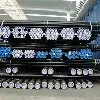
Seamless pipe, as the name implies, has no welding gap inside. This structure makes it perform well when subjected to high pressure and high load, and is not prone to problems such as leakage and rupture, which greatly improves the safety and reliability of work. In addition, the manufacturing process of seamless pipe is complicated and requires multiple processes, including perforation, extension, rolling, etc., to ensure the quality and strength of the pipe.
The structural characteristics of seamless pipe mainly include the following aspects:
Full-size continuity: Seamless steel pipe is manufactured by processes such as hot rolling or cold drawing, so it has full-size continuity and no welded joints. Traditional pipes (such as welded steel pipes) usually require welding joints to connect, which may have welding weaknesses and fracture risks.
Uniform wall thickness: The wall thickness of seamless pipe is uniform, which ensures the smooth flow of fluid or gas in the pipeline and reduces energy loss.
High-strength material: Seamless pipes are usually made of high-strength materials, such as carbon structural steel, low-alloy structural steel or alloy structural steel, which have high mechanical properties and pressure resistance.
Compression resistance: Since seamless steel pipes have no welded joints, the overall structure is stronger and more consistent, and has higher compression resistance. The welded joints of traditional pipes may have weaknesses. For applications that are subject to high pressure or impact loads, seamless steel pipes may be more suitable.
Production process: The production process of seamless steel pipes is relatively complex. They are made of solid stainless steel bars, not strips, which are rolled and welded into pipes. Therefore, it can resist pressure and tension better than welded pipes.
Cold drawn carbon steel pipe