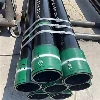
Why Stainless Pipe Moved From Process Plants Into Buildings
For most of the twentieth century stainless steel pipe was specified for chemical plants, refineries and food factories, and galvanised steel or copper carried the water in buildings. The shift began when the cost of replacing corroded galvanised risers, and the cost of the water damage that followed, outgrew the first-cost premium of the alloy. A 304L or 316L tube with a 0.6-1.2 mm wall survives chlorinated potable water, soft aggressive water and intermittent dry-wet cycling without a protective coating, because its chromium-rich passive film re-forms within seconds when the surface is scratched or exposed to fresh aerated water.
Three properties drive the building-services case. The alloy has no sacrificial zinc layer to deplete, so service life does not depend on water chemistry consuming a coating. The bore stays smooth, with a typical roughness of 0.4-0.8 micrometre for cold drawn tube, which keeps the Hazen-Williams C factor near 140-150 for the life of the installation instead of falling as scale builds. And the material is ductile enough to be bent, expanded and press-fitted on site, which removed the last practical objection, the need for hot work in occupied buildings.
What follows is a selection guide for the four applications that account for most building-services demand - domestic hot and cold water, direct drinking water, solar hot water, and hygienic process water - with the standards, grades and acceptance criteria that a purchaser should put on the purchase order.
Domestic Hot and Cold Water Systems
In an ordinary domestic installation the pipe sees three stresses at once: chloride from the mains supply, dissolved oxygen from continuous replenishment, and temperature cycling between 5 degrees C and 60-70 degrees C. Type 304L (UNS S30403) covers mains water below roughly 200 mg/l chloride at temperatures up to 60 degrees C. Above that chloride level, or where the hot leg runs continuously above 60 degrees C, type 316L (UNS S31603) with 2.00-3.00 % molybdenum is the safer choice, and it is the grade normally specified for hotels, hospitals and any building with a long unflushed hot water leg.
Concealed installation is where stainless performs best, because the joint is the weak point of any concealed system rather than the pipe. Press-fit systems with elastomer seals, welded joints and flanged connections all work, but the specification must state the joint method, because the corrosion behaviour of a brazed joint in chlorinated water differs sharply from that of a mechanically pressed joint. Wall thickness for domestic sizes of 15 mm to 54 mm is commonly 0.8-1.5 mm; thinner wall needs careful support spacing to avoid deformation at the clip.
Tubing for this duty is commonly ordered to EN 10312 for welded stainless steel tubes for the conveyance of aqueous liquids including water for human consumption, to ASTM A269 for general-service seamless and welded austenitic tubing, or to GB/T 19228 for the Chinese press-fitting system. The purchase order should nominate the grade with its UNS number, the delivery condition (annealed, pickled, or bright annealed), the surface finish, and the test pressure - a hydrostatic test at 1.5 times the design pressure is the usual minimum for a pressure line.
Direct Drinking Water Pipelines
Direct drinking water systems distribute finished potable water from a treatment point to taps without a storage break, so the pipe becomes part of the water quality chain. Any release of iron, manganese or biofilm nutrients shows up at the tap. Stainless is specified because it releases essentially no metal into neutral potable water, tolerates the chlorine and chlorine dioxide residuals used for disinfection, and can be cleaned and disinfected with the same chemicals used on the treatment plant.
In China the industry standard CJJ/T 110-2017, the technical regulation for pipeline direct drinking water systems in buildings and residential areas, recommends stainless steel pipe and other pipe materials that meet food-grade requirements for the distribution network, and the practice has been adopted in university dormitory refurbishments, hospital buildings and airport terminals. Comparable requirements appear in NSF/ANSI 61 for equipment in contact with drinking water in North America and in the hygienic tubing standards ASTM A270 and EN 10357 for the wetted surface condition.
Acceptance for this duty goes beyond a tensile certificate. The three items that matter are: a wetted-surface roughness normally held at or below 0.8 micrometre Ra for hygienic grades; an internal cleanliness requirement with the ends capped and the bore free of drawing lubricant, which is verified by a white-cloth wipe test at the time of delivery; and a disinfection regime, normally chlorination or hot water pasteurisation, that the pipe material must survive without pitting. Dead legs and stagnant branches are the design risk, not the alloy, so the layout should avoid branches longer than about three pipe diameters.
Solar Hot Water and Thermal Loops
A solar thermal loop is thermally the most demanding water application in a building. A flat plate or evacuated tube collector that stagnates on a sunny day with no draw-off can reach 150-200 degrees C at the absorber, and the pipework between collector and storage tank sees that temperature plus daily thermal cycling. Stainless tube handles the temperature without the creep and embrittlement problems of polymer pipe, and its coefficient of thermal expansion of about 17.3 x 10 to the minus 6 per kelvin for 304 means a 20 m run grows roughly 5 mm over a 15 K swing, which the design must absorb with an expansion loop or a compensator.
Grade selection follows the water chemistry, not the temperature. Type 316L is the usual choice because the loop may be filled with hard or chloride-bearing water and because brazed or welded joints in a 316L circuit are more tolerant of the occasional stagnation event. Where the loop is a closed, deionised or glycol-filled circuit, 304L is adequate and cheaper; where the system is drain-back and refilled with mains water, 316L is the pragmatic default. The Chinese standard GB 50364-2018 on the application of solar hot water systems in civil buildings requires that pipes and fittings directly supplying domestic hot water use stainless steel, copper or other metal pipe that guarantees water quality.
Two installation points cause most failures in this application. First, the collector loop must be able to withstand stagnation pressure, which on a pressurised system can exceed the normal operating pressure; the pipe and fittings should be rated for the stagnation condition, not the working condition. Second, dissimilar metal contact must be broken with a dielectric union, otherwise the copper or brass pump housing becomes the anode in a galvanic couple and the stainless loop survives while the pump body fails.
Hygienic, Medical and Food-Grade Tubing
Where the fluid is a food product, a pharmaceutical intermediate or medical oxygen, the pipe specification moves from "corrosion resistant" to "cleanable and verifiable". ASTM A270 covers seamless and welded austenitic and duplex sanitary tubing with defined surface finish and dimensional tolerances; EN 10357 and ISO 2037 define the hygienic tube and fitting geometry used across Europe; ASTM A269 covers the general-service instrumentation tubing that supplies analysers and medical gas outlets. The common grade is 316L because it resists the caustic and acid cleaning cycles used in clean-in-place routines and because its low carbon content keeps weld zones from sensitising.
Medical gas and oxygen service adds a compatibility requirement: the bore must be degreased and delivered capped, because hydrocarbon residue in an oxygen line is a fire hazard. The acceptance test is a solvent residue check plus a particle count, not a hardness or tensile test. For pharmaceutical water loops the design normally runs at a velocity of at least 1.0-1.5 m/s to keep the loop turbulent and self-cleaning, with orbital welds logged and borescoped.
Heating, Cooling and Industrial Water Circuits
Chilled water, condenser water and closed heating circuits use stainless pipe where the water is treated but the pipe is thin-walled, inaccessible or expected to last the life of the building. The important difference from potable duty is that closed circuits concentrate chemicals: a loop treated with molybdate or nitrite inhibitors, or one that cycles through a cooling tower, can carry chloride well above mains level. Type 316L is specified when the chloride exceeds about 200 mg/l, and duplex grade S32205 is specified for cooling tower water and seawater-adjacent circuits where the pitting resistance equivalent number needs to exceed 34.
Under-insulation corrosion is the classic failure mode in these circuits. Where a cold line is insulated with a permeable material and the jacket is damaged, condensation wets the insulation and chloride concentrates on the outside of the pipe, producing external pitting and, on a hot line above 60 degrees C, chloride stress corrosion cracking. The remedies are a closed-cell insulation, a proper vapour barrier and, for hot chloride-bearing lines, the selection of 316L or a duplex grade rather than 304L.
Grade and Standard Selection Matrix
The table below maps the common building-services applications to the grade and specification that a purchaser should nominate. Size ranges are the commercially standard production windows, not the limits of the process.
| Application | Typical grade | Governing specification | Common size range | Decisive selection criterion |
|---|---|---|---|---|
| Domestic hot and cold water | 304L, 316L | EN 10312, ASTM A269, GB/T 19228 | 15-54 mm OD | Chloride level and continuous hot-leg temperature |
| Direct drinking water network | 304L, 316L | CJJ/T 110-2017, ASTM A270, NSF/ANSI 61 | 20-108 mm OD | Wetted roughness 0.8 micrometre Ra, internal cleanliness |
| Solar thermal collector loop | 316L, 304L for closed glycol loops | GB 50364-2018, ASTM A269, EN 10312 | 15-35 mm OD | Stagnation temperature plus refill water chemistry |
| Food and beverage hygienic line | 316L | ASTM A270, EN 10357, ISO 2037 | 25.4-104 mm OD | Surface finish, weld quality, clean-in-place chemistry |
| Medical gas and oxygen service | 316L | ASTM A269 | 6-15 mm OD | Degreased bore, capped ends, particle count |
| Chilled and condenser water | 316L, S32205 duplex | ASTM A312/A312M, ASTM A790/A790M | 1/2-24 inch NPS | Chloride above 200 mg/l, cooling tower duty |
| District heating and plant room headers | 316L, 304L | ASTM A312/A312M, EN 10216-5 | 1/2-24 inch NPS | Pressure rating, thermal cycling, insulation design |
| Architectural and handrail | 304, 316 | ASTM A554, EN 10296-2 | 21.3-114.3 mm OD | Appearance finish, external atmosphere corrosivity |
Installation Rules That Decide the Service Life
Alloy selection only sets the ceiling on performance; installation sets what is actually achieved. Support spacing should be closer than for carbon steel because the wall is thinner and the elastic modulus of austenitic stainless, about 193 GPa, is lower than that of carbon steel, so the same span deflects more. Thermal movement must be accommodated rather than restrained, and where a run passes through a wall or slab the sleeve must allow axial movement without transferring load to the pipe.
Jointing discipline matters as much as the pipe. Welded joints on hygienic and direct drinking lines require internal purge gas and, for orbital welding, a documented weld log with the current, speed and gas flow; press-fit joints require the correct insert and a calibrated press tool with the jaw checked against the manufacturer's gauge. Threaded joints should be avoided on thin-wall stainless because the cut thread removes most of the wall and leaves a crevice that traps chlorides. Where a transition to another material is unavoidable, a dielectric union or a flanged transition with an insulating gasket prevents galvanic attack.
Commissioning should include a flush at a velocity high enough to remove construction debris, a pressure test at 1.5 times design pressure held for the specified period, and a disinfection cycle compatible with the alloy. Water quality should be recorded at handover, because a system that was clean and chloride-free on day one but is filled later with untreated well water will fail regardless of which grade was installed.
Frequently Observed Failure Modes
Chloride stress corrosion cracking is the first. Austenitic grades under tensile stress, wetted with chloride-bearing water and held above roughly 60 degrees C, can crack within months; the crack is usually transgranular, starts under insulation or at a weld, and is invisible until leakage. Mitigation is grade selection (316L, duplex S32205, or a super-austenitic UNS S31254 for extreme chloride), temperature control, and eliminating external chloride sources such as chloride-bearing insulation or cleaning agents.
Pitting under deposits is the second. Scale, biofilm, construction debris and thread sealant all create an oxygen-depleted crevice where the passive film cannot re-form; the pit then propagates through the wall. Filtration, correct flow velocity and a debris-free commissioning flush prevent it. Galvanic corrosion at a bimetal joint is the third, and it is entirely a design error: the less noble metal corrodes faster than it would alone, so a carbon steel bracket bolted to a stainless pipe in a wet plant room will lose material quickly unless it is isolated or itself galvanised and drained.
The fourth is erosion-corrosion at a turbulence point. Stainless tolerates high flow velocity far better than copper, but a 90 degree elbow immediately downstream of a partially closed valve still sees local velocities that can thin a light-wall tube, and the fix is a longer radius fitting or a thicker schedule at that location rather than a more expensive alloy.
FAQ
Q: Can 304 stainless pipe be used for both hot and cold domestic water in one building?
Yes, provided the chloride content of the supply stays well below about 200 mg/l and the hot leg does not run continuously above 60 degrees C. Where the water is aggressive, or where long stagnant hot branches are unavoidable, type 316L with molybdenum is the more economical choice over the life of the building because it removes the risk of chloride pitting in the hot circuit.
Q: Why is stainless steel preferred over copper for direct drinking water lines?
Because the pipe contributes essentially no copper, iron or manganese to the water, tolerates the chlorine and chlorine dioxide residuals used for disinfection, and can be disinfected thermally without softening. The requirement in CJJ/T 110-2017 for food-grade pipe on the distribution network reflects the same logic, and the absence of a lead-bearing solder joint removes a further compliance risk.
Q: Does a solar thermal loop really need 316L rather than 304L?
Not always. A sealed, glycol-filled loop that is never refilled with mains water can use 304L. A drain-back or open refill system that regularly admits chloride-bearing tap water should use 316L, because repeated stagnation at 150 degrees C or above in the presence of chloride is exactly the condition that initiates stress corrosion cracking in a 304 grade.
Q: What wall thickness is normal for building water services?
Domestic sizes from 15 mm to 54 mm outside diameter are commonly supplied in 0.8 mm to 1.5 mm wall, and larger risers in 1.5 mm to 2.0 mm. The wall is set by the pressure rating and by the jointing method rather than by corrosion allowance, because the alloy does not need a corrosion allowance in potable water; EN 10312 and ASTM A269 both give wall tables tied to the design pressure.
Q: How should stainless pipe be stored on a building site?
Ends capped, off the ground, under cover, and away from carbon steel fabrication dust and chloride-bearing materials such as cement, bleach and de-icing salt. Carbon steel grinding sparks that embed in a stainless surface become initiation sites for pitting, and a pipe that is stored open-ended on a wet concrete slab usually needs internal cleaning before commissioning.
Q: When does a water circuit call for duplex rather than 316L?
When the chloride level climbs above roughly 500 mg/l, when the circuit is a cooling tower or is exposed to seawater aerosols, or when the design requires a higher strength wall for pressure reasons. Grade S32205 duplex offers a pitting resistance equivalent number of about 34-36 and a minimum yield strength of 450 MPa under ASTM A790/A790M, which is why it is common in plant rooms near the coast.