




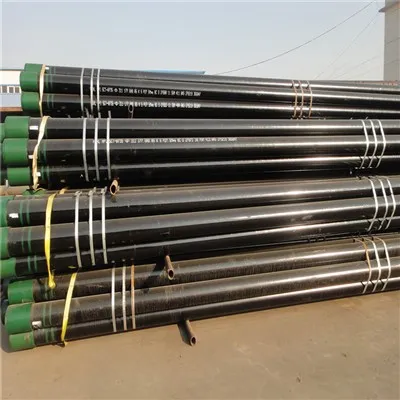
BTC Casing Pipe
Buttress Thread Casing (BTC): A Comprehensive Guide to API Standard Casing Connections
Buttress Thread Casing (BTC) is one of the most widely adopted API-standard casing connection types in the global oil and gas industry. Defined and regulated by API Specification 5B (thread gauging and inspection) and API Specification 5CT (casing product requirements), BTC is engineered to deliver exceptional axial load capacity for well casing strings. This guide provides a technical, standards-aligned breakdown of BTC design, performance, applications, and limitations to support engineering, procurement, and field operation decisions.
What is Buttress Thread Casing (BTC)?
Buttress Thread Casing (BTC) is a standard API casing connection featuring a trapezoidal (buttress) thread profile, designed primarily for high-tensile downhole casing applications. It is classified as an API connection, not a premium proprietary connection, meaning its dimensions and performance criteria are standardized across all API-licensed manufacturers for full interoperability.
As the highest tensile-efficiency standard API casing thread, BTC serves as the industry baseline for deep and heavy casing strings, while maintaining broad global availability and interchangeability. It is compatible with all standard API 5CT steel grades, including J55, K55, N80 Type 1, N80Q, L80, C90, T95, P110, and Q125, enabling flexible material selection for different well pressure and corrosion requirements.
Design Specifications & Technical Parameters
Unlike the 8-round V-shaped thread profile used in STC (Short Round Thread) and LTC (Long Round Thread) casing, BTC utilizes an asymmetric square buttress thread form optimized for load bearing. Key geometric specifications per API standards include:
- Thread Pitch: 5 threads per inch (TPI), with a thicker tooth profile to increase load-bearing surface area
- Thread Taper: 1:16 taper, consistent with standard API casing thread geometry
- Load Flank Angle: 3° from perpendicular to the pipe axis, creating a near-vertical load-bearing surface
- Stabbing Flank Angle: 10° taper to facilitate smooth stabbing and makeup.
This design separates load-carrying and stabbing functions: the steep load flank maximizes tensile strength, while the angled stabbing flank maintains fast, reliable field makeup.
Receive Technical Recommendations
Core Performance Advantages of BTC Connections
The unique buttress thread geometry delivers measurable performance benefits that make BTC the preferred standard connection for demanding well conditions:
1. Industry-Leading Tensile Efficiency
The near-vertical load flank distributes axial tension almost entirely along the thread face, with minimal radial force that would expand the coupling. Combined with a thicker thread root that reduces stress concentration, BTC achieves a tensile efficiency approaching 100% of the pipe body strength. By comparison, STC connections deliver only 60–80% of pipe body strength, and LTC connections deliver 80–85%. This allows properly made-up BTC connections to achieve pipe-body tensile efficiency under most standard loading conditions.
2. Improved Galling Resistance
The broader, flat thread surfaces and optimized contact pressure distribution reduce galling (metal-to-metal adhesion and seizure) during repeated make-up and break-out operations. This extends service life for casing strings that require multiple run-in/pull-out cycles.
3. Full API Standard Interoperability
As a fully standardized API connection, BTC couplings, pins, and inspection gauges from any licensed manufacturer are fully interchangeable. This eliminates supply chain bottlenecks and reduces inventory complexity for drilling operators.
4. Cost-Effective High-Strength Solution
While BTC carries a 15–30% price premium over LTC depending on size and market conditions, it is significantly more economical than premium proprietary connections. For wells that require high tensile capacity but not extreme gas-tight or corrosion-resistant performance, BTC delivers the best value-to-performance ratio.
BTC vs. STC vs. LTC: API Casing Thread Comparison
The three primary API standard casing threads differ in design, strength, and intended use. The table below provides a side-by-side technical comparison:
| Parameter | STC (Short Round Thread) | LTC (Long Round Thread) | BTC (Buttress Thread Casing) |
|---|---|---|---|
| Thread Profile | 8-round V-shape | 8-round V-shape | Trapezoidal buttress |
| Thread Pitch | 8 TPI | 8 TPI | 5 TPI |
| Tensile Efficiency | 60–80% of pipe body | 80–85% of pipe body | ~100% of pipe body |
| Sealing Performance | Thread compound assisted | Thread compound assisted | Thread compound assisted; non-gas-tight |
| Primary Application | Surface casing, shallow wells | Intermediate casing, medium-depth wells | Production casing, deep wells, high-tensile loads |
| Relative Cost | Lowest | Medium | Medium-high (15–30% premium over LTC) |
Key Limitations and Application Boundaries
To ensure proper connection selection and long-term well integrity, it is critical to recognize the inherent design limitations of standard BTC:
- No Inherent Metal-to-Metal Gas Seal: Standard BTC relies entirely on API-modified thread compound to fill the helical leak path between mating thread surfaces. It does not provide a pressure-tight metal-to-metal seal, making it unsuitable for high-pressure gas well applications.
- Not Rated for HPHT Environments: Elevated temperatures and pressure cycling can reduce sealing reliability by affecting thread compound stability and connection geometry. For high-pressure high-temperature (HPHT) wells, modified BTC with integral seal rings or full premium connections are required.
- Limited Bending Fatigue Resistance: BTC connections have lower tolerance for severe dogleg well trajectories. High bending loads increase the risk of jump-out (thread disengagement) and accelerated fatigue failure in highly deviated wells.
- Not Optimized for Sour Service: In sour service, connection performance depends not only on thread design but also on material grade selection in accordance with ISO 15156 / NACE MR0175.
Applications
BTC is the preferred API casing connection for the following well conditions:
- Intermediate and production casing strings in deep and ultra-deep vertical wells
- Long, heavy casing strings where axial tensile load is the primary design constraint
- Wells that require connection strength matching pipe body strength to eliminate weak points
- Operations that require broad parts availability and standardized inspection practices
- Wells with moderate internal pressure and temperature, no strict gas-tight requirements
Per API standards, BTC connections are manufactured for standard casing sizes ranging from 4-1/2 inches up to 20 inches in diameter, covering the vast majority of conventional onshore and offshore casing applications.
Quality Control and Inspection Standards
Consistent dimensional accuracy is critical for BTC connection integrity, and inspection is formally governed by API Spec 5B. Standard quality verification practices include:
Thread Gauging: BTC internal threads (couplings) are inspected with precision plug gauges, and external threads (pins) are inspected with ring gauges. These working gauges verify pitch diameter, thread lead, taper, and stand-off distance to ensure full compliance with API dimensional tolerances.
Gage Calibration Traceability: Working gauges are calibrated against master gauges that are traceable to the National Institute of Standards and Technology (NIST) and licensed under API specifications. Regular scheduled calibration ensures measurement accuracy and consistent quality across all inspection facilities.
Proper gauging and inspection prevent thread defects that could lead to connection failure, leaks, or costly well integrity incidents.
BTC Casing Test and Inspection


Request API 5CT MTC & Third-Party Inspection Reports
FAQ
What API standards govern Buttress Thread Casing?
BTC is defined by two core API standards: API Specification 5CT, which sets requirements for casing pipe materials, dimensions, and mechanical properties; and API Specification 5B, which standardizes thread profile dimensions, gauging methods, and inspection practices for casing, tubing, and line pipe threads.
Is Buttress Thread Casing considered a premium connection?
No. Standard BTC is classified as an API standard connection, not a premium proprietary connection. Premium connections feature patented designs, integrated metal-to-metal gas seals, and specialized high-performance characteristics, while BTC follows open API standards for universal manufacturer interoperability.
What is the tensile efficiency of BTC casing?
Across most common casing sizes and weight grades, BTC connections achieve tensile efficiency approaching 100% of the pipe body tensile strength. This means the connection is as strong as the pipe itself, and tensile failure will occur in the pipe body before the thread connection strips.
Can standard BTC connections provide gas-tight sealing?
No. Standard BTC does not include a metal-to-metal seal, and relies on API-modified thread compound to fill the helical gap between mating threads. While it provides adequate sealing for liquid service, it cannot reliably prevent gas leakage under high pressure and temperature cycling. For gas-tight requirements, operators use modified BTC with integral seal rings or full premium connections.
What casing sizes are available with BTC threads?
Per API standards, BTC connections are manufactured for standard casing sizes ranging from 4-1/2 inches up to 20 inches in diameter, covering the vast majority of conventional onshore and offshore casing applications.
When should I choose BTC over LTC casing?
Choose BTC over LTC when well design requires higher axial tensile capacity, such as in deep wells, long and heavy casing strings, or applications where connection strength matching pipe body strength is required. Choose LTC for medium-depth wells where cost optimization is a priority and tensile loads are moderate.
Conclusion
Buttress Thread Casing remains the benchmark for high-strength API-standard casing connections, delivering near pipe-body tensile strength, proven field reliability, and full industry interoperability. Its trapezoidal thread design addresses the core limitation of round-thread API connections-low tensile efficiency-making it indispensable for deep well construction.
While standard BTC is not suitable for high-pressure gas, HPHT, or severe sour service environments, it delivers unmatched value for conventional deep well applications. Proper specification, inspection per API 5B standards, and appropriate application of qualified thread compound are essential to maximize connection performance and long-term well integrity.
Hot Tags: btc casing pipe, China btc casing pipe manufacturers, suppliers, factory
Previous
API 5CT T95 Casing PipeYou Might Also Like


Send Inquiry