




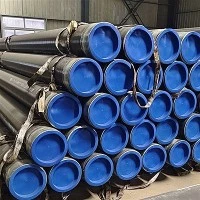
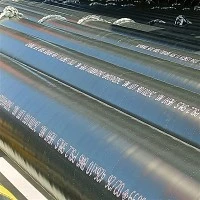


API 5L GR.B PSL 1 Carbon Steel Pipe
API 5L Grade B (Gr.B, written L245 in ISO 3183) is carbon steel line pipe with a specified minimum yield strength of 245 MPa (35,500 psi) and a minimum tensile strength of 415 MPa (60,200 psi); PSL 1 is the product specification level that fixes those minimums and sets no ceiling above them. It is supplied as seamless, ERW, LSAW or HSAW/SSAW pipe from NPS 1/2 to 100 in, scheduled from SCH 10 to XXS, hydrostatically tested pipe by pipe, and it is the most widely stocked grade in the API 5L family.
GNEE supplies API 5L Grade B pipe in PSL1 and PSL2, seamless, ERW, LSAW and HSAW/SSAW, with EN 10204 3.1 mill certificates and third-party inspection on request. Send your size, form and destination port for a quotation.
API 5L Grade B PSL1 Pipe Specification
Supply range for API 5L Grade B PSL1 pipe. Sizes outside these ranges are quoted on request, and wall thickness availability depends on the product form.
| Item | Range |
|---|---|
| Standard | API Spec 5L (aligned with ISO 3183) / GB/T 9711 / EN 10208-1 & -2 |
| Grade | Grade B - equivalent to L245 |
| Specification level | PSL1 (PSL2 available in the same grade) |
| Product form and size | Seamless: NPS 1/2–24 in (21.3–610 mm) ERW / HFW: NPS 1/2–24 in (21.3–610 mm) LSAW: NPS 16–48 in (406–1,219 mm) HSAW / SSAW: NPS 24–100 in (610–2,540 mm) |
| Wall thickness | SCH 10 to XXS; 2.77–59.5 mm (0.109–2.34 in) |
| Length | Single random 5–7 m (16–24 ft); double random 11–13 m (36–42 ft); fixed lengths to 12 m |
| Pipe ends | Plain, bevelled 30° ± 5°, or threaded and coupled; plastic caps or steel bevelled-end protectors |
| Delivery condition | As-rolled, normalized, normalizing rolled, normalized and tempered; quenched and tempered by agreement for seamless pipe |
| Surface and coating | Bare, black varnish, oiled, hot-dip galvanized, FBE, 3LPE / 3LPP to DIN 30670 or ISO 21809-1, coal tar epoxy |
| Certificate | EN 10204 3.1 mill test certificate; API monogram from licensed mills; third-party inspection (SGS, BV, TÜV) on request |
Chemical Composition
PSL1 limits for pipe with wall thickness up to 25 mm (0.984 in). Seamless and welded pipe are listed separately - the welded column is stricter, and this is where most published summaries of the grade go wrong.
| Element | Seamless pipe | Welded pipe | Note |
|---|---|---|---|
| Carbon (C) | 0.28 | 0.26 | Second basis of the manganese rule below |
| Manganese (Mn) | 1.20 | 1.20 | May be raised to 1.65 if carbon is reduced |
| Phosphorus (P) | 0.030 | 0.030 | - |
| Sulphur (S) | 0.030 | 0.030 | Twice the PSL2 limit of 0.015 |
| Copper, nickel, chromium (each) | 0.50 | 0.50 | Residual elements |
| Molybdenum (Mo) | 0.15 | 0.15 | Residual element |
| Niobium + vanadium (Nb + V) | 0.06 | 0.06 | Unless otherwise agreed |
| Nb + V + titanium (Ti) | 0.15 | 0.15 | Unless otherwise agreed |
| Boron (B) | 0.001 residual | 0.001 residual | No deliberate addition permitted |
| Silicon (Si) | Not specified for PSL1 | PSL2 sets 0.40% (R/N) or 0.45% (Q/M) | |
The manganese–carbon trade. API 5L allows the manganese ceiling to be raised by 0.05% for every 0.01% the carbon content falls below the specified maximum, up to 1.65% in the L245–L360 range. A heat at 0.23% carbon in a seamless pipe can therefore carry up to 1.45% manganese. The rule exists to let mills hold strength while improving weldability, and it is the reason two certificates for the same grade can show visibly different analyses.
Mechanical Properties
PSL1 tensile requirements are floors. The table places the PSL1 values against the PSL2 range for the same grade, because the difference is the whole point of the specification level.
| Property | PSL1 | PSL2 |
|---|---|---|
| Yield strength, pipe body | 245 MPa (35,500 psi) min no maximum |
245–450 MPa (35,500–65,300 psi) max 495 MPa for OD < 219.1 mm |
| Tensile strength, pipe body | 415 MPa (60,200 psi) min no maximum |
415–760 MPa (60,200–110,200 psi) |
| Tensile strength, weld seam | 415 MPa (60,200 psi) min | 415 MPa (60,200 psi) min |
| Yield-to-tensile ratio | Not specified | ≤ 0.93 for OD > 323.9 mm (12.750 in) |
| Elongation | Calculated, see below | Calculated, see below |
| Charpy V-notch impact | Not required | Mandatory; 27 J average at 0 °C unless otherwise agreed |
| Carbon equivalent | Not specified | CEIIW ≤ 0.43 if C > 0.12%, or CEPcm ≤ 0.25 if C ≤ 0.12% |
| Hardness | Not specified | Not specified, unless sour service is agreed |
Elongation is not a fixed number. API 5L calculates the minimum from the test piece rather than tabulating it: Af = C × Axc0.2 / U0.9, where C is 1,940 in SI units, Axc is the applicable cross-sectional area of the specimen (130 mm² or 65 mm² for round specimens; the lesser of 485 mm² and the calculated area for full-section and strip specimens), and U is the specified minimum tensile strength - 415 MPa for Grade B. Depending on specimen type and wall thickness, the result falls between roughly 22% and 30%. Any supplier who quotes one elongation figure for every size is quoting a typical result, not the specification.
PSL1 and PSL2 Side by Side
The two levels use the same grade name and the same minimum strength. Everything else differs.
| Requirement | PSL1 | PSL2 | What it means commercially |
|---|---|---|---|
| Carbon (max) | 0.28 seamless / 0.26 welded | 0.24 as-rolled & normalized / 0.18 quenched & tempered / 0.22 thermomechanical | Lower carbon and a CE limit make field weld procedure qualification more predictable |
| Sulphur (max) | 0.030 | 0.015 | Cleaner steel, better impact toughness, and a route into sour service qualification |
| Phosphorus (max) | 0.030 | 0.025 | Marginal for toughness, more relevant in cold climates |
| Silicon (max) | Not specified | 0.40 (R/N) / 0.45 (Q/M) | Removes an unknown from the deoxidation practice |
| Yield strength | 245 MPa min, no max | 245–450 MPa range | An upper bound, which is what strain-based design and girth weld toughness calculations need |
| Yield-to-tensile ratio | Not specified | ≤ 0.93 above 323.9 mm OD | Guarantees post-yield deformation capacity on large-diameter lines |
| Impact testing | Not required | Mandatory, typically 27 J average at 0 °C | Certified toughness for low-temperature and critical service instead of an assumption |
| Non-destructive testing | Weld seam NDT as agreed; hydrostatic test on each pipe | Weld seam NDT mandatory, in addition to the hydrostatic test | Defect detection is a requirement rather than a mill option |
| Traceability | Batch level | Pipe by pipe | Individual pipe data for third-party inspection and asset records |
| Relative cost | Baseline | Higher - extra tests, tighter chemistry, more documentation | Buy PSL2 for a reason, and write the reason into the specification |
Selecting the Grade and the Product Form
Two decisions, usually made in the wrong order. The form should follow the diameter and the service, then the grade should follow the design pressure.
| Grade | ISO 3183 | Min yield | Min tensile | Where it fits |
|---|---|---|---|---|
| Grade B | L245 | 245 MPa (35,500 psi) | 415 MPa (60,200 psi) | Gathering lines, distribution, water, structural, general utility - the commodity grade |
| X42 | L290 | 290 MPa (42,100 psi) | 415 MPa (60,200 psi) | One step up in pressure without a full grade jump; common in medium-pressure lines |
| X52 | L360 | 360 MPa (52,200 psi) | 460 MPa (66,700 psi) | Cross-country transmission in moderate pressure ranges; thins the wall against Grade B |
| X60 | L415 | 415 MPa (60,200 psi) | 520 MPa (75,400 psi) | Transmission lines where tonnage savings justify the higher grade price |
| X70 | L485 | 485 MPa (70,300 psi) | 570 MPa (82,700 psi) | High-pressure long-distance transmission, normally PSL2 only |
The pressure argument is Barlow's: P = 2St/D, so a higher yield strength S allows a thinner wall t at the same design pressure and diameter D. Grade B keeps the thickest wall of the five, which is why a Grade B line is heavier - but it also keeps the lowest price per tonne, the shortest welding procedure qualification and, in most markets, the shortest lead time. On a short or low-pressure line, Grade B usually wins on total cost. On a 200 km transmission line, X52 or X60 usually wins by more than 15% of material cost. The comparison belongs in the design stage; after the pipe is rolled, it is a change order.
| Form | Size range | Choose it when |
|---|---|---|
| Seamless (SMLS) | NPS 1/2–24 in (21.3–610 mm) | High integrity, no weld seam, uniform wall and concentricity; small-diameter high-pressure and instrumentation-adjacent work |
| ERW / HFW | NPS 1/2–24 in (21.3–610 mm) | Distribution mains, utility and structural lines where cost and ex-stock availability dominate |
| LSAW (UOE / JCOE) | NPS 16–48 in (406–1,219 mm) | Large-diameter lines where a single longitudinal seam is preferred for inspection and girth welding |
| HSAW / SSAW | NPS 24–100 in (610–2,540 mm) | Very large diameter, lower pressure mainlines, water and slurry lines; HSAW and SSAW are the same product under different trade names |
Benefits and Advantages
Six points, in the order they usually appear on a purchase decision.
Lowest cost per tonne in the API 5L family. Grade B is produced from plain carbon-manganese steel with wide chemistry latitude, so it is the cheapest grade that still gives you the API 5L dimensional tolerance system (OD ±0.75%, wall thickness +15% / −12.5%) rather than a commercial piping tolerance.
Chemistry that welds with standard procedures. Carbon is capped at 0.28% for seamless and 0.26% for welded pipe, manganese at 1.20%, and PSL1 imposes no carbon equivalent limit - not because weldability is uncontrolled, but because at this strength level it does not need to be. Most girth welds go in without preheat at normal wall thicknesses.
Stock depth. Grade B is the grade most mills run continuously. SCH 40, SCH 80, STD and XS in NPS 1/2 in to 24 in are commonly available ex-stock in China and in Houston, Rotterdam and Singapore, which shortens lead time for repair and small-project work.
A seamless option across the full small-diameter range. When the service needs no weld seam or tighter wall uniformity, Grade B is available seamless from NPS 1/2 to NPS 24, without moving up a grade.
An upgrade path that keeps the grade. If the project later needs toughness or a strength ceiling, PSL2 is available in the same grade with four delivery conditions - BR as-rolled, BN normalized, BQ quenched and tempered, BM thermomechanical - so the drawings change at the specification level, not at the material.
Broad certificate acceptance. Grade B pipe is routinely supplied with EN 10204 3.1 mill test certificates and can carry an API monogram from a licensed mill, which satisfies most EPC and utility documentation requirements.
Applications
Grade B sits at the bottom of the API 5L strength ladder, and that is exactly where most pipeline mileage is. Its role is defined by pressure, not by industry.
Oil and gas gathering lines and flow lines
Field lines that collect production from wellheads and move it to a processing facility or a trunk line operate at moderate pressure over short distances, where the lower strength of Grade B is not the limiting factor - line size and pump or compressor capacity are. PSL1 Grade B is the standard economical choice for sweet (H₂S-free) service in these lines, in seamless form up to NPS 24.
Natural gas distribution networks
City and industrial distribution mains run at a fraction of transmission pressure, so wall thickness is often set by handling and corrosion allowance rather than by hoop stress. That is why Grade B dominates this segment: buying X52 for a 4 bar distribution main adds cost without adding capability. Standard schedules - SCH 40 and SCH 80 - are normally stocked rather than made to order.
Water transmission, water injection and irrigation mains
Raw water, cooling water, produced-water injection and disposal lines use Grade B in both welded and seamless form, frequently with an internal or external coating. Where chlorides, sulphates or stray current are present, the specification conversation moves from the steel grade to the lining and the wall thickness allowance, which is why the same grade appears across very different corrosion environments.
Plant and process piping inside the fence line
Refineries, chemical plants and power stations use Grade B for utility, cooling, fire-water and low-hazard process services. Note the boundary here: in these plants the governing document is usually ASME B31.3 rather than a pipeline code, and the pipe is often ordered dual certified to ASTM A106 Grade B so that one stock item covers both high-temperature process service and general utility work.
Structural and construction service
Piling, foundation supports, culverts, sign gantries and scaffolding use Grade B pipe as a structural section. In this duty the pipe is selected for its dimensions and weldability rather than for pressure containment, and the acceptance test that matters is the tensile and bend test, not the hydrostatic test.
How API 5L Grade B Pipe Is Made
Steelmaking. Molten iron is converted and alloyed to the order chemistry - carbon, manganese, phosphorus and sulphur held inside the PSL1 limits - and cast into slabs for welded pipe or round billets for seamless.
Forming. Seamless: billets are pierced and rolled on a mandrel mill or plug mill to form a hollow shell. Welded: coil is formed into a cylinder, with the edges prepared for the seam.
Welding and sizing. ERW/HFW pipe is welded by high-frequency resistance with the weld flash trimmed; LSAW and SSAW pipe are welded inside and outside by submerged arc. All forms are then sized and straightened to the ordered diameter.
Heat treatment. Pipe is supplied as-rolled, normalized or normalizing rolled, according to the delivery condition on the order. The condition is part of the specification, not a mill preference.
Cutting and end finishing. Pipe is cut to single random, double random or fixed length, then finished plain-ended, bevelled at 30° ± 5°, or threaded and coupled.
Testing. Chemical analysis per heat, tensile test per lot, hydrostatic test on every pipe, flattening and bend tests on welded pipe, and non-destructive inspection of the weld seam as specified.
Coating, marking and documentation. Surface preparation and coating to specification, stencil marking of grade and heat number, and issue of the mill test certificate against the heat numbers.
Quality Control and Testing
PSL1 testing is real, but the division of labour matters: the mill proves the chemistry and the strength, and the buyer verifies the dimensions and the documentation. Here is what each test actually establishes.
| Test | Frequency | What it proves | PSL1 requirement |
|---|---|---|---|
| Chemical analysis | Per heat and per product | The steel is within the Grade B limits, including the manganese–carbon trade | Mandatory |
| Tensile test | Per test unit (lot) | Yield and tensile strength meet 245 / 415 MPa; elongation meets the calculated minimum | Mandatory |
| Hydrostatic test | Every pipe | The pipe holds pressure without leaking: P = 2St/D, hoop stress taken as 60% SMYS for Grade B unless a higher pressure is agreed | Mandatory (holding time ≥ 5 s; 10 s common for large diameter) |
| Flattening test | Per test unit, welded pipe | The weld seam ductility and the bond line | Mandatory for ERW / HFW |
| Bend test | Per test unit, welded pipe | Weld integrity on larger diameters | Mandatory where specified |
| Non-destructive testing | Weld seam, as agreed | Detection of seam defects that the hydrostatic test cannot open | As agreed for PSL1; mandatory for PSL2 |
| Impact (Charpy V-notch) | - | Toughness at the design temperature | Not required - specify PSL2 if you need it |
| Dimensional check | Continuous / sampling | Outside diameter within ±0.75%, wall thickness within +15% / −12.5% | Mandatory |
| HIC / SSC | Per project | Sour service resistance to NACE TM0284 / TM0177 | Not applicable to PSL1; requires PSL2 chemistry |
On delivery, the checks worth doing yourself are quick ones: measure the outside diameter and wall thickness at several points on a sample pipe, confirm the stencil grade and heat number against the EN 10204 3.1 certificate, check the bevelled ends for damage and the bore for coating defects, and confirm the hydrostatic test records cover the quantity shipped. Third-party inspection before shipment is the cheapest way to close the documentation gap, because the pipe is still in the mill yard where a re-test is possible.
Future Development Prospects
Six developments are shaping how Grade B pipe is bought, and they move in opposite directions - some push the grade toward commodity status, others push it toward PSL2.
API Spec 5L 47th edition. Published on 2 June 2026 and applicable from 1 July 2027, it replaces the current edition for orders placed after that date. Projects that straddle the change should fix the certification edition in the purchase order now, and check whether the documentation package they require is written against the older edition.
CO₂ transport and hydrogen blending. Carbon capture pipelines and hydrogen-blend networks specify toughness and tight chemistry, so they land on PSL2 rather than PSL1 even at Grade B strength. The grade stays; the specification level rises.
Dual and triple certification as standard practice. Buyers increasingly want one stock item that covers API 5L, ASTM A106 and ASTM A53. That narrows the acceptable manganese band and pushes mills to hold tighter heats, which shows up in lead time rather than in price.
Coating specifications moving to ISO 21809. Three-layer polyethylene to DIN 30670 is still the default in many markets, but project specifications increasingly cite ISO 21809-1, which sets higher minimum thicknesses for the same service. The coating is now specified as precisely as the steel.
Digital heat-level documentation. Pipe-by-pipe data packages and electronic MTCs are becoming a tender requirement on utility and EPC work, which favours PSL2 and pressures PSL1 suppliers to improve batch traceability.
Weight-driven purchasing. With freight a larger share of landed cost, buyers are re-running the Grade B versus X52 comparison and accepting higher grades to cut tonnage - the trade-off is now calculated rather than assumed.
API 5L GR.B PSL 1 steel Pipe

Why Buy API 5L Grade B Pipe from GNEE
Both specification levels, both routes. Seamless and welded Grade B pipe in PSL1 and PSL2, so the specification level is matched to the service rather than to what happens to be on the floor.
Documentation that stands up. EN 10204 3.1 mill test certificates issued against heat numbers, with API monogram pipe from licensed mills available, and SGS, BV or TÜV third-party inspection arranged before shipment on request.
Sizes that match the schedule, not the brochure. NPS 1/2 in to 100 in across seamless, ERW/HFW, LSAW and HSAW/SSAW, in SCH 10 to XXS, cut to single random, double random or fixed length and finished to your end requirement.
Coating and end finishing in one order. Black varnish, FBE, 3LPE to DIN 30670 or ISO 21809-1 and hot-dip galvanizing, with bevelled ends, thread and coupling, or plastic and steel end protection.
Technical review before the order is released. Send the service conditions with the enquiry and we will tell you if PSL1 is the wrong level for it - that conversation is cheaper before rolling than after delivery.
Gnee Customer visit

FAQ
What is API 5L Grade B PSL1 pipe?
Carbon steel line pipe to API Spec 5L with a minimum yield strength of 245 MPa (35,500 psi) and a minimum tensile strength of 415 MPa (60,200 psi). PSL1 sets minimum values only - no maximum yield, no yield-to-tensile ratio limit and no mandatory Charpy test. The ISO 3183 equivalent is L245.
Is API 5L Grade B 241 MPa or 245 MPa?
API 5L Table 6 gives 245 MPa (35,500 psi). The 241 MPa (35,000 psi) figure is the ASTM A106 and A53 Grade B value and appears in older API editions. Quote 245 MPa on an API 5L order; use 241 MPa when the pipe is bought to ASTM A106 or A53, or when both standards apply at once.
What is the difference between PSL1 and PSL2 for Grade B?
The grade and its minimum strength are identical. PSL2 adds a maximum yield of 450 MPa, tighter chemistry (C 0.24% against 0.28% seamless, S 0.015% against 0.030%), a carbon equivalent limit of 0.43, a yield-to-tensile ratio cap of 0.93 above 323.9 mm outside diameter, mandatory impact testing and pipe-by-pipe traceability.
Can PSL1 Grade B pipe be used in sour H₂S service?
Not on the PSL1 specification alone. Sulphur up to 0.030% encourages manganese sulphide inclusions, which are a primary initiation site for hydrogen-induced cracking, and PSL1 sets no carbon equivalent, hardness or impact requirement. Sour service calls for PSL2 chemistry with qualification to NACE MR0175 / ISO 15156, plus HIC testing to NACE TM0284 and SSC testing to NACE TM0177.
Is there a maximum yield strength for PSL1 Grade B?
No. PSL1 sets a floor of 245 MPa and no ceiling, so pipe yielding well above the minimum is still compliant. If the design needs a maximum yield or a yield-to-tensile cap - strain-based design, girth weld toughness, offshore work - specify PSL2, where the ceiling is 450 MPa and the ratio limit is 0.93 above 323.9 mm OD.
Should I order seamless or ERW Grade B pipe?
Seamless for high-integrity and high-pressure work up to about NPS 24, because there is no weld seam and the wall is uniform. ERW/HFW for distribution, utility and structural lines in the same diameter range, where it is the cheaper route. Above NPS 24, the choice is between LSAW (16–48 in) and HSAW/SSAW (24–100 in).
Can Grade B pipe be dual certified to ASTM A106 and A53?
Yes, and it is common on seamless pipe - but the chemistry must satisfy all three standards simultaneously. A106 Grade B requires carbon 0.30% maximum, manganese 0.29–1.06% and silicon 0.10% minimum, while API 5L PSL1 allows carbon 0.28% and manganese 1.20%. State the certificate combination on the enquiry so the mill can melt to the intersection.
What do I need to provide for a quotation?
Specification level, product form, outside diameter and wall thickness or schedule, quantity, length type, end finish, delivery condition, coating, certificate and third-party inspection requirements, impact test temperature if PSL2, and destination port. The three most commonly missing items are the specification level, the delivery condition and the impact test requirement.
Need API 5L Grade B PSL1 Pipe for a Project?
Send the product specification level, product form, size, quantity, coating and destination port, together with the service conditions if the line carries wet H₂S or operates below 0 °C. Our technical team will confirm whether PSL1 is the correct level for the duty and return a quotation with lead time within 24 hours. Contact GNEE today.
Conclusion
API 5L Grade B PSL1 carbon steel pipe is a commodity grade with a specific and limited promise: a minimum yield of 245 MPa (35,500 psi), a minimum tensile of 415 MPa (60,200 psi), carbon capped at 0.28% in seamless and 0.26% in welded pipe, and a chemistry that welds easily with standard procedures. It is the right purchase for gathering lines, gas distribution, water mains, plant utilities and structural work where pressure is moderate and the service is sweet. It is the wrong purchase wherever a certificate has to prove low-temperature toughness, a maximum yield, a yield-to-tensile ratio or resistance to wet H₂S - those duties belong to PSL2, and the cost of finding out afterwards is a rolled and coated order that cannot be used. Specify the level, the form and the delivery condition on the enquiry, and the pipe you receive will match the line you are building.
Hot Tags: api 5l gr.b psl 1 carbon steel pipe, China api 5l gr.b psl 1 carbon steel pipe manufacturers, suppliers, factory, api 5l grade x46 pipe, api 5l steel pipe, api 5l grade b pipe, api 5l line pipe for harsh environments, api 5l line pipe for irrigation, api 5l line pipe for crude oil transportation
You Might Also Like


Send Inquiry